

How we treat catchment water to make it safe to drink
- Written by: Mark Patrick Taylor, Chief Environmental Scientist, EPA Victoria; Honorary Professor, School of Natural Sciences, Macquarie University
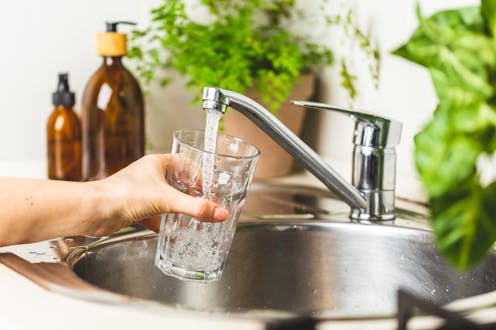
Most of us are fortunate that, when we turn on the tap, clean, safe and high-quality water comes out.
But a senate inquiry into the presence of PFAS or “forever chemicals” is putting the safety of our drinking water back in the spotlight.
Lidia Thorpe, the independent senator leading the inquiry, says Elders in the Aboriginal community of Wreck Bay in New South Wales are “buying bottled water out of their aged care packages” due to concerns about the health impacts of PFAS in their drinking water.
So, how is water deemed safe to drink in Australia? And why does water quality differ in some areas?
Here’s what happens between a water catchment and your tap.
Human intervention in the water cycle
There is no “new” water on Earth. The water we drink can be up to 4.5 billion years old and is continuously recycled through the hydrological cycle. This transfers water from the ground to the atmosphere through evaporation and back again (for example, through rain).
Humans interfere with this natural cycle by trapping and redirecting water from various sources to use. A lot happens before it reaches your home.
The quality of the water when you turn on the tap depends on a range of factors, including the local geology, what kind of activities happen in catchment areas, and the different treatments used to process it.
How do we decide what’s safe?
The Australian Drinking Water Guidelines define what is considered safe, good-quality drinking water.
The guidelines set acceptable water quality values for more than 250 physical, chemical and bacterial contaminants. They take into account any potential health impact of drinking the contaminant over a lifetime as well as aesthetics – the taste and colour of the water.
The guidelines are not mandatory but provide the basis for determining if the quality of water to be supplied to consumers in all parts of Australia is safe to drink. The guidelines undergo rolling revision to ensure they represent the latest scientific evidence.
From water catchment to tap
Australians’ drinking water mainly comes from natural catchments. Sources include surface water, groundwater and seawater (via desalination).
Public access to these areas is typically limited to preserve optimal water quality.
Filtration and purification of water occurs naturally in catchments as it passes through soil, sediments, rocks and vegetation.
But catchment water is subject to further treatment via standard processes that typically focus on:
removing particulates (for example, soil and sediment)
filtration (to remove particles and their contaminants)
disinfection (for example, using chlorine and chloramine to kill bacteria and viruses)
adding fluoride to prevent tooth decay
adjusting pH to balance the chemistry of the water and to aid filtration.
This water is delivered to our taps via a reticulated system – a network of underground reservoirs, pipes, pumps and fittings.
In areas where there is no reticulated system, drinking water can also be sourced from rainwater tanks. This means the quality of drinking water can vary.
Sources of contamination can come from roof catchments feeding rainwater tanks as well from the tap due to lead in plumbing fittings and materials.
So, does all water meet these standards?
Some rural and remote areas, especially First Nations communities, rely on poor-quality surface water and groundwater for their drinking water.
Rural and regional water can exceed recommended guidelines for salt, microbial contaminants and trace elements, such as lead, manganese and arsenic.
The federal government and other agencies are trying to address this.
There are many impacts of poor regional water quality. These include its implication in elevated rates of tooth decay in First Nations people. This occurs when access to chilled, sugary drinks is cheaper and easier than access to good quality water.
What about PFAS?
There is also renewed concern about the presence of PFAS or “forever” chemicals in drinking water.
Recent research examining the toxicity of PFAS chemicals along with their presence in some drinking water catchments in Australia and overseas has prompted a recent assessment of water source contamination.
A review by the National Health and Medical Research Council (NHMRC) proposed lowering the limits for four PFAS chemicals in drinking water: PFOA, PFOS, PFHxS and PFBS.
The review used publicly available data and found most drinking water supplies are currently below the proposed new guideline values for PFAS.
However, “hotspots” of PFAS remain where drinking water catchments or other sources (for example, groundwater) have been impacted by activities where PFAS has been used in industrial applications. And some communities have voiced concerns about an association between elevated PFAS levels in their communities and cancer clusters.
While some PFAS has been identified as carcinogenic, it’s not certain that PFAS causes cancer. The link is still being debated.
Importantly, assessment of exposure levels from all sources in the population shows PFAS levels are falling meaning any exposure risk has also reduced over time.
How about removing PFAS from water?
Most sources of drinking water are not associated with industrial contaminants like PFAS. So water sources are generally not subject to expensive treatment processes, like reverse osmosis, that can remove most waterborne pollutants, including PFAS. These treatments are energy-intensive and expensive and based on recent water quality assessments by the NHMRC will not be needed.
While contaminants are everywhere, it is the dose that makes the poison. Ultra-low concentrations of chemicals including PFAS, while not desirable, may not be harmful and total removal is not warranted.
Authors: Mark Patrick Taylor, Chief Environmental Scientist, EPA Victoria; Honorary Professor, School of Natural Sciences, Macquarie University
Read more https://theconversation.com/how-we-treat-catchment-water-to-make-it-safe-to-drink-242206


















