

What is the story of hongbao, the red envelopes given out at celebrations like Lunar New Year?
- Written by: Ming Gao, Research Scholar of East Asia Studies, Gender and Women's History Research Centre, Australian Catholic University
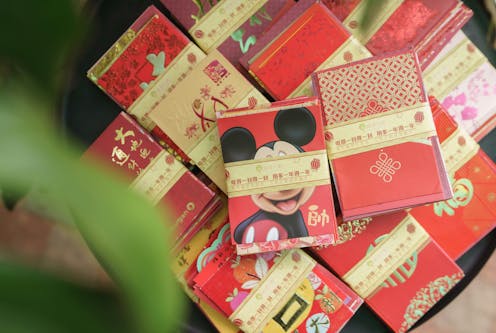
Red envelopes, known as hongbao in Mandarin, are a cherished cultural tradition in China and many other parts of Asia.
In China, the vibrant red colour symbolises good fortune and joy. Hongbao can be given during many various festive and joyful occasions, and they are a prominent feature of Lunar New Year.
Receiving a hongbao is something most Chinese people, particularly children, eagerly anticipate every Lunar New Year. It was also one of my fondest childhood memories. But what’s the history behind this tradition?
A historical tradition
The origins of hongbao can be traced back to the Han dynasty (206 BCE–220 CE) when amulet-like items in the shapes of coins were worn.
Early practices resembling money giving took place in the Tang dynasty court (618–907 CE), where coins were scattered in springtime as part of celebrations.
Giving children money during celebrations became an established custom during the Song and Yuan dynasties (960–1368). In the Ming and Qing dynasties (1368–1911/12), this tradition evolved further with money being given to children threaded on red string.

The modern concept of hongbao emerged in early 20th-century China. Elders would give money wrapped in red paper to children during the Lunar New Year as a talisman against evil spirits, known as sui (祟).
The red envelopes given to children, or in some cases unmarried adults, during Lunar New Year are also called ya sui qian.
Colloquially, ya sui qian translates to “suppressing age money”, as sui (岁) also means age. Ya sui qian reflects the belief this money could ward off misfortune and slow ageing.
In traditional contexts, the amount of money inside the envelope carries symbolic meaning.
Even numbers, except for the number four (considered unlucky due to its phonetic similarity to the word for “death” in Chinese), are regarded as lucky. Six (symbolising smooth progress) and eight (symbolising prosperity) are particularly favoured.
Beyond monetary value, the act of giving and receiving hongbao represents a gesture of goodwill, reinforcing social bonds and conveying respect and care.
The digital revolution
Today, hongbao straddle the worlds of tradition and modernity, adapting to societal changes while preserving their cultural essence.
Super-apps like WeChat and AliPay have transformed this age-old practice from a physical tradition into a digital, virtual experience.

WeChat popularised the concept of “digital red envelopes” in 2014, incorporating gamified elements such as randomised monetary amounts and group exchanges.
In 2017, WeChat recorded a staggering 14.2 billion hongbao transactions on the eve of Lunar New Year alone. While the initial excitement around the digital hongbao has waned over time, the practice remains popular. On Lunar New Year’s Eve in 2024, WeChat users recorded approximately 5.08 billion digital hongbao transactions.
The shift to digital formats aligns with our increasingly cashless society, making it easier for people to participate in the custom, even across great distances. Families separated by migration can partake in this tradition in real time, maintaining connections that might otherwise weaken over long distances.
My child doesn’t get to see my parents very often, but my mother promised to send a “large” hongbao to her grandchild on the eve of the Lunar New Year this year. Despite the geographical distance spanning the ocean between Australia and China, the tradition of giving hongbao transcends borders, connecting our family members across continents every Lunar New Year.
Societal significance
The enduring popularity of hongbao highlights its importance in Chinese culture. It serves not only as a means of giving but also as a way to uphold tradition amid rapid modernisation.
The act of giving hongbao, whether physical or digital, reinforces intergenerational ties and preserves cultural heritage. Parents and grandparents giving hongbao to children during Lunar New Year continue to embody the traditional values of family and unity.
 The act of giving hongbao reinforces intergenerational ties and preserves cultural heritage.
SeventyFour/Shutterstock
The act of giving hongbao reinforces intergenerational ties and preserves cultural heritage.
SeventyFour/Shutterstock
But the digitisation of hongbao has sparked debates about its impact on traditional values. Some argue the ease of sending digital hongbao reduces the personal touch and thoughtfulness inherent in the physical exchange.
Others view it as an evolution that keeps the practice relevant and accessible in a fast-paced world.
Regional variations
While hongbao is most closely associated with Chinese culture, similar traditions exist across Asia, each with notable regional variations.
In Korea, during the Lunar New Year (Seollal), elders give money to young or unmarried adults after receiving their New Year’s bow (sebae). One legend suggests the Korean tradition originates from China. However, unlike the red envelopes used in Chinese culture, the money in Korea can be presented in white envelopes, as whiteness in Korean culture symbolises purity and new beginnings.
 Similar traditions exist across Asia. These red envelopes are hanging in Ho Chi Minh City, Vietnam.
Marie Shark/Shutterstock
Similar traditions exist across Asia. These red envelopes are hanging in Ho Chi Minh City, Vietnam.
Marie Shark/Shutterstock
In Singapore, where a diverse population blends Chinese, Malay and Indian traditions, the giving of hongbao (also known as ang bao or ang pow in Hokkien) is a common practice. This tradition has extended beyond the Chinese population, reflecting the cultural influence of Chinese diasporic communities.
While red envelopes are traditional, envelopes in other colours, such as pink or gold, are also considered acceptable.
The Future of hongbao
As technology continues to shape societal norms, the practice of giving hongbao is likely to further evolve.
The advancement of E-CNY (China’s digital currency), regardless of its ultimate success, could introduce new dimensions to traditional practices, enabling more innovative and secure forms of exchange.
The enduring appeal of hongbao lies in its core values: the celebration of relationships, the sharing of blessings, and the preservation of cultural heritage.
As the Lunar New Year of the Snake approaches, it’s wise to have some hongbao ready, whether digital or physical, to avoid being caught off guard by a playful youngster cheerfully exclaiming, “May you be prosperous, now hand over the red envelope!” (“gong xi fa cai, hong bao na lai”). This light-hearted and catchy greeting cleverly combines good wishes with a cheeky request for a hongbao.
Authors: Ming Gao, Research Scholar of East Asia Studies, Gender and Women's History Research Centre, Australian Catholic University


















