

The threat of 3D-printed ‘ghost guns’ is growing, but NZ is yet to act on these 3 big legal gaps
- Written by: Alexander Gillespie, Professor of Law, University of Waikato
It’s an unfortunate fact that bad people sometimes want guns. And while laws are designed to prevent guns falling into the wrong hands, the determined criminal can be highly resourceful.
There are three main ways to source an illegal weapon: find a lawful owner willing to provide one unlawfully, buy one from another criminal, or make your own.
The first two options aren’t as easy as they sound. The buyer might “know a guy” willing to sell, but the seller generally has good reason to be cautious about who they sell to.
The price of the right firearm can be high, too, as is how “clean” its history is. No criminal wants to be connected to someone else’s crimes by their weapon’s history.
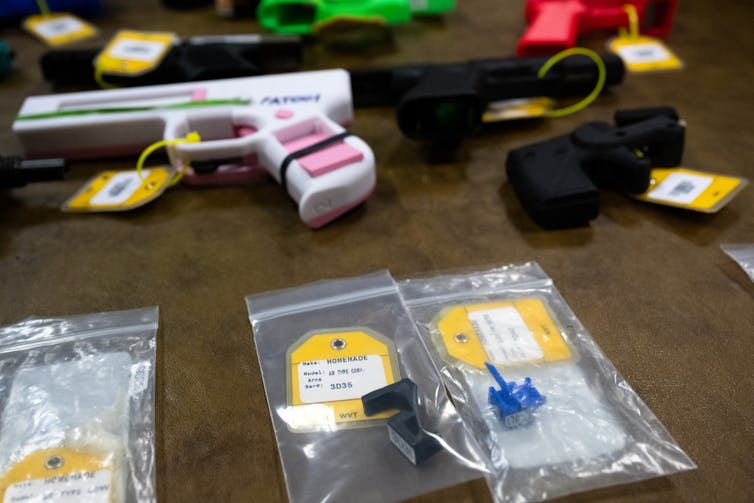
Which leads us to the third option. Privately made firearms, manufactured to avoid detection by the authorities, are nothing new. What has grown is the computer-aided manufacture, of which 3D-printing technology is the best known form, enabling manufacture without traditional gunsmithing skills.
The resulting “ghost guns” will potentially become more prevalent in New Zealand, and are already posing a significant challenge in overseas jurisdictions. With public submissions on the planned rewriting of the Arms Act closing at the end of February, it’s an issue we can’t ignore.
No room for complacency
Although blueprints of fully 3D-printed firearms are most common, hybrid designs, conversion kits, and firearms components sold as a kit or as separate pieces, are all gaining ground.
These are all far more advanced and deadly than the homemade wood and metal weapon used in 2022 to kill former Japanese Prime Minister Shinzo Abe.
Their ease of manufacture, improved reliability and performance, non-traceability and lower cost all appear to be driving demand. There is also the ideological attraction of avoiding state scrutiny that makes 3D-printing popular with far-right extremist groups.
New Zealand authorities seized their first 3D-printed firearm in the middle of 2018. As of the end of last year, 58 3D-printed guns and between 200 and 300 firearms parts had been seized.
This growth mirrors overseas trends. But it’s important to keep the numbers in perspective. Of the 9,662 firearms (including airguns) the New Zealand Police seized between August 2016 and July 2022, the most common were conventional rifles and shotguns.
However, that is no cause for complacency. If proposed firearms law reforms – such as a new registry – help shrink the black market, we can expect the ghost gun market to grow.
Gaps in the law
Legislation passed in 2020 makes the crime of illegal manufacturing (by unlicensed people) punishable by up to ten years’ imprisonment.
Additional penalties can be added for making certain prohibited items, such as large-capacity magazines. In October last year, an Otago man became the first to be imprisoned in New Zealand for 3D-printing firearms.
Despite this, and the foreseeable risk, there are several significant gaps in New Zealand law.
1. Making guns detectable
Unlike the US and some other countries, New Zealand does not mandate that every gun be detectable by containing enough metal to set off X-ray machines and metal detectors.
The US also prohibits any firearms with major components that do not show up accurately in standard airport imaging technology.
2. Penalties for obtaining blueprints
While the manufacture of 3D-printed firearms is illegal, there is nothing specific in New Zealand law about downloading blueprints.
There may be scope within existing censorship laws around downloading objectionable material. But this may be limited by the need to classify each plan or blueprint as objectionable. And artificial intelligence means these plans can change and evolve rapidly.
More wholesale laws covering the computer-aided manufacture of firearms or their individual parts would be preferable.
Canada, for example, introduced recent changes to firearms law making it a crime to access or download plans or graphics. Knowingly sharing or selling such data online for manufacturing or trafficking is also a crime, with penalties of up to ten years in prison.
New South Wales, Tasmania and South Australia are all making new laws in this area. In the case of South Australia, offenders face up to 15 years in prison for the possession of 3D-printer firearms blueprints.
3. Preventing ‘ghost ammunition’
Privately manufactured firearms still require ammunition to be effective, and the Arms Act is only partly effective in this area.
Only firearms licence holders can lawfully possess non-prohibited ammunition, and all firearms dealers and ammunition sellers must keep a record of those transactions.
But that obligation does not apply when firearms licence holders give, share or otherwise supply ammunition among themselves. Furthermore, there are only limited regulations around obtaining the precursors or tools for making ammunition, with only a few key ingredients, like gunpowder, restricted to licence holders.
This is similar to the Australian approach. But Australia also requires licensed owners to purchase only the type of ammunition required for their specific firearms type.
Trying to the correct balance here is tricky: the law must be practical to work but also ensure a potential ghost gun market does not create a “ghost ammunition” market, too.
The ability to privately manufacture firearms, by computer-aided methods in particular, is a foreseeable and potentially hard-to-police problem. But by learning from other jurisdictions and making a few simple law changes, New Zealand can move now to make communities safer.
The author thanks Clementine Annabell for assisting with the research for this article.
Authors: Alexander Gillespie, Professor of Law, University of Waikato


















