

how Australia can keep illegal seafood off our plates
- Written by: Leslie Roberson, Postdoctoral research fellow, Centre for Biodiversity and Conservation Science, The University of Queensland
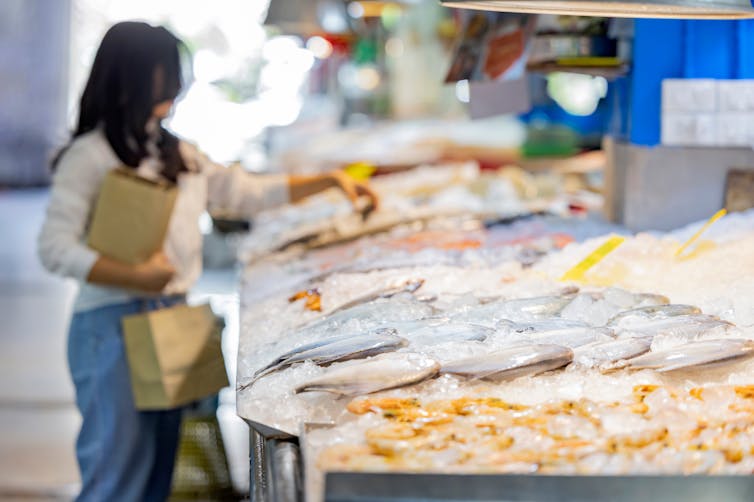
If you’ve ever been stopped by quarantine officers at the airport, you might think Australia’s international border is locked down like a fortress. But when it comes to trade in seafood, it’s more like a net full of holes.
Products sourced from illegal, unreported and unregulated fishing can easily slip through to unsuspecting buyers.
Seafood is among the world’s most traded agricultural commodities. Yet illegal fishing accounts for an estimated one-fifth of all wild-caught seafood.
This represents a serious threat to marine ecosystems, food security and even human rights. The phenomenon has been linked to organised crime, modern slavery, and the depletion of vulnerable species such as abalone and hammerhead sharks.
The blame usually falls on countries where the fishing occurs, or where the boat is registered. But seafood markets, including processors, retailers and consumers, play a major role in driving demand. They could also play a crucial role in combating illegal fishing.
In our new policy paper, we propose more effective controls on seafood imports.
What is illegal, unreported and unregulated fishing? (Australian Fisheries Management Authority)Australia’s role as a seafood-loving nation
Australia spends considerable effort managing its own fisheries, ensuring they are legal and sustainable.
Yet, 60 to 70% of the seafood consumed in Australia is imported.
These imports come mainly from countries with weaker environmental regulations, more illegal activity, and greater vulnerability to labour abuse and slavery.
Current policies leave Australia vulnerable to illegally sourced seafood. Key information, such as the fishing location or species name, is often not required under current trade measures. This means seafood products can be imported under vague labels such as “frozen fish”, obscuring their identity and origins.
Suspect seafood products
Certain seafood products such as shark fins are more likely to be sourced illegally for a variety of reasons, including high market value. Other riskier wild-caught products imported into Australia include:

A new border policy could help crack down on fishy imports
Australia has made international commitments to consume sustainable seafood, in fisheries policy and through subscribing to the United Nations 2030 Sustainable Development Goals and the Global Biodiversity Framework. Meeting these commitments will require being more careful about what we import from other countries. This could take the form of stricter border regulations.
The Australian government has begun to explore trade measures aimed at denying entry to illegal or untraceable seafood products. A group of organisations was formed two years ago to support this process. While a draft report was released at the end of 2023, the final outcome remains delayed – perhaps until after the next federal election.
To inform this process, we reviewed the existing seafood import policies and recommend eight key design criteria for improvement.
Only the United States, the European Union, and Japan have systems in place to verify the legal origin of imported seafood. Since these are some of the world’s largest seafood import markets, their efforts are important. But their schemes all have notable flaws that Australia should avoid replicating.
These systems are technologically obsolete, lack solid traceability and accounting mechanisms, and rely on trade documents that are often impossible to verify. Most systems are not fully electronic, resulting in shipping containers of seafood arriving with shoeboxes of paper catch certificates.
There are no mechanisms for cooperation between countries. Crosschecking of the same certificate arriving in both France and Italy, for instance, is not yet possible. This makes it easy to reuse certificates across multiple countries, enabling trade of falsely labelled or illegally caught seafood.

Australia’s chance to take the lead against fishy imports
Seafood supply chains are notoriously complex. Without effective certification schemes, keeping seafood sourced from illegal fishing operations out of our market is virtually impossible.
Although Australia’s seafood appetite is minuscule compared to the US, the EU, or Japan, it has the resources and the opportunity to create a better import control system. Such a system would involve designing an electronic platform with automated fraud detection mechanisms that tracks seafood products from the fishing boat, through the supply chain, to the Australian border. Australia can then start to close the sizeable loophole in its efforts to secure a legal and traceable seafood supply.
Such policies would support sustainable Australian fisheries and help the country’s biggest seafood suppliers to source responsibly. Nearly every country in the world trades seafood: if countries implement smart import policies, illegally sourced seafood will become much easier to intercept.
The authors appreciate the valuable contributions of Gilles Hosch, a fisheries expert with 25 years of experience in global fisheries compliance and seafood traceability.
Authors: Leslie Roberson, Postdoctoral research fellow, Centre for Biodiversity and Conservation Science, The University of Queensland


















