

Humans generate 62 million tonnes of e-waste each year. Here’s what happens when it’s recycled
- Written by: Sukhbir Sandhu, Associate Professor in Sustainability, University of South Australia
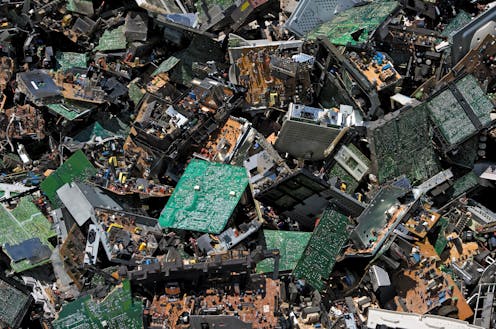
In 2022, humans generated roughly 62 million tonnes of electronic waste – or e-waste. That’s enough to fill more than 1.5 million garbage trucks. And by 2030, that figure is expected to rise to 82 million tonnes.
Australia is a huge contributor to this problem. Every year each Australian, on average, generates 20kg of e-waste, compared with the global average of 7kg per person.
Less than one quarter of the world’s e-waste – which includes desktop computers, laptops, mobile phones, televisions, kitchen appliances, batteries and solar panels – is recycled. That means most of it ends up in landfill, which can result in major accidents. For example, earlier this month, a rubbish truck in Melbourne caught fire after a laptop battery that had been thrown in the garbage bin exploded.
So what can be done to increase the amount of e-waste that’s recycled? And what actually happens during the e-waste recycling process?
From breakdown to planned obsolescence
The growing problem of e-waste is fuelled by both perceived and planned obsolescence.
Perceived obsolescence happens when we discard functioning products in favour of newer models. For example, we buy the latest iPhone even though our current phone works fine.
Planned obsolescence is when manufacturers “build in” a use-by date. One way they do this is by not offering software updates, which then renders an existing product incompatible with other, newer devices or presents cybersecurity risks.
Of course, sometimes existing electronic products simply stop working, which forces us to buy a replacement.

A multi-step process
In Australia, the process of recycling e-waste starts with consumers delivering their e-waste to a designated collection centre.
Some manufacturers offer trade-in programs where people can drop off their old phones and laptops at retail shops and get a small discount on a new product. Some councils also run services for periodic collection and offer drop-off centres for e-waste.
The collection is followed by sorting and inspection of the discarded items.
At this stage, the discarded electronic items are sorted based on the type of devices. Some devices can be refurbished and reused if they are still functional.
Those that cannot be refurbished are dismantled.
This involves separating the various components, such as circuit boards, batteries and wiring. Hazardous materials such as mercury and lead are removed, before recyclable and valuable materials are recovered. These include plastic and glass, as well as precious metals like gold and silver from the circuit boards.
After purifying and refining, the recycled materials can be used in new electronics or put to other uses.
According to the national waste report there are 535 facilities in Australia that accept e-waste. But only 20 facilities reprocess these for further recycling.
This means much of Australia’s e-waste is exported to China, India and other Asian countries to be recycled.

Significant challenges
There are significant challenges when it comes to recycling e-waste.
Some are associated with consumer behaviour. For example, unlike kerbside recycling services for paper, glass and cardboard, recycling e-waste generally involves consumers making a special trip to a designated drop-off location. Accessing these locations involves extra effort and can be an inconvenience which deters people from recycling their e-waste.
Also, compared to container deposit schemes, where people get paid to recycle their glass bottles and cans, there are generally no monetary incentives available for recycling e-waste.
Concerns about data security also prevent some people from recycling their e-waste. People are often reluctant to recycle their computer, phones and other electronic items as they are worried their data could be stolen during the recycling process, even after they have deleted the files.
The other set of challenges with recycling e-waste comes from the economic incentives for recycling. Recycling e-waste is complex and costly. The costs involved in recycling can often be higher than the price of raw materials. Hazardous wastes must also be disposed safely, which adds extra costs to the process.
All of this makes it less attractive for businesses to recycle e-waste.
 There are many challenges associated with recycling e-waste.
Morten B/Shutterstock
There are many challenges associated with recycling e-waste.
Morten B/Shutterstock
The way forward
Australia’s new circular economy framework is expected to provide a way forward for businesses to address some of these challenges.
The framework seeks to double the rate at which Australia recovers, recycles and reuses materials by 2035, partly by providing direction and designing policies for businesses that encourage recycling.
It’s also important for local governments to make it easier for people to recycle their e-waste.
While it may not be cost effective for councils to have kerbside recycling for e- waste, they could place e-waste collection centres in local areas.
Councils can also explore offering consumers incentives for e-waste recycling. These incentives can be monetary. But even non-monetary incentives, such as letting people know how their recycled e-waste contributes to addressing the bigger problem, can be a motivation.
And finally, as consumers, it would help to remember that the best way to contribute to decreasing e-waste is to repair and reuse our existing products.
Authors: Sukhbir Sandhu, Associate Professor in Sustainability, University of South Australia


















