

how snails and oysters became luxury foods
- Written by Garritt C. Van Dyk, Senior Lecturer in History, University of Waikato
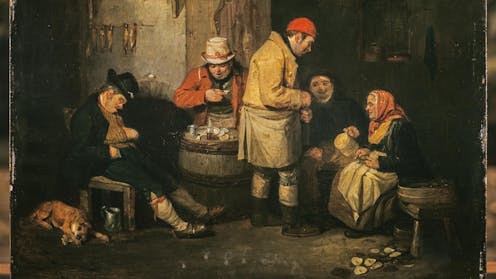
Oysters and escargot are recognised as luxury foods around the world – but they were once valued by the lower classes as cheap sources of protein.
Less adventurous eaters today see snails as a garden pest, and are quick to point out that freshly shucked oysters are not only raw but also alive when they are eaten.
How did these unusual ingredients become items of conspicuous consumption?
From garden snail to gastronomy
Eating what many consider to be a slimy nuisance seems almost counter-intuitive, but consuming land snails has an ancient history, dating to the Palaeolithic period, some 30,000 years ago in eastern Spain.
Ancient Romans also dined on snails, and spread their eating habits across their empire into Europe.
Lower and middle class Romans ate snails from their gardens, while elite consumers ate specially farmed snails, fed spices, honey and milk.

Pliny the Elder (AD 24–79) described how snails were raised in ponds and given wine to fatten them up.
The first French recipe for snails appears in 1390, in Le Ménagier de Paris (The Good Wife’s Guide), but not in other cookbooks from the period.
In 1530, a French treatise on frogs, snails, turtles and artichokes considered all these foods bizarre, but surprisingly popular. Some of the appeal had to do with avoiding meat on “lean” days. Snails were classified as fish by the Catholic Church, and could even be eaten during Lent.
For the next 200 years, snails only appeared in Parisian cookbooks with an apology for including such a disgusting ingredient. This reflected the taste of upper-class urbanites, but snails were still eaten in the eastern provinces.

An 1811 cookbook from Metz, in the Alsace region in northeastern France, describes raising snails like the Romans, and a special platter, l'escargotière, for serving them. The trend did not travel to Paris until after 1814.
French diplomat Charles-Maurice de Talleyrand-Périgord (1754–1838) hosted a dinner for Russian Tsar Alexander I, after he marched into Paris following the allied forces’ defeat of Napoleon in 1814.
The chef catering the meal was the father of French cuisine Marie-Antoine Carême, a native of Burgundy, spiritual home of the now famous escargots de Bourgogne.
Carême served the Tsar what would become a classic recipe, prepared with garlic, parsley and butter. Allegedly, the Tsar raved about the “new” dish, and snails became wildly popular. A recipe for Burgundy snails first appeared in a French culinary dictionary published in 1825.
It is ironic that it took the approval of a foreign emperor, who had just conquered Napoleon, to restore luxury status to escargot, a food that became a symbol of French cuisine.
Snails remain popular today in France, with consumption peaking during the Christmas holidays, but May 24 is National Escargot Day in France.
Oysters: the original fast food
Oysters are another ancient food, as seen in fossils dating to the Triassic Era, 200 million years ago. Evidence of fossilised oysters are found on every major land mass, and there is evidence of Indigenous oyster fisheries in North America and Australia that dates to the Holocene period, about 12,000 years ago.
There are references in classical Greek texts to what are probably oysters, by authors like Aristotle and Homer. Oyster shells found at Troy confirm they were a favoured food. Traditionally served as a first course at banquets in Ancient Greece, they were often cooked, sometimes with exotic spices.
 Music-cover sheet for ‘Bonne-Bouche’ by Emile Waldteufel, 1847-1897.
© The Trustees of the British Museum, CC BY-NC-SA
Music-cover sheet for ‘Bonne-Bouche’ by Emile Waldteufel, 1847-1897.
© The Trustees of the British Museum, CC BY-NC-SA
Pliny the Elder refers to oysters as a Roman delicacy. He recorded methods of the pioneer of Roman oyster farming, Sergius Orata, who brought the best specimens from across the Empire to sell to elite customers.
Medieval coastal dwellers gathered oysters at low tide, while wealthy inland consumers would have paid a premium for shellfish, a perishable luxury, transported to their castles.
French nobles in 1390 preferred cooked oysters, roasted over coals or poached in broths, perhaps as a measure to prevent food poisoning. As late as the 17th century, authors cautioned:
But if they be eaten raw, they require good wine […] to aid digestion.
 Oyster Seller, Jacob Gole, 1688–1724.
Rijksmuseum
Oyster Seller, Jacob Gole, 1688–1724.
Rijksmuseum
By the 18th century, small oysters were a popular pub snack, and larger ones were added as meat to the stew pot. That century, it is believed as many as 100,000 oysters were eaten each day in Edinburgh and the shells from the tavern in the basement filled in gaps in the brickwork at Gladstone’s Land in Edinburgh’s Royal Mile.
Scottish oyster farms in the Firth of Forth, an inlet of the North Sea, produced 30 million oysters in 1790, but continual over-harvesting took its toll.
By 1883 only 6,000 oysters were landed, and the population was declared extinct in 1957.
As wild oyster stocks dwindled, large oyster farms developed in cities like New York in the 19th century. Initially successful, they were polluted, and infected by typhoid from sewage. An outbreak in 1924 killed 150 people, the deadliest food poisoning in United States history.
 Costumes of Naples: Oyster Sellers, c. 1906–10.
Rijksmuseum
Costumes of Naples: Oyster Sellers, c. 1906–10.
Rijksmuseum
Far from the overabundance of oysters we once had, over-fishing, pollution, and invasive species all threaten oyster populations worldwide today. Due to this scarcity of wild oysters and the resources required to safely farm environmentally sustainable oysters, they are now a premium product.
Next on the menu
Scarcity made oysters a luxury, and a Tsar’s approval elevated snails to gourmet status. Could insects become the next status food?
Ancient Romans ate beetles and grasshoppers, and cultures around the world consume insects, but not (yet) as luxury products.
Maybe the right influencer can make honey-roasted locust the next species to jump from paddock to plate.
Authors: Garritt C. Van Dyk, Senior Lecturer in History, University of Waikato


















