

Want to make social distancing even more effective? It's about time (as well as space)
- Written by Mike Lee, Professor in Evolutionary Biology (jointly appointed with South Australian Museum), Flinders University
While the world waits for an effective vaccine against COVID-19, we are relying heavily on social distancing – perhaps better termed “physical distancing” – to control the spread of the coronavirus.
Physical distancing works because COVID-19 spreads most efficiently when groups of people come into close contact, although there is some evidence the virus can also spread by touching contaminated surfaces.
Modelling suggests Australia can effectively suppress transmission and control the outbreak only if at least 80% of people practise good physical distancing.
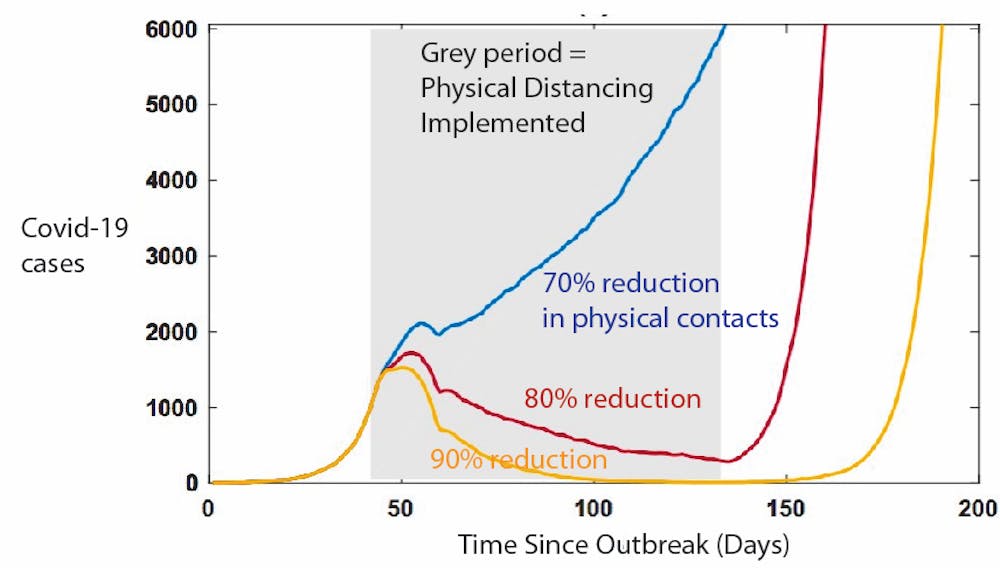 At least 80% compliance with physical distancing measures is required to beat Covid-19.
Mikhail Prokopenko/Univ. Sydney (extra labels added)
At least 80% compliance with physical distancing measures is required to beat Covid-19.
Mikhail Prokopenko/Univ. Sydney (extra labels added)
Government advice for implementing physical distancing has mainly urged people to isolate themselves in space: staying at least 1.5 metres apart, working from home, avoiding gatherings, and minimising travel.
However, effectively separating people in space is extremely challenging. Different people still need access to the same essential locations, such as shops, workplaces and health care facilities.
Temporal distancing
But physical distancing can be done in two ways: spatial distancing (separating people in space) and temporal distancing (separating people in time). Temporal distancing is an easy concept to grasp. Any time we take an early lunch to beat the crowds, or catch a later bus to avoid the commuter crush, we are using temporal distancing.
People are allowed entry into the same spaces – they just need to do so at different times. Of course, temporal distancing needs to be accompanied by fastidious hygiene to eliminate all possibility of COVID-19 transmission via surfaces.
Staggering strategy
Substantial and effective scheduling changes that can be made without too much inconvenience (or where the benefits clearly outweigh the costs) might include:
Reduced supermarket opening hours, as happened in parts of Italy, might not help physical distancing because it compresses customers into the same space during a shorter time window.
The concept of regular work hours could be relaxed a bit more. Morning people might choose to start at 7 am, while night owls could opt for 10 am.
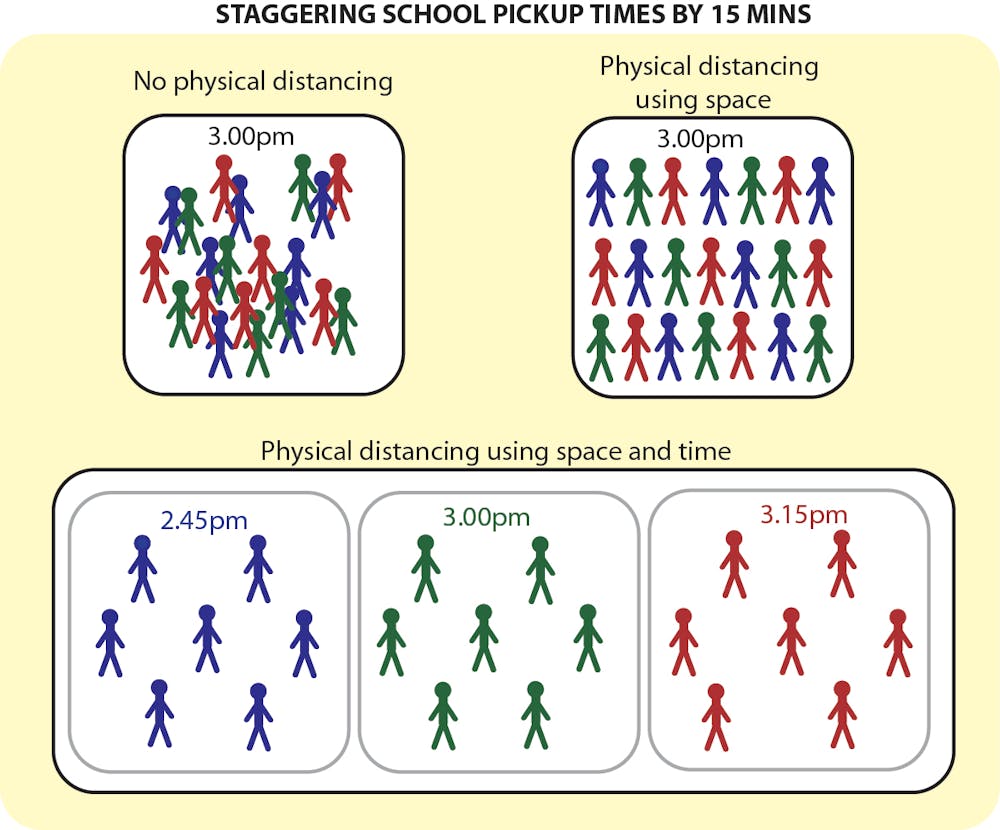 Staggering the end of the school day 15 minutes either side of 3pm would substantially improve physical distancing.
Michael Lee/Flinders Univ./SA Museum
Staggering the end of the school day 15 minutes either side of 3pm would substantially improve physical distancing.
Michael Lee/Flinders Univ./SA Museum
Why it works
The diagram below shows how spatial and temporal distancing can work together to flatten the curve of infections. Imagine a randomly spread population of 1,000 people, one of whom is infected. With free movement, everyone becomes infected within a relatively short time. If we reduce movement by 80% (spatial distancing; dashed curve), the rate of infection is slowed. If we halve the time people spend exposed to one another (temporal distancing; dotted curve), the rate of infection also slows, but not as much. But if we combine both of these measures (red curve), the effect is strongest of all.
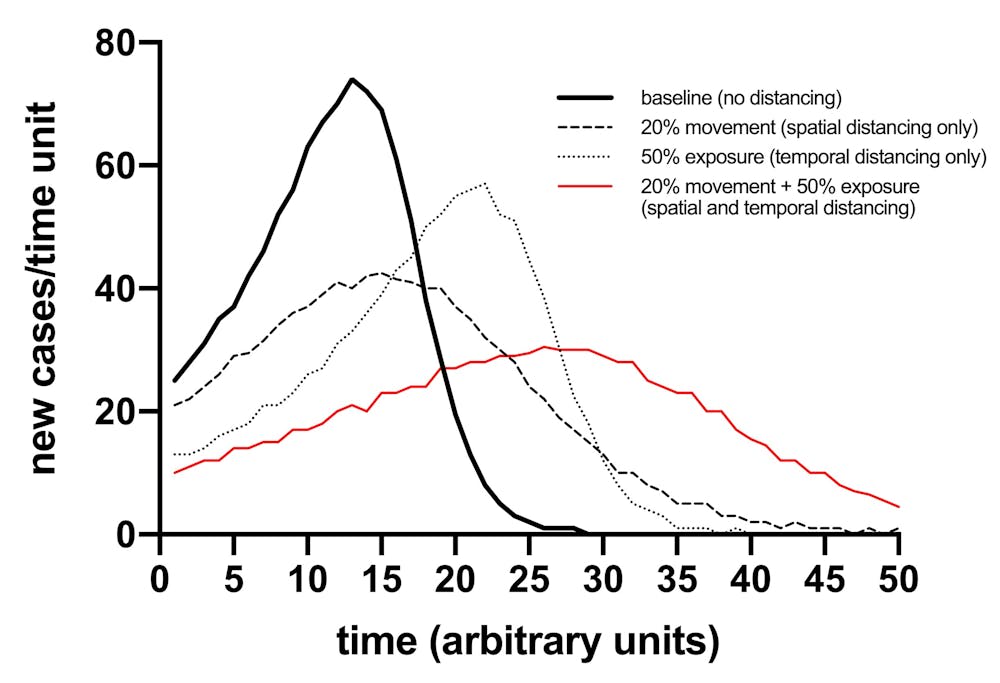 Different hypothetical COVID-19 infection scenarios compared to a do-nothing baseline. The first scenario considers a movement probability that’s only 20% of normal (spatial distancing). The second scenario halves the exposure time to represent temporal distancing. The final scenario includes both spatial and temporal distancing. R code to reproduce this graph can be obtained at: https://github.com/cjabradshaw/COVID19distancing.
Corey Bradshaw/Flinders Univ.
Different hypothetical COVID-19 infection scenarios compared to a do-nothing baseline. The first scenario considers a movement probability that’s only 20% of normal (spatial distancing). The second scenario halves the exposure time to represent temporal distancing. The final scenario includes both spatial and temporal distancing. R code to reproduce this graph can be obtained at: https://github.com/cjabradshaw/COVID19distancing.
Corey Bradshaw/Flinders Univ.
Read more: How to flatten the curve of coronavirus, a mathematician explains
Temporal distancing will come with economic and social costs. Working night shifts or irregular hours can cause health problems; organising childcare or work meetings outside ‘regular’ business hours could be challenging; and travel and outdoor activity at night have safety risks. These costs will have to be carefully weighed in any particular instance.
Even after the current pandemic is controlled, there will remain economic incentives for temporal distancing: boom-and-bust cycles are inefficient. Public transport, restaurants, telcos, electricity suppliers, and other service providers already offer off-peak discounts.
Cutting the numbers
Besides using both spatial and temporal distancing, we can further slow the virus by restricting the number of different people we encounter.
For example, while small-group personal fitness training is still allowed, having the same 10 people in each class is better than mixing and matching classes. This would help restrict any infections to a small group, and make contact tracing much easier.
Workplaces and schools could also consider keeping people in consistent teams rather than mixing them up, at least while distancing is required.
Reducing contacts between groups is even more important for older people. Age-stratified visiting or service times, such as the dedicated elderly shopping hours already in place in some supermarkets, might also help reduce transmission between younger people (who generally have higher mixing and infection rates) and older people (who are at greater risk of severe disease).
Social distancing will be a fact of life for months to come. So we need to do it as smartly and efficiently as possible.
Authors: Mike Lee, Professor in Evolutionary Biology (jointly appointed with South Australian Museum), Flinders University

















