

Australia’s ‘solar godfather’: Vietnam leads Southeast Asia’s clean energy transition
HANOI, VIETNAM - Media OutReach Newswire - 23 June 2025 - With the invention of solar cells using Passivated Emitter and Rear Contact (PERC) technology, Prof. Martin Andrew Green from the University of New South Wales (Australia) and his team made a groundbreaking contribution to green energy production.
Two years after receiving the 2023 VinFuture Grand Prize, he continues to push the boundaries of solar innovation, working to improve efficiency and help pave the way for a future of productive renewable energy harvest.
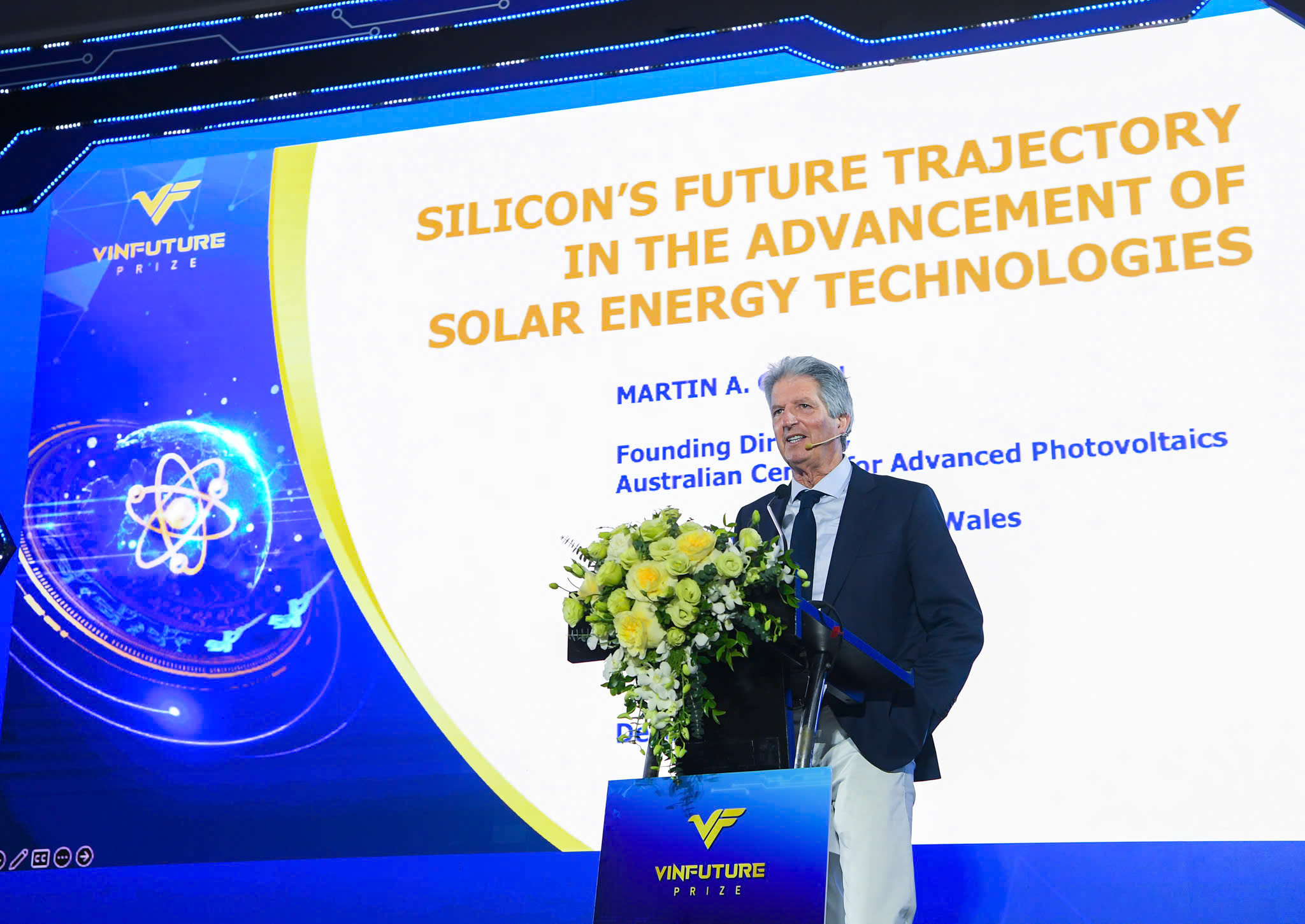
Nurturing the energy revolution
Renowned as the "godfather of solar," Prof. Martin Green has spent over five decades advancing solar energy technologies. In 2023, Prof. Green's revolutionary development of Passivated Emitter and Rear Contact (PERC) technology, now used in over 90% of solar panels worldwide, earned him the VinFuture Grand Prize. Through the VinFuture Prize, Prof. Green has also had a unique perspective on Vietnam's progress toward global sustainability, as he continues to become a member of the VinFuture Prize Council.
"One of the most immediate outcomes was the opportunity to establish new collaborations in Vietnam. I have gained much greater insight into the progress being made in Vietnam's clean energy sector than I knew before," he shared.
Prof. Green also expressed deep appreciation for the VinFuture Prize, noting that winning such a significant award had undoubtedly enhanced his research group's ability to attract the necessary resources to develop new ideas.
Earlier this year, his pioneering work was honored with a clean-energy ferry named after him in Australia. While he felt "fortunate to be selected," Prof. Green emphasized that this recognition propelled him toward a broader movement for a global solar energy revolution.
"We need to move faster," he urged, pointing to the stark evidence already unfolding in Australia, including massive bushfires followed by widespread flooding that falls well outside the norm. "It is a bit of a sign of what lies in the future. We're beginning to feel the initial effects of climate change, which will only intensify unless we take urgent action," Prof. Green warned.
The "godfather of solar" also shared that the path forward hinges on international collaboration and government leadership. The global exchange of knowledge and talent has allowed innovations from his lab to influence commercial solar production in China, which in turn benefits countries like Australia that import these cost-effective solar technologies.
Much of that progress, Prof. Green added, has been made possible by falling prices driven by technologies like PERC, as well as support from international organizations such as the United Nations (UN). One of the UN's key Sustainable Development Goals is to ensure universal access to energy by 2030 and solar offers the most viable path to get there.
Pushing solar frontiers
In recent years, Prof. Martin Green and his team have continuously challenged the boundaries of what photovoltaic technology can achieve. One of the most compelling directions in his current research revisits a landmark theoretical paper he wrote about 40 years ago, regarding the limits on the energy conversion efficiency of silicon cells.
"At the time, most people believed that the efficiency limits lay just over 20% energy conversion efficiency. However, in my paper, I calculated the theoretical limit to be between 29% and 30%, significantly higher than what was commonly accepted," he said, suggesting that 25% efficiency was a feasible target.
This insight became a key motivation for his team to explore greater efficiency gains. They set a practical goal of 25% efficiency, which they ultimately reached around the turn of the century. Today, many commercial solar cells already operate at this level of efficiency, getting closer to the 29-30% limit he proposed years ago.
The second area of focus involves stacking cells made from different materials on top of each other to capture more energy from sunlight. Sunlight can be regarded as a stream of particles called photons. Silicon cells respond to photons of all colors in sunlight, from blue to red and even to the lower-energy infrared ones that our eyes can't see. However, blue photons contain much more energy than needed, and in standard silicon cells, that excess energy is wasted.
This is the key reasons behind the limits on the energy conversion efficiency of silicon cells.
One material showing strong potential in lab settings is a special kind of perovskite, made with heavy elements like lead and iodine. Still, there is no guarantee that perovskites will meet the stability standards required for widespread commercial use, which is why researchers are also investigating alternative materials. Though these alternatives don't currently match perovskites in performance, they may offer better long-term reliability.
These approaches, aiming to increase efficiency, have opened a door for the large-scale deployment of the solar revolution.
According to Prof. Green, it has been a key driver in the dramatic cost reductions in photovoltaics over the past few decades. "If we can transition to one of these stacked tandem cells, like perovskite on silicon, it could revolutionize not only performance but also system-wide cost dynamics. Not so much in the cost of making the cell, but by leveraging those efficiency gains to reduce the broader costs of solar deployment," he emphasized.
Bringing down the cost of cell production will be a key to expanding the interest in using them. According to the International Energy Agency, solar power delivers some of the cheapest electricity in history.
"The exciting thing is that the cost of solar is still coming down despite the massive decreases we have seen over the last 15 years. It continues to fall week by week," he said. "We witnessed the agricultural revolution and then the industrial revolution. Now, many believe we are entering an energy revolution, where it becomes so affordable and accessible that new applications open up."
However, one of the biggest near-term challenges is finding a cell that can be used in these stacks. Silicon is an ideal material for photovoltaics as it is abundant, non-toxic, and stable. What's missing is a complementary material that matches these qualities while offering additional performance benefits.
In this search, artificial intelligence can provide a much wider scanning of possibilities than traditional methods permit. The whole material system will be canvassed, and perhaps some new materials will be identified.
The potential of Vietnam
As the global race to renewable energy and net-zero emissions accelerates, Vietnam is not standing on the sidelines. In terms of photovoltaics, he cited the data suggesting that over 10% of Vietnam's electricity has been generated from solar in recent years.
As the adoption scales up, the uptake needs to match the electricity network's ability to absorb solar power. This requires parallel investment in battery storage systems and other stabilizing technologies, and Prof. Green believed Vietnam is progressing well on this front.
"So I think Vietnam would be one of Southeast Asia's leaders in terms of photovoltaics," he remarked, "Vietnam is probably already leading Southeast Asia in the clean energy transition."
In Southeast Asia, where two-wheeled vehicles dominate urban transportation, the shift toward electric scooters is also crucial. Drawing parallels with China, where the replacement of fossil-fueled bikes with electric versions has reduced pollution and CO₂ emissions, he believed that Southeast Asian nations could see similar environmental benefits by following this path.
On this front, Prof. Green was impressed by VinFast's electric vehicles when visiting Vietnam in 2023.
"The quality of the cars seemed like genuinely competitive products. I also like the electric buses that VinBus has developed in Vietnam," he stated. "In this context, Vingroup seems to be leading the way in developing vehicles that can meet this potential demand," he noted.
The VinFuture Prize has also enabled Prof. Green to build valuable connections with experts in clean technology and beyond. "I shared the 2023 VinFuture Grand Prize with Prof. Rachid Yazami, Prof. Akira Yoshino and Prof. Stanley Whittingham, whose pioneering work is in lithium-ion batteries. Meeting those people and getting to understand their contributions better has been really important to me as well", he said.
Reflecting on the diversity of fields represented, he noted:"The VinFuture Prize is not limited to clean energy; it is designed to honor innovations with global impact across a wide range of disciplines."
Hashtag: #VinFuture
https://vinfutureprize.org/vinfuture-prize-nomination/
The issuer is solely responsible for the content of this announcement.
VinFuture
The VinFuture Foundation, established on International Human Solidarity Day on December 20th, 2020, is a non-profit organization co-founded by billionaire Mr. Pham Nhat Vuong and his wife, Madam Pham Thu Huong. The Foundation's core activity is awarding the annual VinFuture Prize, which recognizes transformative scientific and technological innovations capable of making significant positive changes in the lives of millions of people worldwide.
The VinFuture Prize is now accepting nominations for the 2026 VinFuture Prize. Submit your nominations here: https://vinfutureprize.org/vinfuture-prize-nomination/. Outstanding nominators will be honored through the VinFuture Nominator Recognition Program.
The VinFuture Prize consists of four prestigious awards presented each year. The most esteemed is the VinFuture Grand Prize, valued at US$3 million, making it one of the largest annual prizes globally. Additionally, there are three Special Prizes, each valued at US$500,000, specifically dedicated to honoring Women Innovators, Innovators from Developing Countries, and Innovators with Outstanding Achievements in Emerging Fields.


















