

what pregnant women need to know
- Written by Hannah Dahlen, Professor of Midwifery, Associate Dean Research and HDR, Midwifery Discipline Leader, Western Sydney University
Group B streptococcal (GBS) is a common bacteria that likes to live in the human gut and migrate down the rectum, vagina and sometimes to the urinary tract. Not everyone has GBS but even if you do, you might not know it; it can cause illnesses in people of all ages and sex, but most of the time it doesn’t.
One group at particular risk of GBS, however, is newborn babies, who may pick up GBS from their mother’s vaginal tract during childbirth. For newborns, GBS is a major cause of meningitis (infection of the lining of the brain and spinal cord), sepsis (blood infection) and pneumonia (lung infection).
Most early onset GBS disease (90%) occurs in the first 24 hours and up to a week following birth. It affects around 1 in 2,000 babies. Some become very sick and, while rare, around 1 in 17,000 die of it.
Around 10-30% of pregnant women are colonised with GBS, meaning the bacteria live in or on the woman’s body without her necessarily feeling unwell.
It was once standard procedure in many Australian hospitals to administer intravenous antibiotics to such women early in labour in an effort to reduce risk to newborn babies.
However, other countries are pursing different approaches to attempt to reduce the disruption early exposure to antibiotics can cause to the newborn’s microbiome.
Read more: Coronavirus while pregnant or giving birth: here's what you need to know
Two approaches to screening pregnant women for GBS
There are two approaches to GBS screening in pregnancy: universal screening and a risk-based strategy.
Universal screening involves a urine test and taking a swab of the pregnant woman’s vagina and around the anus (which women can do themselves) when they’re around 36 weeks pregnant. Under the universal approach, all women who test positive to GBS are recommended to have intravenous antibiotics during labour to reduce the risk of the baby developing a GBS infection soon after birth.
A risk-based strategy means only giving antibiotics to women who test positive to GBS and have other high risk factors such as:
- the labour that starts before 37 weeks
- the baby has a low birth weight
- membranes (water surrounding the baby) are broken for longer than 18-24 hours
- the mother has had a baby previously sick with GBS
- the mother has a high temperature during labour.
So which approach delivers better outcomes? Unfortunately, it’s not yet possible to answer that question conclusively.
In the United Kingdom, Denmark, Netherlands and New Zealand universal screening is not recommended.
In the United States universal screening for GBS is recommended.
In Australia it’s up to health providers and hospitals to make a decision with women on whether to test. But this can also be very confusing.
 For a newborn baby, the first super dose of microbes comes during the birth through the vagina.
Shutterstock
For a newborn baby, the first super dose of microbes comes during the birth through the vagina.
Shutterstock
GBS can come and go
The problem is that GBS can come and go. It may be present when a woman is screened late in pregnancy but not at the time of birth. And more than 60% of confirmed GBS sepsis (blood infection) cases in babies occur in mothers who tested negative for GBS when screened around 36 weeks.
In short: sometimes GBS testing has meant women (and their newborns) who don’t need antibiotics are getting them, while others who might benefit from antibiotics are missing out.
However, new rapid GBS screening takes around two hours to get the result, meaning women can be tested when they go into labour or their waters break. Unfortunately, these rapid tests are not yet available in all Australian hospitals.
What does the evidence say about antibiotics for GBS?
If antibiotics are given more than four hours before the birth, it prevents GBS in the baby in 91% of cases.
But antibiotics prevent GBS in babies in less than 50% of cases if given fewer than four hours before the birth.
And antibiotics during labour make no difference when it comes to reducing late-onset GBS disease (one week or more following birth).
A review of four randomised controlled trials involving 852 women found giving antibiotics to women who tested positive for GBS reduces the incidence of early onset GBS disease in babies, though not death from GBS infection or other bacterial infections.
However, there were some problems with these studies, including small numbers and poor reporting which makes these results unreliable.
This means automatically giving antibiotics to all women during labour is not supported by conclusive high-level evidence; however, it is widely recommended if GBS has been found.
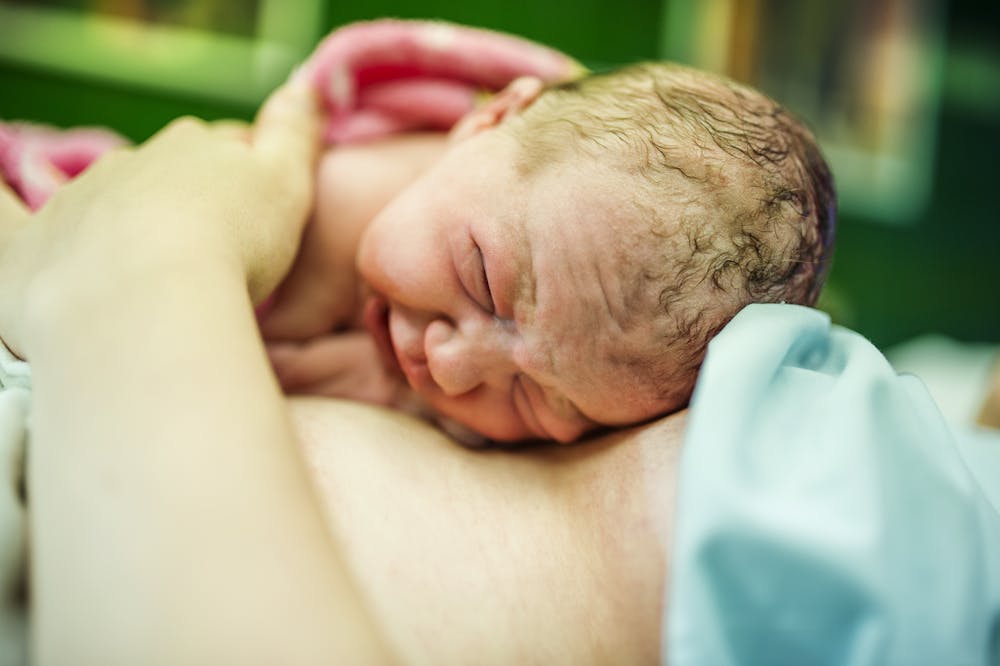 As the baby passes through the vagina, it is coated in and ingests protective bacteria.
Shutterstock
As the baby passes through the vagina, it is coated in and ingests protective bacteria.
Shutterstock
What about the impact of antibiotics on the microbiome?
For a newborn baby, the first super dose of microbes comes during the birth through the vagina, which contains around 200-300 bacteria.
These bacteria help seed the new baby’s microbiome, shaping its health and setting up an effective defence shield for infections.
The microbiome of the vagina changes through pregnancy. Halfway through pregnancy, hormonal shifts begin to stockpile glycogen (bacteria’s favourite food). As the bacteria turn this glycogen into lactic acid the PH level of the vagina lowers (more acid like) and this discourages harmful bacteria like GBS from growing.
As the baby passes through the vagina, it is coated in and ingests this protective bacteria (this process doesn’t occur with caesarean section). When the baby breastfeeds, they ingest components that are only found in breastmilk that feed the good bacteria and protect the baby.
Disturbance of this vulnerable early seeding of the microbiome with antibiotic use during labour and birth for GBS alter the balance of microbes in the baby’s intestines.
Several inflammatory conditions, including obesity, have also been linked to this.
Weighing all this information up means a clear recommended pathway for GBS detection and treatment still evades us.
The most important thing for new parents to know is how to look out for an unwell baby and get help quickly. Signs of GBS infection include:
temperature that’s too high or low (get a thermometer)
poor feeding
irritability
sleeping more than normal or not moving much
rapid or noisy breathing (grunting or moaning)
skin colour changes (including looking blotchy)
any significant change in behaviour that does not resolve.
The quicker the treatment, the better the outcome. Breastfeeding can’t pass GBS infection to your baby and, in fact, is really important to help protect your baby from infections.
The MothersBabies Study
Our MothersBabies Study is investigating how the microbiome affects a woman’s health before pregnancy, during pregnancy, and in the first year of their child’s life.
This study can’t be conducted without the help of the community, so please get in touch if you want to know more or are interested in being included. You just need to be living in NSW and planning to get pregnant in the next 12 months. Email mothersbabies@unsw.edu.au to register your interest or find out more.
Read more: Coronavirus with a baby: what you need to know to prepare and respond
Authors: Hannah Dahlen, Professor of Midwifery, Associate Dean Research and HDR, Midwifery Discipline Leader, Western Sydney University
Read more https://theconversation.com/group-b-strep-and-having-a-baby-what-pregnant-women-need-to-know-131893

















