Melbourne's second lockdown spells death for small businesses. Here are 3 things government can do to save them
- Written by John Vaz, Senior Lecturer, Department of Banking and Finance, Monash University
The reimposition of stage 3 restrictions on metropolitan Melbourne is, as Victorian premier Daniel Andrews says, a matter of life or death. That’s also true for small businesses.
A further six weeks of stay-at-home orders for the city’s 5 million residents will kill off many small and medium sized businesses unless there are critical changes to federal and state government assistance policies.
Read more: Six-week lockdown for Melbourne as record 191 new cases in latest tally
Even with assistance many will not survive. But ensuring those that are viable are not lost is crucial to the recovery of both the Victorian and national economies.
Small businesses are the engine of economic growth. They are typically the first to innovate and respond to economic changes. The abnormal economic shock wrought by the necessary public health response to the COVID-19 pandemic means they have generally been hit hardest. Without policies and money to address their core needs, this second wave of restrictions will be a killer blow.
Three fundamentals
These fundamentals are absolute to the success of small business.
First, and most obviously, they need customers. Those providing essential local goods and services, such as groceries or health services, may cope. But those offering discretionary goods and services, such as hospitality, will suffer both from loss of foot traffic and suppressed consumer spending, as people save more in uncertain times.
Second, they need access to credit. This is much harder for small businesses to obtain than large businesses with assets. Small businesses are typically started by entrepreneurs who finance their endeavours with their own savings, through mortgaging their homes, or taking out personal loans.
They typically have extremely limited cash reserves to ride out tough times. Many juggle their bills from month to month to stay afloat.
Third, they rely on momentum. They grow by acquiring both customers and knowledge of their market. When repeat business stop, they lose that momentum. If they have to shed employees, they lose “business knowledge”, which sets them back even further in their recovery.
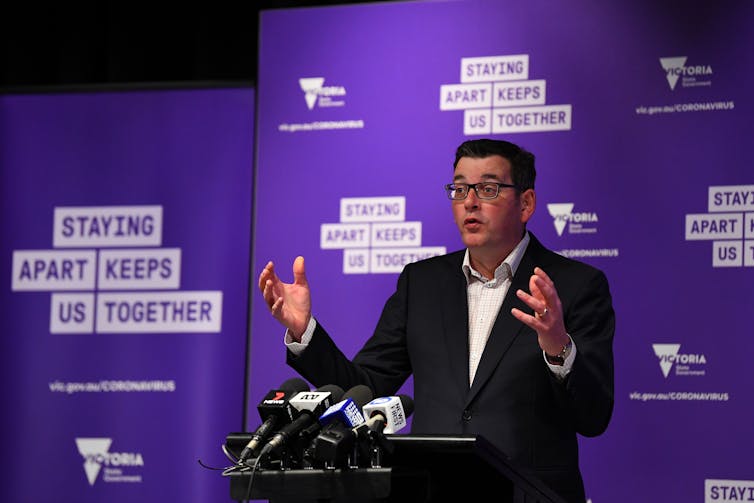 Victorian premier Daniel Andrews announces the return to lockdown in Melbourne on Tuesday, July 7 2020.
James Ross/AAP
Victorian premier Daniel Andrews announces the return to lockdown in Melbourne on Tuesday, July 7 2020.
James Ross/AAP
Calamitous damage
All economic slowdowns typically reduce demand, but this health/economic crisis has calamitously damaged all three aspects.
The federal government’s Job Keeper program and subsidies being provided through the Australian Taxation Ofice to boost business cash flow has enabled business to hold on to employees for now. But without customers or credit, even extending these measures beyond their scheduled September 30 end won’t be enough.
It’s my view it will take three to five years for consumer confidence and spending to return to pre-COVID levels. This assessment is based on past recessions where high unemployment prevailed compounded by the novel problem that health fears will suppress consumer confidence long after the coronavirus is contained and things return to “normal” (or at least a new normal).
Read more: Forget JobSeeker. In our post-COVID economy, Australia needs a 'liveable income guarantee' instead
The Melbourne outbreak of COVID-19 underlines there is no quick fix to the COVID-19 crisis. The only light at the end of tunnel is a possible a vaccine, which might take years, or never be found. The economy must therefore adjust. Not all businesses are viable. To continue indefinitely to pump public money into direct grants to prop them up is unsustainable.
To do so will lead to “perverse” consequences – providing windfalls to businesses that would have failed anyway – as many small business ventures do – while providing inadequate support to those that are important and would have survived but for the crisis.
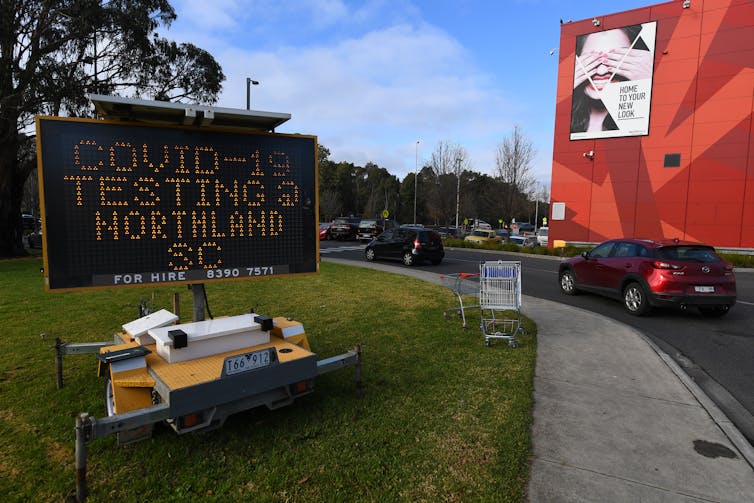 A COVID-19 testing site at Northland Shopping Centre, the largest retail mall in Melbourne’s northern suburbs.
James Ross/AAP
A COVID-19 testing site at Northland Shopping Centre, the largest retail mall in Melbourne’s northern suburbs.
James Ross/AAP
Three suggestions
Therefore I offer three suggestions.
First, continue JobKeeper and the tax office’s cashflow boost for as long as COVID-19 restrictions are in place. Businesses would need to apply for this on a month-by-month basis, and need to meet set criteria.
Read more: Forget JobSeeker. In our post-COVID economy, Australia needs a 'liveable income guarantee' instead
Second, the government should ensure easy access to low-interest loans for the next two to three years. Loans are more efficient than direct grants or subsidies. The fact the loans have to be repaid will encourage only those businesses with a good chance of being sustainable of seeking them.
Getting a loan is slow and hard for small businesses because banks scrutinise them due to the risk. Few small business have the skills to prepare the extensive documentation banks require. Banks will be motivated to lend faster and to more businesses if governments remove the risk by buying those loans.
To speed up the lending application process, there should also be subsidies to licensed financial advisers to prepare those applications.
Third, a system of subsidised vouchers for financial management advice from accountants and financial advisers (who are also mostly small businesses).
Financial services are critical for small businesses. In tough times it might be tempting to dispense with these services. But sound financial advice will be critical to business owners making the right decision – including whether they should be borrowing money to sustain their businesses or making the hard decision to cut their losses and move on.
Authors: John Vaz, Senior Lecturer, Department of Banking and Finance, Monash University