

When English becomes the global language of education we risk losing other – often better – ways of learning
- Written by Stephen Dobson, Professor and Dean of Education, Te Herenga Waka — Victoria University of Wellington
The English language in education today is all-pervasive. “Hear more English, speak more English and become more successful” has become a self-fulfilling prophecy.
Some say it’s already a universal language, ahead of other mother tongues such as Arabic, Chinese, Russian, Spanish or French. In reality, of course, this has been centuries in the making. Colonial conquest and global trade routes won the hearts and minds of foreign education systems.
These days, the power of English (or the versions of English spoken in different countries) has become accepted wisdom, used to justify the globalisation of education at the cost of existing systems in non-English-speaking countries.
The British Council exemplifies this, with its global presence and approving references to the “English effect” on educational and employment prospects.
English as a passport to success
In non-English countries the packaging of English and its promise of success takes many forms. Instead of being integrated into (or added to) national teaching curricula, English language learning institutes, language courses and international education standards can dominate whole systems.
Among the most visible examples are Cambridge Assessment International Education and the International Baccalaureate (which is truly international and, to be fair, also offered in French and Spanish).
Schools in non-English-speaking countries attract globally ambitious parents and their children with a mix of national and international curricula, such as the courses offered by the Singapore Intercultural School across South-East Asia.
Language and the class divide
The love of all things English begins at a young age in non-English-speaking countries, promoted by pop culture, Hollywood movies, fast-food brands, sports events and TV shows.
Later, with English skills and international education qualifications from high school, the path is laid to prestigious international universities in the English-speaking world and employment opportunities at home and abroad.
But those opportunities aren’t distributed equally across socioeconomic groups. Global education in English is largely reserved for middle-class students.
This is creating a divide between those inside the global English proficiency ecosystem and those relegated to parts of the education system where such opportunities don’t exist.
For the latter there is only the national education curriculum and the lesson that social mobility is a largely unattainable goal.
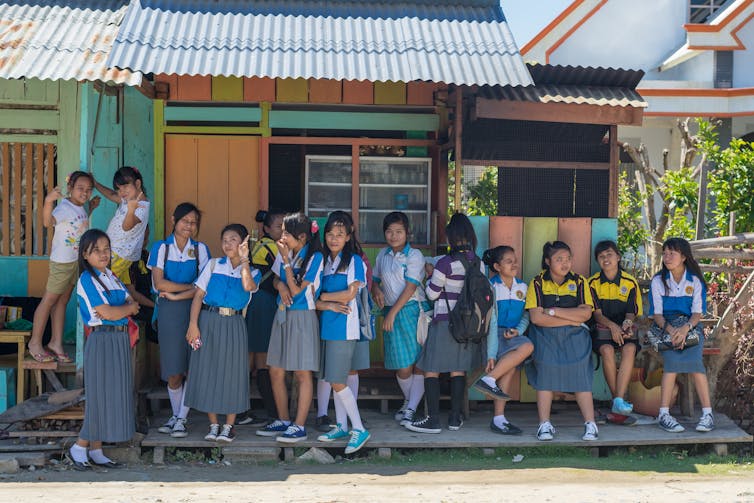 Schoolgirls in Sulawesi, Indonesia: is the language divide also a class divide?
Shutterstock
Schoolgirls in Sulawesi, Indonesia: is the language divide also a class divide?
Shutterstock
The Indonesian experience
Indonesia presents a good case study. With a population of 268 million, access to English language curricula has mostly been limited to urban areas and middle-class parents who can afford to pay for private schools.
At the turn of this century, all Indonesian districts were mandated to have at least one public school offering a globally recognised curriculum in English to an international standard. But in 2013 this was deemed unconstitutional because equal educational opportunity should exist across all public schools.
Read more: Lessons taught in English are reshaping the global classroom
Nevertheless, today there are 219 private schools offering at least some part of the curriculum through Cambridge International, and 38 that identify as Muslim private schools. Western international curricula remain influential in setting the standard for what constitutes quality education.
In Muslim schools that have adopted globally recognised curricula in English, there is a tendency to over-focus on academic performance. Consequently, the important Muslim value of تَرْبِيَة (Tarbiya) is downplayed.
Encompassing the flourishing of the whole child and the realisation of their potential, Tarbiya is a central pillar in Muslim education. Viewed like this, schooling that concentrates solely on academic performance fails in terms of both culture and faith.
Learning is about more than academic performance
Academic performance measured by knowledge and skill is, of course, still important and a source of personal fulfilment. But without that cultural balance and the nurturing of positive character traits, we argue it lacks deeper meaning.
A regulation issued by the Indonesian minister of education in 2018 underlined this. It listed a set of values and virtues that school education should foster: faith, honesty, tolerance, discipline, hard work, creativity, independence, democracy, curiosity, nationalism, patriotism, appreciation, communication, peace, a love of reading, environmental awareness, social awareness and responsibility.
These have been simplified to five basic elements of character education: religion, nationalism, Gotong Royong (collective voluntary work), independence and integrity.
These are not necessarily measurable by conventional, Western, English-speaking and empirical means. Is it time, then, to reconsider the internationalising of education (and not just in South-East Asia)? Has it gone too far, at least in its English form?
Isn’t it time to look closely at other forms of education in societies where English is not the mother tongue? These education systems are based on different values and they understand success in different ways.
It’s unfortunate so many schools view an English-speaking model as the gold standard and overlook their own local or regional wisdoms. We need to remember that encouraging young people to join a privileged English-speaking élite educated in foreign universities is only one of many possible educational options.
Authors: Stephen Dobson, Professor and Dean of Education, Te Herenga Waka — Victoria University of Wellington

















