

The shipping sector is finally on board in the fight against climate change
- Written by: Beatriz Garcia, Lecturer, Western Sydney University
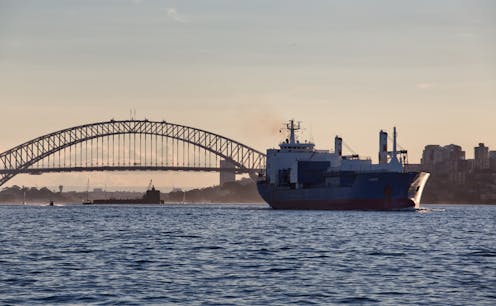
For the first time, the massive global shipping sector has agreed to a 50% reduction in greenhouse gas emissions by 2050, in what’s been called a “historic” moment.
Maritime shipping, which carries about 80% of global trade by volume, contributes around A$9 billion directly to Australia’s gross domestic product, and A$11.8 billion indirectly.
Read more: Three ways to improve commercial shipping's environmental footprint
Sea transport has a relatively green image because ships emit less carbon dioxide per tonne and per kilometre than rail, truck or air transport. Yet, given its scale and rapid growth, it’s a major source of carbon emissions. Maritime transport emits around 1,000 million tonnes of CO₂ a year and is responsible for about 2.5% of global greenhouse gas emissions.
The international law
Despite being a major contributor to climate change, the powerful shipping industry has successfully lobbied to be excluded from obligations to reduce emissions under the 1997 Kyoto Protocol and, more recently, the 2015 Paris Agreement.
There are also no sector-wide emission reduction targets in maritime shipping under the United Nations Framework Convention on Climate Change (UNFCCC). In other key policy spaces, such as the International Maritime Organization (IMO) and the United Nations Convention on the Law of the Sea (UNCLOS), there are no obligations imposed on either states or shipping corporations to reduce maritime emissions.
Countries could potentially set emissions targets domestically, but they rarely set sectoral targets, especially for sectors that are heavily exposed to international trade. In this context, the shipping industry has been particularly footloose in its response to climate change.
It is therefore a cause for celebration that decades of negotiation have now yielded this agreement. The deal requires all IMO countries to reduce shipping emissions by 50% compared with 2008 levels.
Ships will be required to be more energy-efficient and to use cleaner energy such as solar and wind electricity generation. Currently, the shipping industry is overwhelmingly reliant on dirty, carbon-rich fuels such as heavy diesel.
Some stormy seas ahead
The climate deal has been described as “historic”, but not all countries are on board. Some, particularly island nations that are vulnerable to sea level rise, wanted a “far, far more ambitious” target. Others, including the United States, Brazil, Panama and Saudi Arabia, are strongly against it. Reconciling these differences will be a difficult task for the IMO.
It has always been technically difficult to accurately calculate the precise amount of fuel used during shipping operations. It’s even harder to allocate maritime emissions to specific countries.
Contributing to the potential confusion is the use of “flags of convenience”. This is where a ship’s owners register the vessel in a country other than their own, and fly the flag of the country where registered.
This is usually done to disguise the relationship between the vessel and its actual owner, due to the attractive, lower regulatory burdens that some open registries offer. Shipping corporations could also use flags of convenience to avoid mandatory emission reduction targets.
The way forward
As a result of the climate deal, states will eventually need to introduce domestic laws setting emission reduction targets for their shipping industry.
These targets could also be applied to ships that call at their ports. The good news is that there is potential synergy between such regulation and existing laws, such as the European Union regulation that requires ship owners and operators to monitor, report and verify CO₂ emissions from certain vessels that dock at European ports.
Read more: Five ways the shipping industry can reduce its carbon emissions
The new climate deal has the potential to change the way shipping companies operate. It presents an opportunity for the shipping industry to become part of the solution rather than the problem when it comes to climate change.
It’s also a strong signal to other international industries, such as the aviation sector, that have largely escaped emissions reduction targets. If we can reduce emissions in such a large and complex sector as marine transport, it bodes well for the capacity of international frameworks to tackle other difficult problems.
Authors: Beatriz Garcia, Lecturer, Western Sydney University


















