

the dizzying spectacle of Gaudí's Basílica de la Sagrada Família
- Written by: John Willsteed, Senior Lecturer, School of Creative Practice, Queensland University of Technology
In this series we pay tribute to the art we wish could visit — and hope to see once travel restrictions are lifted.
We hadn’t packed bags yet, but it was about all that was left to do. I had compiled playlists to keep me diverted, amused, energised on the long flights. We’d pored over pictures and hopeful descriptions of poky little apartments in the right places, or spacious, sleek pads too far away from the action.
It took us three months to get the accommodation and the flights just so. The right amount of layover; the right seats for me and the kid and my sweetheart; the menus, the access options for my travelling companions and their idiosyncratic needs.
All the while, Antoni Gaudí’s dream cast its evening shadow over the park across the Carrer de la Marina. Darkening the playground, the streets of the Eixample and their endless cars; blurring the faces of the crowds that ebb and flow past and through the structure, dwindling at day’s end and disappearing into the larger tide of Barcelona at night.
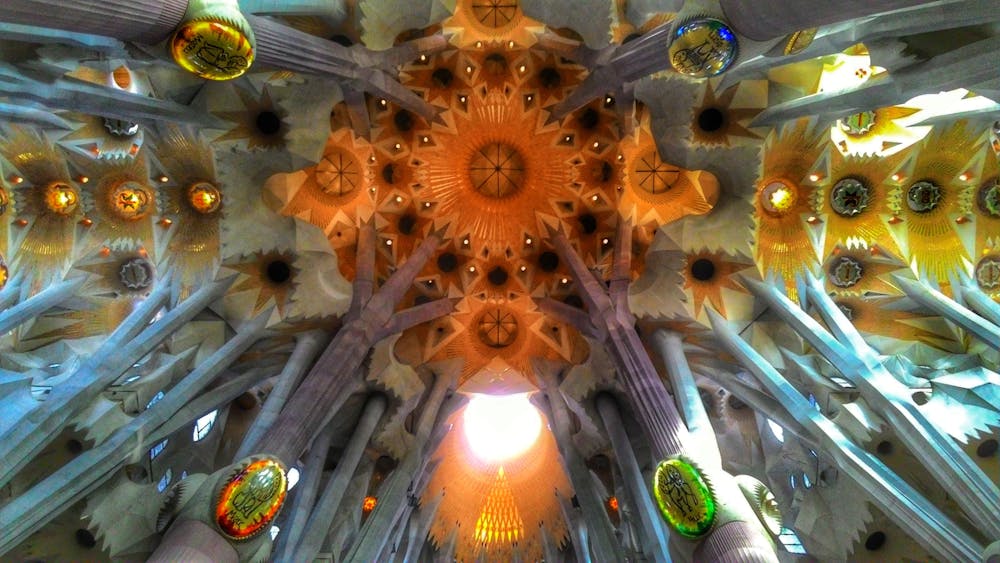 Inside the Basilica.
Unsplash/La Partida Eterna, CC BY
Inside the Basilica.
Unsplash/La Partida Eterna, CC BY
Since builders broke ground for the Basílica de la Sagrada Família under architect Francisco de Paula del Villar in 1882, the site has seen several architects and project managers. But Antoni Gaudí remains its creative heart.
Read more: Cathedrals of light, cathedrals of ice, cathedrals of glass, cathedrals of bones
An otherworldly mix of styles
When Gaudí turned his attention in 1909 to del Villar’s original neo-Gothic design, he mixed it with the organic flow of the Art Nouveau.
Using intricate upside-down models, with weighted strings tracing parabolic curves, reflected in mirrors, Gaudí created his own style.
Gaudí sculpted rather than drew, creating apartments and parks and public buildings whose undulating lines and unexpected textures weren’t really seen again until Frank Gehry’s iconic structures, such as the Olympic Fish Pavilion and the Bilbao Guggenheim, both in Spain. Like the Sagrada Família, these buildings are otherworldly, seeming to exist outside both time and gravity.
 Gaudí used hanging chain models, like this one of the chapel in Park Güell, reflected in mirrors for his architectural designs.
Allen Gathman/Flickr, CC BY
Gaudí used hanging chain models, like this one of the chapel in Park Güell, reflected in mirrors for his architectural designs.
Allen Gathman/Flickr, CC BY
A stop on tour
The first time I saw the Basílica, it was a grey afternoon in late August, 1988. I was on vacation from touring as bassist with The Go-Betweens and fled London with a dear travelling companion to saunter/stagger through southern Portugal, then Lisbon and Spain.
Brisbane friend Peter Loveday was “our man in Barcelona” and graciously led us through the town, cracking open each day as a fresh delight. I loved a wine, back in those days, and a beer. Prawns, vodka, gin and mussels. Barcelona was made of such treats, but the greatest treat was Gaudí.
We lingered in the wonder of Park Güell, where architecture and nature entwine, and the view stretches south across the city to the blue of the Mar Balear. On the clearest of clear days you can see the mountains on Majorca.
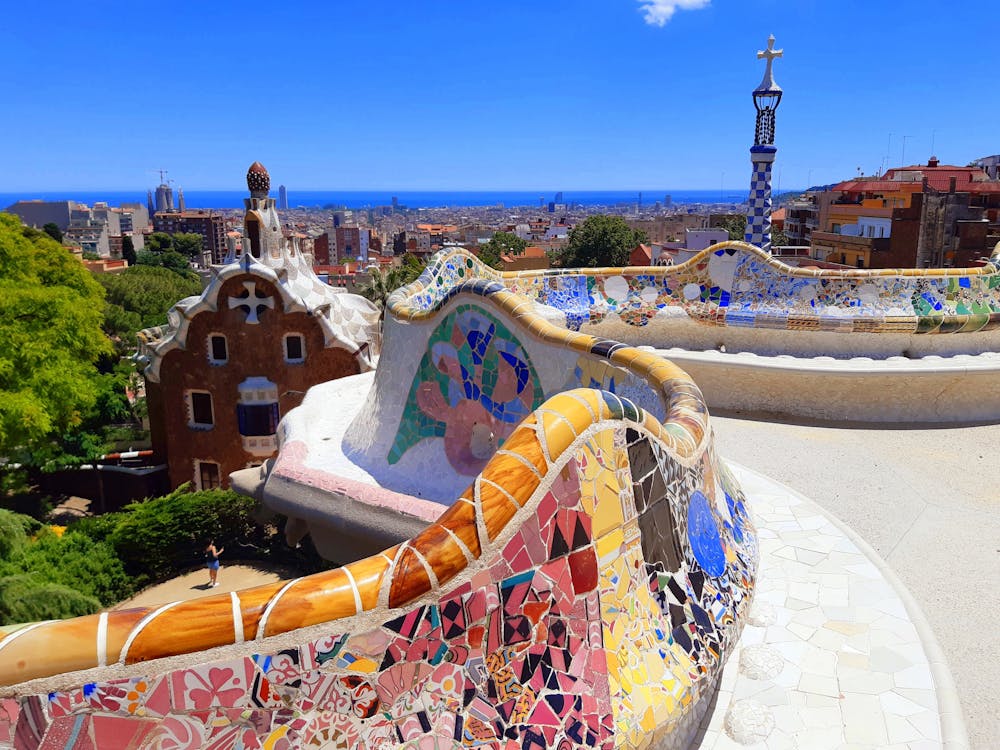 A place to rest on a summer’s day of sightseeing at Park Güell.
Denise Jones/Unsplash, CC BY
A place to rest on a summer’s day of sightseeing at Park Güell.
Denise Jones/Unsplash, CC BY
We were tourists visiting Casa Milà and Casa Batlló, dumbstruck by the extraordinary colours and finishes (lots of murals and tiles, cool to the touch on a hot afternoon), the bespoke furniture and fittings, and the opulent, sensual design of the facades and interiors.
Towering scale
The Sagrada Família stood apart from these architectural treasures. On that August afternoon, the scale of the cathedral was staggering. Not just in size, towering over this five-storey city, but in the depth of detail.
 Under construction.
Alex Reiss/Unsplash, CC BY
Under construction.
Alex Reiss/Unsplash, CC BY
The Basílica is based on a crucifix, with the two facades — the Passion and the Nativity — at the ends of the transept or crosspiece. Each of these facades is dense with sculpture — flowers, plants, animals, angels, saints and scenes from the Bible — and from each rises four belltowers.
The spiral staircase inside the eastern belltower of the Nativity facade was worn smooth, a fractal path tracing the interior of a Nautilus shell. The towers are just over 100 metres tall (the central tower will top 170 metres when completed sometime after 2026). With little room for passing on the stair and no handrail, the experience was dizzying.
We emerged into the afternoon high above the city, on a little bridge between the towers; the beginnings of the cathedral below us. We saw colourful glazes of the cimborio (domes or cups) capping the belltowers. The sight, as I later noted in my diary, brought tears. I’d been triggered by the vastness of the idea, the astonishing detail and the knowledge that Gaudí didn’t live to see it finished.
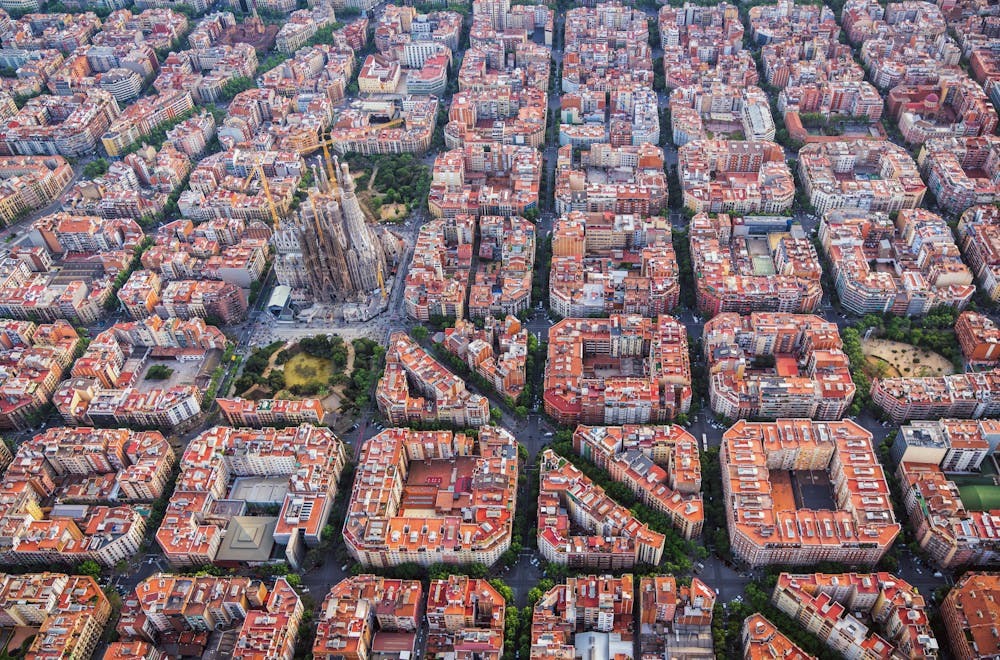 Barcelona Eixample’s grid residential district.
Shutterstock
Barcelona Eixample’s grid residential district.
Shutterstock
God’s architect
In June 1926, at the age of 73 and after almost two decades of working on the Basílica, Gaudí stepped into the path of a tram a few blocks from the cathedral. “God’s architect”, the Catalan Modernist, was buried in the underground crypt of the Sagrada Família below the Basílica he designed.
I have returned to Barcelona a couple of times over the years but never to the Sagrada Família. Much has changed since the 31-year-old me climbed those stairs.
A century and a half in the making.The nave has been built, with towering columns and stained-glass windows. More belltowers rise above the street, with more to come. It is within a handful of years of being completed, hopefully by the 100th anniversary of Gaudí’s death.
Our carefully laid travel plans would have seen us arrive in Barcelona early in July 2020. The pandemic put those plans (and much else) on hold. I enjoyed the quiet but ache for the trip we had imagined. I think I’ve waited long enough for a second visit to my favourite building.
Read more: If I could go anywhere: Japanese art island Chichu, a meditation and an education
Authors: John Willsteed, Senior Lecturer, School of Creative Practice, Queensland University of Technology


















