

a public service or surveillance and advertising tool?
- Written by: Justine Humphry, Senior Lecturer in Digital Cultures, University of Sydney
Smart street furniture – powered and digitally networked furniture that collects and generates data – is arriving in Australia. It comes in a variety of forms, including benches, kiosks, light poles and bus stops. Early examples in Australia include ChillOUT Hubs installed by Georges River Council in the Sydney suburbs of Kogarah, Hurstville and Mortdale, and information kiosks and smart light poles in the City of Newcastle as part of its Smart City Strategy.
The “smartness” of this street furniture comes from its new data and connectivity capabilities. The idea is that these can generate new products and services, and support real-time planning decisions in cities. Most offer free wi-fi in combination with other functions like advertising, wayfinding, emergency buttons, phone calling and device charging via USB.
Read more: Sensors in public spaces can help create cities that are both smart and sociable
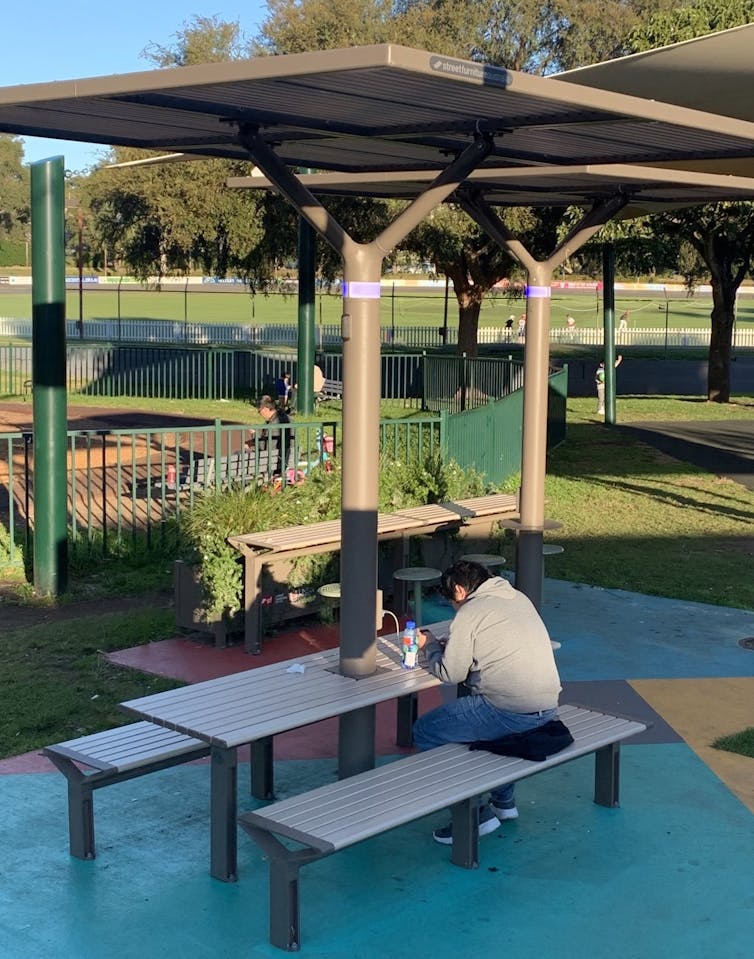 A ChillOUT Hub installed in Timothy Reserve, Hurstville, by St Georges River Council.
Photo: Chris Chesher, Author provided
A ChillOUT Hub installed in Timothy Reserve, Hurstville, by St Georges River Council.
Photo: Chris Chesher, Author provided
Smart, but controversial
The promise of smart street furniture is that it will enhance public spaces and revitalise ageing infrastructure. By providing vulnerable and disadvantaged citizens with access to free connectivity services it can also bridge digital barriers.
Despite these benefits, some aspects of smart street furniture are controversial. In particular, its data collection and impact on public space have created concerns.
In New York City, the replacement of phone booths by LinkNYC digital kiosks has given rise to protest about data ownership and sharing and surveillance through built-in security cameras. Other sources of tension are the kiosks’ physical footprint, visual impact and use for outdoor advertising with its double-sided 140cm digital displays.
In Australia, Telstra has been fighting a long court case against the cities of Sydney, Melbourne and Brisbane over plans to convert its phone booths into smart hubs equipped with digital advertising. Councils objected to these on the basis that they required local planning approval. Telstra argued the hubs were exempt as “low-impact facilities”, but has had to delay installation.
What can we learn from early adopters overseas?
We don’t yet understand the public impact and value of smart street furniture, what service model is to be adopted at scale, or what kind of future it offers. To what extent are these facilities offering public services, or are they just enablers of more advertising and surveillance?
Australia can learn from the early examples of smart street furniture in other countries. Our Smart Publics research project investigated the design, use and governance of InLinkUK kiosks in Glasgow and Strawberry Energy smart benches in London with a research team at the University of Glasgow. (The final report is here.)
We found the main users were those who were living rough, young people, students and gig workers. Smart furniture enabled these groups to stay digitally connected. They used these facilities to charge their phones and make free calls, which were especially valuable for those who didn’t own phones or lacked the credit to use them. (The InLinkUK kiosks offered free calls to any mobile or landline in the UK.)
Read more: How do we stop people falling through the gaps in a digitally connected city?
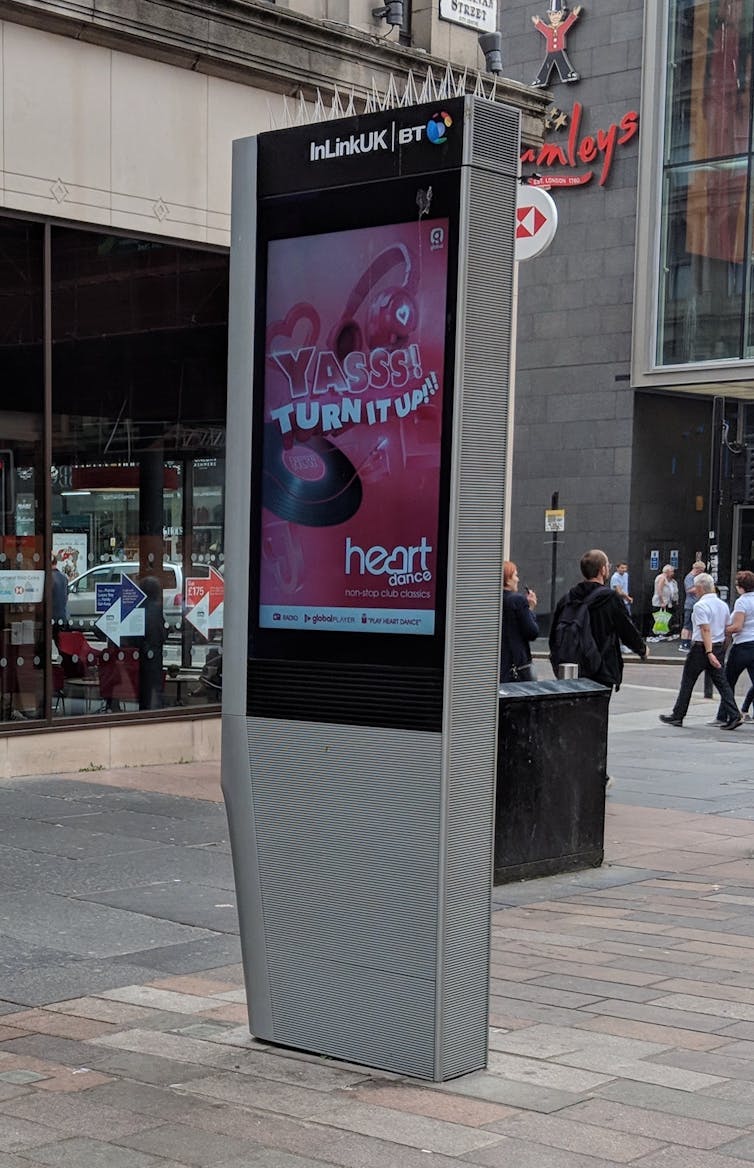 An InLinkUK kiosk in Glasgow city centre.
Photo: Smart Publics researchers, Author provided
An InLinkUK kiosk in Glasgow city centre.
Photo: Smart Publics researchers, Author provided
Who is funding these facilities?
Even though kiosks and smart benches could be used for community service information, we found it was commercial advertising that drove private investment in this infrastructure. Advertising revenue paid for the services offered by the InLinkUK kiosks and sponsorship for the Strawberry Energy benches. Advertising agency Primesight was one of the three main partners in InLinkUK (with British Telecom and Intersection, the company responsible for LinkNYC).
Because advertising was so prominent in their design, many people were unaware of their other functions. Asked if they’d noticed the InLinks, one person replied:
“Er no, I haven’t […] what’s it for? Is it to make free calls to anywhere in the UK? […] I just thought it was like an advertising board, I guess!”
People recognised the wide public value of free wi-fi, device charging and phone calls. But we found the public as a whole didn’t understand the data-collection aspects. The marginalised groups who relied on these services were more exposed to corporate advertising, data collection and surveillance in public spaces.
Read more: People-friendly furniture in public places matters more than ever in today's city
Councils were also limited in their ability to leverage the benefits that came from the data. The Strawberry Energy benches, for example, collected environmental data such as temperature, noise level and air quality from inbuilt sensors. However, these data weren’t being used to inform planning or policy.
Reliability of the data was another issue. We found inaccuracies when we tested the environmental data.
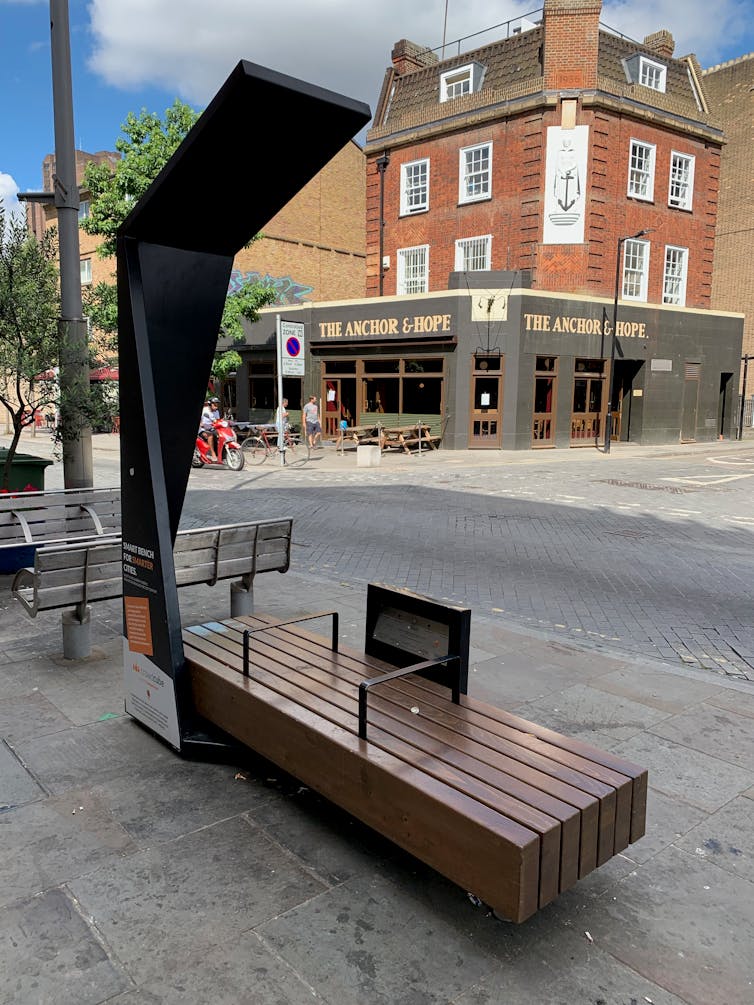 A Strawberry Energy smart bench in Southwark, South London.
Photo: Smart Publics researchers, Author provided
A Strawberry Energy smart bench in Southwark, South London.
Photo: Smart Publics researchers, Author provided
Where to now in Australia?
These issues highlight some of the challenges councils encounter when embarking on smart street furniture initiatives with private companies. These include data-sharing contract arrangements as well as the need to upskill council staff to manage new kinds of data capabilities and systems.
The examples we studied in the UK had been rolled out in public-private partnerships. However, some of the models emerging suggest a different kind of civic implementation.
Local governments that have been early adopters of smart furniture in Australia have envisioned it as an extension of council services without added advertising or compromising heritage values. These have typically begun as experimental initiatives funded by federal and state government grants. The City of Newcastle, for example, is planning to integrate smart city technologies into regular council operations.
Smart street furniture is not going away. If anything, it will become pervasive as technology advances and becomes more integrated into our physical surroundings.
The issues raised by smart street furniture warrant close inspection and further research. It is crucial that governments and private actors are transparent about its use for advertising and data collection. To ensure the benefits of smart street furniture are realised, they need to:
- emphasise the public value of smart street furniture, including its use for community-based information
- collaborate with the public on its design and placement
- in the case of councils, take a pro-active approach to access, ownership and stewardship of data
- ensure marginalised citizens are not exposed to increased risk of surveillance and data harms.
Authors: Justine Humphry, Senior Lecturer in Digital Cultures, University of Sydney


















