

The Taliban's rule threatens what's left of Afghanistan's dazzlingly diverse cultural history
- Written by Julian Droogan, Senior Lecturer, Macquarie University
Despite cliched talk of a “graveyard of empires”, what we now call Afghanistan has for thousands of years been an important part of many sophisticated cultures.
Situated along the Silk Road — a tangle of Eurasian trade routes stretching back to the days of the Roman Empire — Afghanistan and its people have long served as a place of connection between Mediterranean, Persian, Indian and Chinese civilisations.
It has been home to Hellenistic cities populated by the successors of Alexander the Great, glittering Buddhist monasteries that served to transmit early Buddhism from India to far away China and Japan, and a series of Medieval Islamic kingdoms at the forefront of the literature and science of their day.
This dazzlingly diverse heritage is preserved in over 2,600 archaeological sites scattered across its rugged terrain, numerous regional museums and galleries, and, most famously, the National Museum of Afghanistan in Kabul. Refurbished in 2007, the museum holds a collection of over 80,000 artefacts from throughout the region.
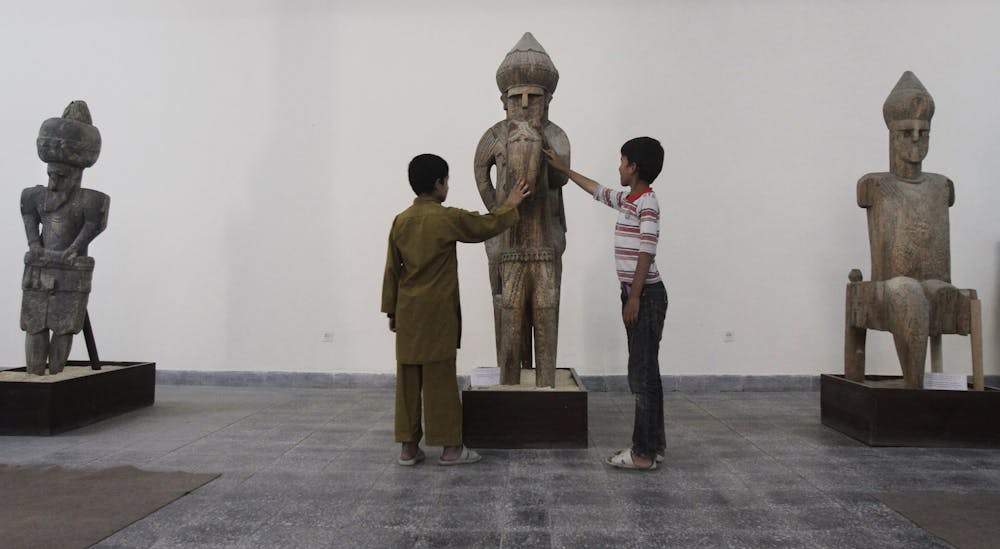 The National Museum of Afghanistan in Kabul was destroyed in 1992 and refurbished in 2007. Here, two boys visit the museum in 2012.
AP Photo/Ahmad Jamshid
The National Museum of Afghanistan in Kabul was destroyed in 1992 and refurbished in 2007. Here, two boys visit the museum in 2012.
AP Photo/Ahmad Jamshid
All of this is now under renewed threat by Taliban forces, whose fanatical interpretation of Islam forbids representative imagery, and is particularly dismissive of anything it considers to be non-Islamic.
While remaining focused on the plight of the Afghan people, countries such as the US, UK, and Australia need to also start planning how they can reduce the coming assault on Afghanistan’s art, history and material culture.
A history of destruction
Afghanistan’s archaeological sites were previously systematically looted and destroyed during the period of Soviet occupation and warlordism that followed.
In the 1980s, whole ancient sites were illegally excavated with artifacts sold off under cover of war. The Hellenistic Greek city of Ai-Khanoum, dating from the 4th century BCE to the mid-2nd century CE and discovered in the 1830s, was destroyed, including its Greek theatre, gymnasium and temple to Zeus.
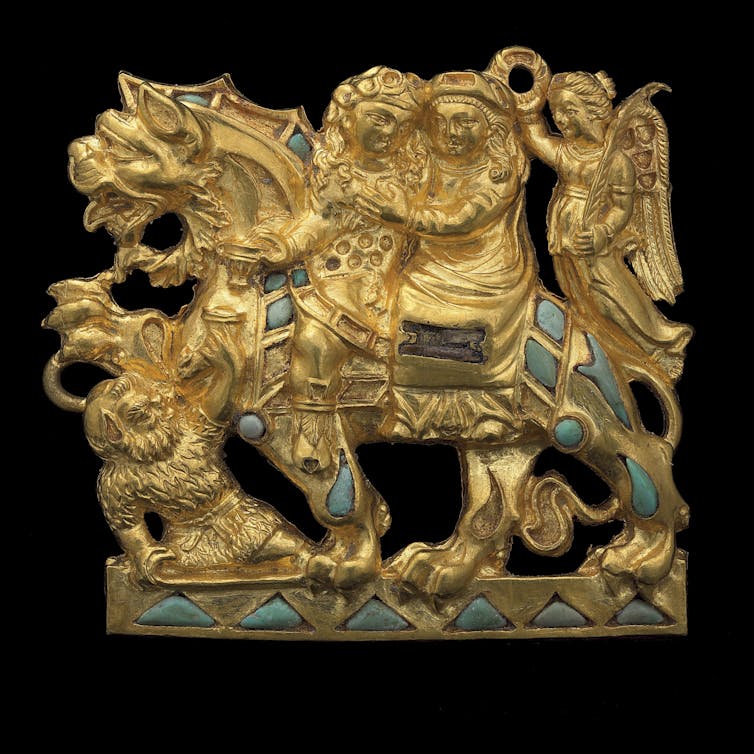
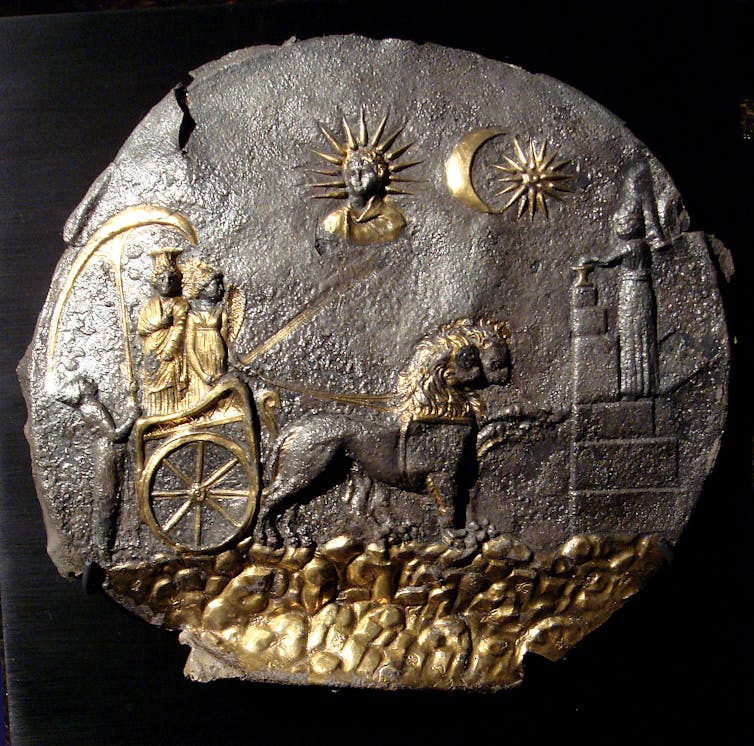 This plate, dating from the 3rd century BCE, depicts the Greek gods Cybele and Nike. It was found in Ai-Khanoum, an ancient city in what is modern-day Takhar Province in Afghanistan.
National Museum of Afghanistan, Kabul
This plate, dating from the 3rd century BCE, depicts the Greek gods Cybele and Nike. It was found in Ai-Khanoum, an ancient city in what is modern-day Takhar Province in Afghanistan.
National Museum of Afghanistan, Kabul
During Afghanistan’s civil war in the early 1990s, items from the 12th century palace of Mas’ud III were looted and distributed through international black markets.
The National Museum in Kabul, established in 1919, was extensively damaged and looted in the period immediately following the end of communist rule in 1992.
The “Dead Seas Scrolls of Buddhism” — thousands of scrolls and fragments written on leaves, bark, parchment and copper containing Buddhist sermons and treatises from as early as the 2nd century AD — were smuggled out of Afghanistan and dispersed among various manuscript collections from 1994 to 2001. Some were looted from the Kabul museum, but most were found in caves in the region of Bamiyan in the 1990s.
From 1996 to 2001, the Taliban outlawed almost all forms of art while systematically looting and destroying libraries and museums, and persecuting anyone considered to be an expert or academic.
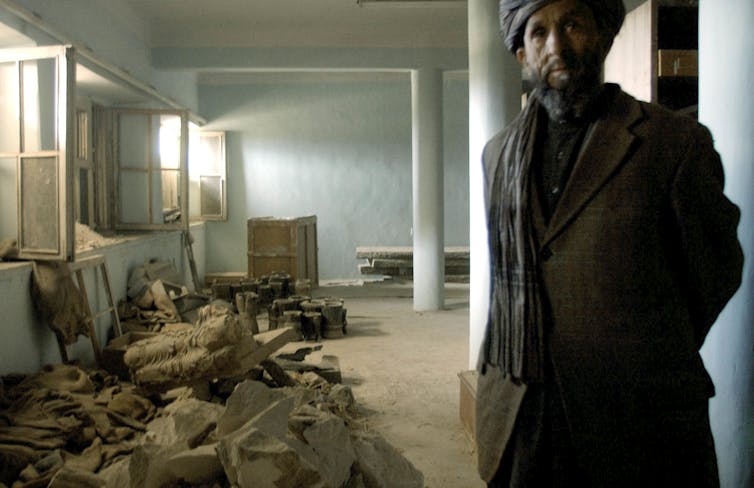 A museum employee stands in front of a destroyed statue in the basement of the Kabul Museum in Kabul, Afghanistan in 2001.
AP Photo/Marco Di Lauro
A museum employee stands in front of a destroyed statue in the basement of the Kabul Museum in Kabul, Afghanistan in 2001.
AP Photo/Marco Di Lauro
The Taliban were ruthless in their destruction, but also strategic. They saw Afghanistan’s pre-Islamic art and culture as a resource to be used and abused where possible to aid their international objectives.
Most infamously, during their final year in power they glorified in the demolition of the 6th century Bamiyan Buddhas while also decimating the already weakened collections of the National Museum.
Just two years earlier, in 1999, the Taliban Minister of Culture had assured the international community Afghanistan’s Buddhist heritage would be safe under his custodianship. In 2001, the Bayiman Buddhas were held hostage — and ultimately destroyed — while the Taliban demanded international recognition.
Read more: Should Australia recognise a Taliban government?
What does this mean for Afghanistan today?
The Taliban are again claiming Afghanistan’s heritage will be safe under their rule.
Statements have been released instructing fighters to protect and preserve historical sites, halt the plundering of archaeological digs, and forbid the selling of antiquities on the black market. Guards have been posted at the National Museum to prevent looting.
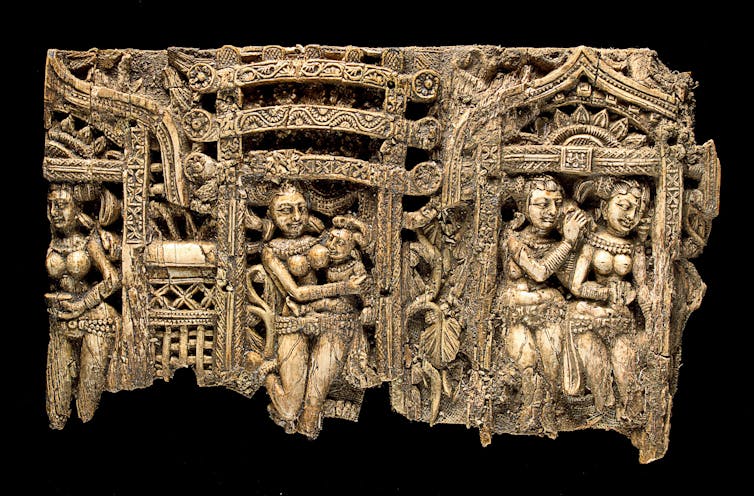 National Museum of Kabul is home to incredible artefacts, like this decorative plaque with women standing under gateways from the 1st century A.D. Afghanistan.
AAP Image/National Museum of Afghanistan, Thierry Ollivier
National Museum of Kabul is home to incredible artefacts, like this decorative plaque with women standing under gateways from the 1st century A.D. Afghanistan.
AAP Image/National Museum of Afghanistan, Thierry Ollivier
However, this initial charm offensive could just be the opening move in a longer strategy in which Afghanistan’s history and heritage will be once again held hostage. Priceless cultural treasures may be threatened with destruction.
Archaeologists and curators responsible for preserving Afghanistan’s national heritage were caught off-guard by the Taliban’s rapid advance. Many are now seeking to flee the country or are going into hiding.
Read more: The situation in Afghanistan is beyond horrifying: this is what you can do to help
The loss of these experts and custodians of Afghanistan’s rich heritage will mean there is nobody to protect its material past from neglect or looting. Nor will future generations of young Afghans be able to learn about their past from fellow citizens who have dedicated their lives to preserving it.
Australia’s part to play in stopping illegal trade
Looted antiquities make up a lucrative international black market. There is a proven connection between these back markets and international terrorist groups such as the Islamic State.
 A 1st century Clasp from the collection of the National Museum of Kabul.
(AAP Image/National Museum of Afghanistan, Thierry Ollivier
A 1st century Clasp from the collection of the National Museum of Kabul.
(AAP Image/National Museum of Afghanistan, Thierry Ollivier
As has been seen in Iraq and Syria, the looting and sale of the archaeological heritage of Afghanistan could be used to fund international terrorism.
Markets for illegally looted artefacts only exist while international collectors — including museums and galleries — continue to acquire stolen antiquities.
Read more: Illegal trade in antiquities: a scourge that has gone on for millennia too long
Afghanistan remains, first and foremost, a humanitarian tragedy and we must do what we can to assist the Afghan people.
But now is also the time for Australia and other liberal democracies to put in place stronger legal safeguards to prevent the trafficking of antiquities, in particular much stronger border security and customs measures for the detection and ending of this illicit trade.
A brief history of the Taliban by an Afghan scholar who lived through it.Authors: Julian Droogan, Senior Lecturer, Macquarie University

















