

Home rapid antigen testing is on its way. But we need to make sure everyone has access
- Written by Lesley Russell, Adjunct Associate Professor, Menzies Centre for Health Policy, University of Sydney
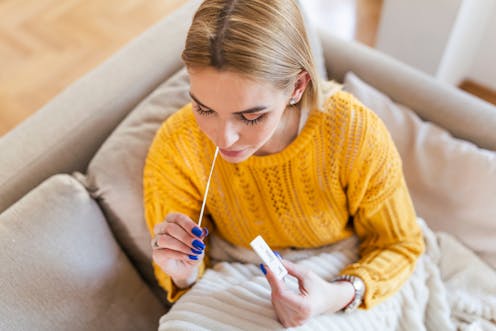
As Australia opens up and we learn to live with COVID-19, rapid antigen tests are likely to play an increasingly important role in limiting the spread of the virus.
So we can expect growing demand for these tests, which can give a result in minutes, and are already used in other countries, including the United Kingdom.
Airline travel, accommodation, entry to ticketed events and school attendance may depend on this type of testing. Large-scale family gatherings and community events will also want to ensure the safety of all attendees, especially if some, for whatever reason, are unvaccinated.
Read more: Rapid antigen tests have long been used overseas to detect COVID. Here's what Australia can learn
What are rapid antigen tests?
Rapid antigen tests have many advantages over the polymerase chain reaction (PCR) tests used at public testing centres. They are cheaper, can be used anywhere at any time, and results are available within minutes. But they are also less reliable than PCR tests.
The Therapeutic Goods Administration (TGA) has approved dozens of these rapid antigen tests. But these are only available for use in health care, aged care, schools and workplaces.
These tests are not commercially available for home use, although this is on its way. Health Minister Greg Hunt expects home tests will be available from November 1.
Between now and then, here are four issues we need to consider if individuals and families are expected to use these tests and if rapid antigen testing is to be an effective and equitable gateway to activities and services.
1. Do they work?
The TGA will need to ensure the tests, many of which were developed more than a year ago, perform well with the Delta variant.
A Cochrane review recommends evaluations of the tests in the settings where they are intended to be used to fully establish how well they work in practice. It is not clear if this research is being done in Australia.
Tests from different manufacturers vary in accuracy and are less accurate in people without symptoms and/or with low viral loads – when they will most likely be used.
Read more: Rapid antigen testing isn't perfect. But it could be a useful part of Australia's COVID response
Many home tests advise testing twice over a three-day period, with at least 36 hours between tests; they work best when testing is done regularly.
Appropriate consumer information material needs to be included with the tests to ensure people are using and interpreting them correctly at home.
There also needs to be a back-up service (such as a telephone hotline) for people who are confused, get unexpected results, and for those who test positive and need PCR testing to confirm their status.

2. Do we have enough tests?
There are already signs supply of these tests could be a problem.
The biggest Australian manufacturer of rapid antigen tests has a large government supply contract with the United States, where supply of such tests cannot keep pace with demand.
India has also recently acted to restrict export of rapid antigen tests.
There are indications the federal government has supplies for distribution to aged-care facilities and local government areas as needed. However, the extent of the stockpile – and whether tests might be released from the stockpile for home use – is unknown.
3. What will they cost?
Once approved for use at home, people will most likely be able to buy these tests in pharmacies. However, there’s been no suggestion these will be subsidised or their price controlled.
There are different international approaches. In the UK, people can order two packs of seven tests free from a government website and can pick them up from places including pharmacies and libraries.
In Germany, people can buy tests in supermarkets for about €25 (about AU$39) for a pack of five.
In the US, there are huge price variations with each test costing US$5-30 (about AU$6.80-$40.90).
In Australia, worksites in Sydney can buy tests direct from suppliers for AU$8.50-$12.50 (depending on quantity). But they also need to employ a health-care professional to oversee their use.
Companies providing rapid antigen tests are reportedly contacting schools, saying they can supply tests at A$15 each (with additional costs for a nurse and administration).
It will not be sustainable to ask parents of schoolchildren and university students to pay such costs on an ongoing basis.
Read more: Keeping workers COVID-safe requires more than just following public health orders
4. How do we ensure equity?
US survey results indicate Americans’ willingness to regularly use home testing is price sensitive. That surely is also the case in Australia.
To date, all the signs are the federal government is taking a hands-off approach to the introduction of rapid antigen testing for home use. But it’s essential we have effective distribution mechanisms to cover all of Australia. We also need a regulated price structure and/or subsidies to make the cost of these tests affordable.
Failure to ensure availability and affordability of home testing will further disadvantage Australians already disproportionately affected by the pandemic.
Read more: As lockdowns ease, vaccination disparities risk further entrenching disadvantage
Authors: Lesley Russell, Adjunct Associate Professor, Menzies Centre for Health Policy, University of Sydney

















