

Modern Australian
Men's Weekly

.

Billionaires taking action on climate change are part of a long tradition

  • Written by David Tuffley, Senior Lecturer in Applied Ethics & CyberSecurity, Griffith University
Billionaires taking action on climate change are part of a long tradition

If governments won’t act quickly enough on climate change, who will?

Enter the new breed of (mostly young) billionaire philanthropists. Their goal is to use their influence and money to push the boundaries of science and technology for society’s benefit.

One example is Mike Cannon-Brookes, billionaire co-founder of software developer Atlassian and his partner Annie Cannon-Brooke who this month pledged A$1.5 billion to invest in climate projects by 2030.

$1 billion will be in financial investments and $500 million in philanthropic and advocacy work, with the aim of keeping global warming to 1.5 degrees. He wants other executives to follow suit.

In the US the world’s largest funds manager Blackrock has injected funds into billionaire Bill Gates’ Breakthrough Energy, which is using philanthropic money to accelerate investments in new technologies.

Breakthrough has reportedly secured US$1 billion in investments from Microsoft, General Motors, American Airlines, Boston Consulting Group, Bank of America and ArcelorMittal.

In India, in Denmark, in Australia

In India, its richest citizen Mukesh Ambani has pledged to take his energy giant net-zero by 2035, an undertaking he will fulfil by switching to renewable sources and converting carbon dioxide emissions into useful products and chemicals.

Australia’s Andrew Forrest has established Fortescue Future Industries as part of Fortescue Metals with a mandate to invest billions in Green Hydrogen projects in Queensland and NSW and to take the mining group carbon-neutral by 2040.

Read more: The AFR's 2021 Rich List shows we're not all in this together

Elsewhere a Danish sceptic on carbon pricing Bjørn Lomborg has made a case for innovation in energy research in energy research as the way to limit carbon emissions, citing a parallel from the 1860’s when whales were hunted to near extinction for oil that was used to light homes.

He says the solution was not to tax whales, it was the invention of kerosene that undercut the cost of whale oil.

What’s happening isn’t new

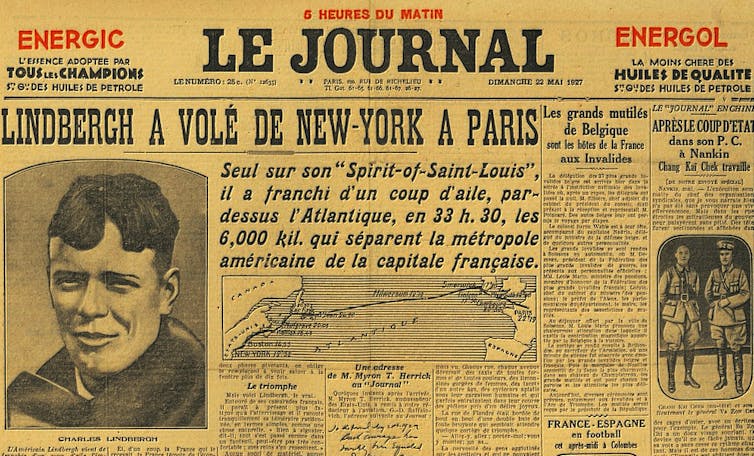
In 1919 businessman Raymond Orteig offered US$25,000 for the first person to fly non-stop from New York to Paris.

The prize was won by an unknown 25-year-old US Army Reserve officer, Charles Lindberg, spurring enormous advances in aviation.

Le Journals’ coverage of Charles A. Lindbergh’s 33 hour flight from New York to Pariswhich won him US$25,000 in prize money.

Today, the X Prize Foundation and the Musk Foundation are offering a US$100 million X Prize for Carbon Removal funded by billionaire Elon Musk.

The prize will go to the team from anywhere on the planet who can invent a machine that extracts carbon dioxide from the atmosphere or oceans at gigatonne-scale.

Previous X Prizes have been awarded for the application of artificial intelligence to global issues, turning carbon dioxide into useful products, developing cheaper methods of mass testing for COVID, and creating water from thin air.

Horses for courses

There is a sound argument that important pledges and projects should be the responsibility of governments rather than individuals.

Billionaires often get where they are by acting on self-interest, so it isn’t reasonable to expect them to act in the interest of the entire public.

Read more: Bill and Melinda Gates: philanthropy caught in the crosshairs of society's obsession with celebrity

On the other hand, some problems are too important and time sensitive to leave in the hands of governments that can’t act with agility.

If an individual loses their money, it’s their loss. If the government loses the money, its the taxpayer’s loss. So governments have to be cautious.

It’s probably not a matter of one or the other. Governments shouldn’t abandon their responsibility to act in the public interest. On the other hand, wealthy philanthropists throughout history have been prepared to help.

Authors: David Tuffley, Senior Lecturer in Applied Ethics & CyberSecurity, Griffith University

Read more https://theconversation.com/billionaires-taking-action-on-climate-change-are-part-of-a-long-tradition-170463

Legal Remedies Available in a Breach of Contract Case

When a contract is broken, the consequences can affect cash flow, reputation and ongoing business relationships. A breach of contract may occur when...

Long Weekend Camping in the Yarra Ranges: Three Weekends of High Country Adventure

Yarra Ranges National Park, Victoria. Image by Mattinbgn (talk · contribs), CC BY 3.0, via Wikimedia CommonsVictoria’s Yarra Ranges offer keen trav...

Why Waste Management Solutions Are Essential For Modern Businesses

Managing waste responsibly has become a critical priority for organisations of all sizes, which is why waste management solutions play such an impo...

The Importance and Varieties of Ride-On Mower Tyres

Ride-on mowers are built to manage larger lawns with consistency and control. The quality and design of ride on mower tyres play a critical role in ...

Gain Peace Of Mind: The Undeniable Benefits Of A Ready First Aid Kit

Life in our vibrant communities, whether it's the bustling city or the quiet country town, is full of unexpected moments. From a scraped knee on the...

The Most Common Conveyor System Issues in Manufacturing

In modern manufacturing, conveyor systems play a central role in keeping production lines efficient, consistent, and cost-effective. When they operate...

How to Secure a Long-Term Rental in a Competitive Market

The rental market can be unpredictable and may present challenges if you’re not prepared. Initially, you might submit numerous applications and stil...

What Smart Investors Know About Real Estate

Many people think investing in property is just about buying a house and waiting for it to get expensive. While that can happen, the people who actual...

The Benefits of Seeking Help for Anxiety and Stress

Anxiety and stress have become common experiences in today’s fast-paced world, affecting people across all ages and lifestyles. From work pressures ...

How to Make the Most of Fashion Wholesale Options for Your Brand

If you want to grow a fashion brand without constantly reinventing the wheel, wholesale can be one of the smartest ways to scale. The key is knowing h...

How to Add Value to Your Home Before Selling

Selling a home is not just about putting up a sign and waiting for offers. It is about presenting a property that buyers instantly connect with and ar...

How Outdoor Play Enhances Learning and Wellbeing

You don’t need to be an expert to conclude that play is an essential part of growing up. When children aren’t restricted and kept indoors, they de...

How to Build Passive Income Through Real Estate

Building passive income is one of the most effective ways to create long-term financial security. While there are many investment opportunities availa...

DIY Guide to Replacing Small Parts in Your Laundry Machine

Finding a puddle or a broken washer is frustrating, but you don’t always need a professional. Many common issues are caused by tiny parts that are c...

Best Practices for Managing Your Warehouse Partner Relationships

Your warehouse partner is an important part of your business. They sit in the middle of your promises to customers. Yet, when they deliver what’s pr...

Benefits of Solar-Based Water Circulation Systems

Imagine your water system running all day without touching your electricity bill. No noise, no heavy cables, no stress when prices go up. Fantastic, r...

Benefits of Using an Outrigger Crane for Complex Lifts

Complex lifts aren’t the kind of jobs you improvise. You’re dealing with awkward shapes, serious weight, and sites that never seem designed for wh...

A Beginner's Guide to Website Ranking

If you have a website, you probably want people to find it. But building a website alone does not guarantee visitors. Millions of websites compete for...
















