Modern Australian
The Times

The Morrison government spent a record amount on taxpayer-funded advertising, new data reveal

  • Written by Kate Griffiths, Deputy Program Director, Grattan Institute
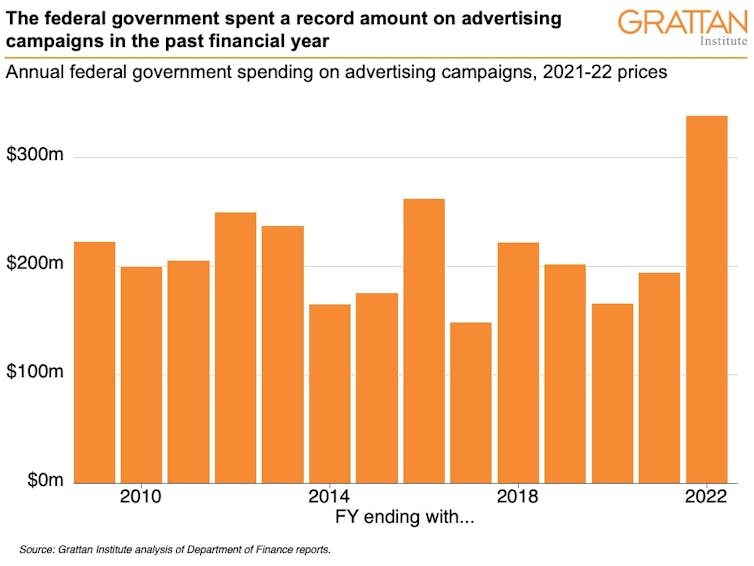
Graph showing annual federal government spending on advertising campaigns

The federal government is a big spender in the advertising world, regularly spending more than major companies such as McDonald’s, Telstra and Coles. New data released on Friday by the Department of Finance shows that in the lead-up to the May 2022 election, the Coalition government’s advertising spend skyrocketed yet again.

The past financial year was the biggest year on record for taxpayer-funded advertising. The previous federal government spent A$339 million on taxpayer-funded advertising campaigns in 2021-22, well above the 25-year average of about $200 million a year.

In the first six months of 2022, the previous government was the biggest advertising spender in the country.

Graph showing annual federal government spending on advertising campaigns
The Morrison government ran 28 separate advertising campaigns last financial year – the most on record. Many were for legitimate purposes, such as an $89 million campaign encouraging take-up of the COVID-19 vaccine, and a $25 million campaign urging people to fill out the Census. But sometimes, taxpayer-funded advertising campaigns seek to confer a political advantage. This is often achieved by including party slogans or colours, and/or spruiking government achievements – often in the lead-up to elections. Chart showing the top 20 most expensive taxpayer-funded campaigns for 2021-22
Author provided Why does government advertising spike before elections? Taxpayer-funded advertising typically spikes in election years, and 2022 was no exception. In the six months leading up to the 2022 election, the Coalition government spent about $180 million, compared with about $120 million in the six months leading up to the 2019 election. Chart showing federal government advertising spend spikes just before federal elections Author provided An otherwise legitimate campaign might be strategically run pre-election to encourage a positive impression of the government. For example, an $18 million federal government campaign on recycling was called out by the then-Labor opposition as “ridiculous and self-serving greenwash”. But usually, pre-election advertising also contains messages that look politically motivated – promoting the government’s policy platform on key election issues. For example, the $28.5 million Emissions Reduction campaign – the third most expensive campaign of the year – ran from September 2021 to April 2022, and sought to promote the government’s “good progress” on reducing greenhouse emissions and switching to renewable energy. The campaign clearly used messaging that created a positive image of the government’s performance, and lacked a call to action that might justify it on public interest grounds. Grattan Institute analysis shows that typically, about a quarter of government spending on advertising is politicised in some way, by both sides of politics. Historically, about $50 million on average each year has been spent on campaigns that are politicised. The former government’s “COVID-19 Economic Recovery Plan” fell into this category, because it blatantly spruiked the government of the day, without requiring any action or behaviour change from citizens. Officially, the campaign sought “to inform Australians about the government response to the recurring challenges being faced and reassure [us] there was an adaptable and future-focused plan in place for the economy”. This was criticised by Labor Senator Tim Ayres in early 2022, who asked: What possible public purpose is there in ‘Australia’s Economic Plan – we’re taking the next step’? […] What is it asking people to do apart from vote Liberal? Why is politicisation of taxpayer-funded advertising harmful? Politicisation of taxpayer-funded advertising is wasteful and creates an uneven playing field in elections. Government advertising budgets are well above the expenditure of individual political parties, even in election years. We won’t know until February 2023 how much political parties spent in the 2022 federal election. But in the lead-up to the 2019 election, the Coalition spent $178 million, Labor $122 million, and Clive Palmer $89 million, with advertising only a portion of their expenses. Read more: How big money influenced the 2019 federal election – and what we can do to fix the system How things should change The new federal government has announced it will cut taxpayer-funded advertising, although by how much is not yet clear. Labor has promised to tackle advertising as part of its broader “rorts and waste” audit. That promise to cut wasteful spending will be best tested by whether Labor tightens the rules and oversight for government advertising. Public money should not be used to spruik government policies. It should be used only on public-interest advertising campaigns that have a clear “need to know” message and a call to action. An independent panel should be established to check compliance. The panel should have the power to knock back campaigns that aren’t compliant – whether they are politicised, or more generally don’t offer value for money. And if the rules are broken, then the political party – not the taxpayer – should foot the bill for the entire advertising campaign. Establishing a proper process is the only way to truly reduce waste and restore public confidence in genuinely important government messages. Kate Griffiths and Anika Stobart are coauthors of New politics: Depoliticising taxpayer-funded advertising, Grattan Institute, 2022. Authors: Kate Griffiths, Deputy Program Director, Grattan Institute

Read more https://theconversation.com/the-morrison-government-spent-a-record-amount-on-taxpayer-funded-advertising-new-data-reveal-196870

Road Signs: Understanding Their Role in Clear and Effective Signage

Effective signage and display hardware can help businesses communicate information, promote products and organise customer or visitor movement. Road...

Bottle Label Printing: Key Factors to Consider Before Your Next Packaging Run

Effective packaging begins with understanding the product, bottle material, artwork and production requirements when planning bottle label printing. H...

Planning a Long-Distance Move With Interstate Movers Melbourne

Moving between states involves more planning than a typical local relocation. Along with packing and transporting household belongings, you need to...

Understanding the Role of an I/O Controller in Industrial Automation

Modern industrial systems depend on accurate communication between sensors, machines and control systems. An I/O controller can help manage this commu...

How the Right Mining Hose Supports Demanding Operations

Mining environments place considerable demands on equipment used for material transfer, water management and processing. Hoses operating in these co...

Simple Ideas for Making Social Gatherings More Memorable

We have all been to those parties where everyone just stands around the kitchen island, staring at their phones, waiting for someone else to make a mo...

Outdoor Wall Lights: Improving Exterior Lighting Around Your Home

Lighting can influence how a room looks, feels and functions, so the right fitting should be selected according to both appearance and practical req...

Commercial Office Cleaning: Combining Routine Office Cleaning With Melbourne Service

Keeping a workplace clean requires a service that can accommodate everyday tasks as well as the particular needs of the business. Professional comme...

Caravan Sales in Queensland: How to Find the Right Caravan for Sale QLD

Caravan ownership is about more than having somewhere to sleep while travelling. For many Queenslanders, it is one of the best ways to explore regio...

What Sir Walter Buffalo Turf Actually Costs in 2026 (And Why Quotes Vary So Much)

Two quotes landed on a Hills District homeowner's kitchen table last spring for the exact same 80-square-metre backyard. One said $12 a metre. The o...

Nearly 1,300 NSW Hospital Beds Are Occupied By People Who Are Ready To Go Home

1,276 people in NSW hospitals have been medically cleared for discharge but remain in hospital because they're still waiting for NDIS or aged care sup...

National Survey Launched to Measure Operational Impacts of Federal NDIS Policy Reforms

The effects of recent NDIS reforms are beginning to move beyond policy papers and into day to day service delivery. A new national survey is asking ...

Beyond the Nappy Cake: Baby Shower Gifts That Get Used

What new Australian parents unwrap, keep, and quietly thank you for months later. Six weeks after my daughter was born, I did an audit of the baby sh...

Parent-Advocates Are Reshaping Frontline Disability Service Delivery

Parents have always been part of the disability sector. They advocate, coordinate services, challenge decisions and often become the person holding ev...

Vista Cruises Enters "Two-Flagship Era" as Vista Aurora Completes Inaugural Voyage

Vista Aurora Sets Sail along the Yangtze. (Photo courtesy of the company)YICHANG, China — August 5, 2026 — Vista Aurora, a high-end interprovinc...

A Digital Preparation Checklist For International Medical Conferences

An international medical conference compresses many responsibilities into a few days. A delegate may need to present research, move between venues, ...

The Growing Popularity of Lab Grown Diamonds in Sydney and Hong Kong

The diamond industry has changed significantly in recent years as more buyers seek ethical, affordable, and sustainable alternatives to mined diamon...

Modern AI SEO Agency vs Traditional SEO: What’s the Difference

Search engine optimisation has changed dramatically over the past few years. Search engines have become smarter, user behaviour has evolved, and bus...