

Too many smelly candles? Here's how scents impact the air quality in your home
- Written by Svetlana Stevanovic, Senior Lecturer in Environmental Engineering, Deakin University
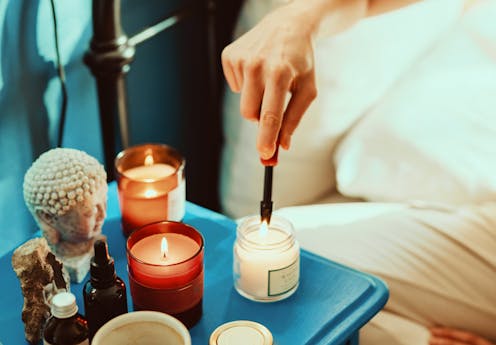
There’s nothing wrong with wanting your home to smell nice and fresh – and from candles to diffusers, there’s no shortage of home scent products to help you achieve that.
But having rampant fragrances in our indoor air can dramatically impact air quality, coming with a host of potential problems.
Indoor air quality is a going concern
People in high- and middle-income countries spend 85-90% of their time indoors. An average person inhales up to 20,000 litres of air daily, and exposure to air pollutants in stagnant air indoors can pose risks to our health and wellbeing, causing symptoms such as eye irritation, respiratory issues and even headaches.
According to the US Environmental Protection Agency (EPA), levels of indoor air pollutants are typically more than three times higher than outdoors.
Sources of indoor pollution can be many: cooking, heating, scented cleaning products, and also the products we use to deodorise our living or working spaces – whether they’re candles, diffusers, room sprays, gels, beads or other products.
The sole purpose of home scents is to make the air smell nice. This means we’re intentionally releasing a mix of chemicals in an indoor environment and potentially lowering the indoor air quality.
Read more: Common products, like perfume, paint and printer ink, are polluting the atmosphere
Meet the VOCs
Air fresheners emit more than 100 different chemicals, including volatile organic compounds (VOCs). These are airborne chemicals that include wide classes of organic compounds: terpenes such as limonene (lemon scent), alpha-pinene (smell of pine trees), and beta-pinene; solvents such as ethanol, formaldehyde, benzene, toluene and xylene, and many other compounds.
These VOCs will react with ozone and other indoor oxidants to generate a range of oxidation products, which are potentially toxic molecules. The level of exposure and concentration determines the potential toxicity.
Fragrances and ozone can also generate pollutants such as formaldehyde, acetaldehyde and free radicals, all classified as toxic or hazardous by agencies such as the EPA.
The type and amount of pollutants created by your home fragrance will depend on many factors, such as the type of product (does it burn or is it a vapour?), its composition (although ingredients aren’t always known), and the indoor air itself.
All air freshener types produce high emissions of volatile organic compounds in some settings. How scents are delivered into the space is reported to be less important for emissions than the composition of the scent in question.
Legally, the chemicals used in air fresheners do not have to be disclosed. Studies have found vast variation in what gets disclosed on the label.
Apart from fragrance compounds, a home scent can also emit solvents such as ethanol and iso-propanol, or dipropylene glycol and tens of others. Odourless solvents are of specific concern as it is difficult for a consumer to predict the impact and to be aware of higher concentrations present in the air.
Notably, manufacturers of scents can use the words “fragrance”, “perfume” and “essential oil” in the list of ingredients without specifying which chemicals are used to form the fragrance.
Typically, it can be tens or hundreds of different chemicals that were not disclosed.
‘Green’ isn’t always better either
Even when the ingredients are listed on the label, it doesn’t mean the product is entirely off the hook.
For example, consumers can be easily misled by labels such as “green”, “organic” or “natural” on their products, also known as greenwashing.
Read more: Greenwashing: can you trust that label?
There is generally a lack of awareness that the scents marketed as green or organic release similar amounts of potentially hazardous materials into the air as other products, as there’s no regulation on what can be labelled “green”.
For example, essential oils are natural aromatic compounds but, once released into the air, can form nanoparticles and pollutants such as formaldehyde, a known carcinogen.
Keeping it fresh
Our ubiquitous exposure to fragranced products, even at low levels, has been associated with various adverse health effects. In a study across the United States, Australia, Sweden and the United Kingdom, 32.2% of people were reported to have a sensitivity to fragrance. In those who are sensitive, fragrances are a risk factor for asthma and headaches.
All this doesn’t mean you must throw your scented candles in the bin. But using them in moderation is highly advisable if you care about the overall quality of your indoor air.
Although there is no safe threshold for exposure to particulate matter (such as soot) and VOCs, burning soy, beeswax or other non-paraffin candles in a moderate way – along with proper ventilation and/or indoor air filtration – should be considered generally safe.
That said, removing air fresheners, fragrances and scented candles will likely improve your indoor air quality overall. It will also make your living space safer for your family, pets and friends.
Some other measures you may consider to make your indoor environment cleaner and healthier are frequently ventilating spaces, using vacuum cleaners with HEPA filters, using air purifiers, surrounding yourself with greenery, and cleaning regularly.
Read more: We can't afford to ignore indoor air quality – our lives depend on it
Authors: Svetlana Stevanovic, Senior Lecturer in Environmental Engineering, Deakin University

















