

a new species of New Zealand gecko hidden in plain sight
- Written by Lachie Scarsbrook, DPhil Student, University of Oxford
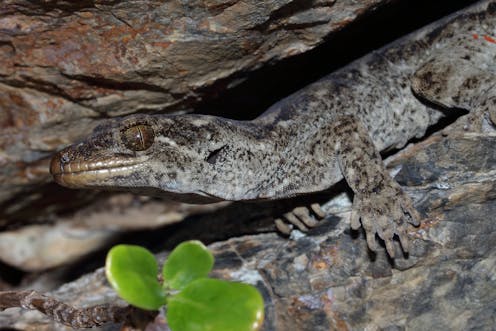
Aotearoa New Zealand is home to an incredible diversity of lizards (mokomoko) – more than 120 species are identified, and counting.
Elusive species are being (re)discovered in cracks and crevices in remote areas, while geneticists are using DNA to untangle hidden diversity in widespread populations.
We’ve known for a long time that Hoplodactylus geckos living on rocky islands in the Cook Strait were a little different from their northern counterparts. They are smaller, have different patterns and possess unique DNA fingerprints – all indicating a new species.
The arrival of rats, coupled with the burning of native forests centuries ago, complicated this taxonomic task by driving geographically intermediate mainland populations to extinction. With those crucial puzzle pieces missing, it was unclear how significant the observed differences between northern and southern populations were.
It wasn’t until we used new methods of analysing ancient DNA on those extinct populations that we realised northern and southern Hoplodactylus geckos were quite different indeed – they had been separated for over five million years. Our new research describes these populations as different species.
Mistaken identity
Before now, all living Hoplodactylus populations were known as Duvaucel’s gecko, named after French naturalist Alfred Duvaucel.
In the early 19th century, Duvaucel travelled through India, where he acquired various plants and animals to ship back to Paris. Among these samples was a jar of pickled geckos of a species that was later named Hoplodactylus duvaucelii in his honour.
Scientists later realised the assumption that Duvaucel’s geckos lived in Bengal, India, was incorrect, as no similar geckos were ever found in Asia. Hoplodactylus geckos are only found in Aotearoa and, at up to 30 cm in length, they are our largest living lizards.
What’s in a name?
Taxonomy is the study of how different lineages relate to one another. Funding and conservation efforts are often dependent on taxonomic recognition. Robust taxonomic work is critical to conservation.
Once published, scientific names can be impossible to change. This is to limit petty and confusing changes. However, this practice can also “lock in” names that honour historical figures who have fallen from social grace, as well as misspellings and names of little significance to the communities where the species lives.
We wanted to ensure our newly identified species of gecko was appropriately named. We approached Te Ātiawa o Te Waka-a-Māui, mana whenua of Ngāwhatu-Kai-ponu (the Brothers Islands) in Cook Strait, home to the largest surviving population of the “new” gecko. They proposed the te reo Māori common name te mokomoko a Tohu (scientific name: Hoplodactylus tohu).
Tohu Kākahi, with whakapapa (genealogical) ties to Te Ātiawa, was a pacifist who was taken prisoner by British forces during the invasion of Parihaka in Taranaki. He was transported to Whakatū (Nelson) and then passed the Brothers Islands while being taken south along the prehistoric range of te mokomoko a Tohu to Ōtepoti (Dunedin). This legacy is now immortalised in the name of this special gecko.
The North Island Hoplodactylus populations retain the name Duvaucel’s gecko following International Code of Zoological Nomenclature (ICZN) rules.
As a globally applied system, scientific naming conventions sometimes conflict with regional perspectives and values: non-Roman characters (such as macrons) cannot be used, for example, and it may seem that long-standing traditional names are being replaced. Formulation of most new scientific names does not include consultation with Indigenous communities. Women, people of colour and Indigenous people remain underrepresented in species names or as authors of new species.
Currently, the legality and ethics of how to select a taxonomic name, who chooses it and what root languages are used are subject to heated debate. As yet, there are no widely supported solutions.
Our naming of te mokomoko a Tohu is just one example of how researchers might approach the naming of new species. Taxonomic and Indigenous names and perspectives constitute different systems, yet those systems are not inherently incompatible. How names are formed and used can be very important, and convey respect to these species and to the communities for whom they are a taonga (treasure).
How to save a species
The few remaining populations in Cook Strait are the last survivers of te mokomoko a Tohu, making them critically endangered. While these islands are currently safe havens, climate change, scrub fires and potential predator incursion pose ongoing risks.
To safeguard their survival, translocation to mainland ecosanctuaries (such as Orokonui Ecosanctuary in Otago) could be used to establish “insurance” populations in regions they once lived. If we don’t act soon, this species may disappear.
Read more: Taxonomy, the science of naming things, is under threat
We cannot hope to stop extinctions if we don’t know what’s out there. This is why taxonomy, which is critically underfunded in Aotearoa, is so important. Our research has merely scratched the surface of understanding the diversity in New Zealand’s lizard fauna.
We desperately need scientific methods to inform evidence-based conservation management so we can be effective kaitiaki (guardians) of taonga species. Who knows what we will discover as we delve into the biological heritage of other species.
Authors: Lachie Scarsbrook, DPhil Student, University of Oxford

















