

Modern Australian
Men's Weekly

.

Astronomers reveal the most detailed radio image yet of the Milky Way's galactic plane

  • Written by Andrew Hopkins, Professor of Astronomy, Macquarie University
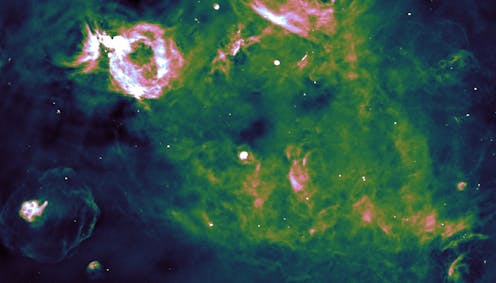
Astronomers reveal the most detailed radio image yet of the Milky Way's galactic plane

Two major astronomy research programs, called EMU and PEGASUS, have joined forces to resolve one of the mysteries of our Milky Way: where are all the supernova remnants?

A supernova remnant is an expanding cloud of gas and dust marking the last phase in the life of a star, after it has exploded as a supernova. But the number of supernova remnants we have detected so far with radio telescopes is too low. Models predict five times as many, so where are the missing ones?

We have combined observations from two of Australia’s world-leading radio telescopes, the ASKAP radio telescope and the Parkes radio telescope, Murriyang, to answer this question.

The gas between the stars

Comparison between the ASKAP/EMU image and the combined ASKAP/EMU plus Parkes/PEGASUS image. Images: R. Kothes (NRC) and E. Carretti (INAF).

The new image reveals thin tendrils and clumpy clouds associated with hydrogen gas filling the space between the stars. We can see sites where new stars are forming, as well as supernova remnants.

In just this small patch, only about 1% of the whole Milky Way, we have discovered more than 20 new possible supernova remnants where only seven were previously known.

These discoveries were led by PhD student Brianna Ball from Canada’s University of Alberta, working with her supervisor, Roland Kothes of the National Research Council of Canada, who prepared the image. These new discoveries suggest we are close to accounting for the missing remnants.

So why can we see them now when we couldn’t before?

The ASKAP radio telescope, showing radio dishes pointed at a blue sky with the sun in the background.
The ASKAP radio telescope at Inyarrimanha Ilgari Bundara, the CSIRO Murchison Radio-astronomy Observatory in Western Australia. CSIRO

The power of joining forces

I lead the Evolutionary Map of the Universe or EMU program, an ambitious project with ASKAP to make the best radio atlas of the Southern Hemisphere.

EMU will measure about 40 million new distant galaxies and supermassive black holes, to help us understand how galaxies have changed over the history of the universe.

Early EMU data have already led to the discovery of odd radio circles (or “ORCs”), and revealed rare oddities like the “Dancing Ghosts”.

For any telescope, the resolution of its images depends on the size of its aperture. Interferometers like ASKAP simulate the aperture of a much larger telescope. With 36 relatively small dishes (each 12m in diameter) but a 6km distance connecting the farthest of these, ASKAP mimics a single telescope with a 6km wide dish.

That gives ASKAP a good resolution, but comes at the expense of missing radio emission on the largest scales. In the comparison above, the ASKAP image alone appears too skeletal.

The Parkes radio telescope, Murriyang, showing the 64 telescope dish.
The Parkes radio telescope, Murriyang. CSIRO

To recover that missing information, we turned to a companion project called PEGASUS, led by Ettore Caretti of Italy’s National Institute of Astrophysics.

PEGASUS uses the 64m diameter Parkes/Murriyang telescope – one of the largest single-dish radio telescopes in the world – to map the sky.

Even with such a large dish, Parkes has rather limited resolution. By combining the information from both Parkes and ASKAP, each fills in the gaps of the other to give us the best fidelity image of this region of our Milky Way galaxy. This combination reveals the radio emission on all scales to help uncover the missing supernova remnants.

Linking the datasets from EMU and PEGASUS will allow us to reveal more hidden gems. In the next few years we will have an unprecedented view of almost the entire Milky Way, about a hundred times larger than this initial image, but with the same level of detail and sensitivity.

We estimate there may be up to 1,500 or more new supernova remnants yet to discover. Solving the puzzle of these missing remnants will open new windows into the history of our Milky Way.

ASKAP and Parkes are owned and operated by CSIRO, Australia’s national science agency, as part of the Australia Telescope National Facility. CSIRO acknowledge the Wajarri Yamatji people as the Traditional Owners and native title holders of Inyarrimanha Ilgari Bundara, the CSIRO Murchison Radio-astronomy Observatory, where ASKAP is located, and the Wiradjuri people as the traditional owners of the Parkes Observatory.

Authors: Andrew Hopkins, Professor of Astronomy, Macquarie University

Read more https://theconversation.com/astronomers-reveal-the-most-detailed-radio-image-yet-of-the-milky-ways-galactic-plane-197905

Pizza Brisbane City: Your Ultimate Guide to Finding the Perfect Slice in the CBD

Brisbane's city centre has evolved into a vibrant culinary destination, and nowhere is this transformation more evident than in its thriving pizza s...

Maximising Your Savings: How to Choose a Competitive Savings Account in Australia

In today's economic climate, Australians are increasingly focused on making their money work harder. With interest rates fluctuating and living cost...

What to Know When Researching a Tummy Tuck on the Gold Coast

Body confidence is something many people seek to improve as they move through different stages of life. Pregnancy, weight fluctuations and ageing ca...

Employer of Record Services & Manpower Outsourcing — The Smart Solution for Seamless Workforce Management

Expanding into Asian markets can feel overwhelming for many Australian businesses, especially when hiring employees in regions like Singapore, Malaysi...

Why Far-Infrared Saunas Are Becoming a Must-Have in Australian Homes; Just What Is a Far-Infrared Sauna?

A far-infrared sauna uses far-infrared (FIR) wavelengths to heat the body directly instead of relying on high cabin temperatures. Unlike traditional...

Tax Accountants Melbourne: Expert Support for Compliance and Financial Efficiency

Taxation is one of the most critical — and often most complex — aspects of financial management. Whether you’re a business owner, property inv...

Pinboard: A Practical and Stylish Solution for Organisation, Display, and Inspiration

In homes, classrooms, and offices across Melbourne, the pinboard has long been a staple for organisation, communication, and creativity. Simple yet ...

Solar Panels Geelong: Powering Homes and Businesses with Clean, Renewable Energy

Across Victoria, and particularly in regional hubs like Geelong, solar energy has become an increasingly popular investment for those looking to red...

Hurstville Tutoring: Helping Students Reach Their Full Academic Potential

In a world where education is becoming increasingly competitive, students often need extra guidance to excel. For families seeking quality academic ...

A First-Time Author’s Guide to Eco-Friendly Book Printing in Melbourne

Congratulations! You’ve done the hard part: you’ve actually finished a manuscript. That alone puts you ahead of countless people who say they’ll...

The Paint Job That Sells Homes: Design That Speaks Value Before You Step Inside

A proper paint job can do much more than simply modernize the color of the walls; it can affect how implicit buyers view a home. In real estate, curb ...

Global Humanitarian Alison Thompson Named 2026 NSW Australian of the Year — Why First Aid Knowledge Matters

Global humanitarian Alison Thompson OAM has been named the 2026 Australian of the Year for New South Wales, recognised for her decades of frontline re...

Modern Roller Shutters and Electric Roller Shutters: Security, Style, and Smart Living

When it comes to home and business security, few solutions offer the same balance of protection, convenience, and style as modern roller shutters. D...

What Is a Plunge Pool? A Complete Guide for Australian Backyards

Plunge pools have become one of Australia’s most sought-after outdoor features, offering a stylish, compact, and refreshing escape for homes of all ...

Gas Ducted Heating: Efficient, Reliable, and Cost-Effective Warmth for Melbourne Homes

Melbourne’s winters are known for their biting cold, and maintaining a comfortable indoor temperature becomes a top priority for homeowners. While...

Common Commercial Leasing Mistakes and How to Avoid Them

Leasing a commercial property is a major commitment that can shape the future of a business. Yet, many tenants and landlords overlook key details th...

Laser Skin Tightening: The Non-Surgical Way to Restore Youthful, Firm Skin

As we age, our skin naturally begins to lose its elasticity and firmness due to reduced collagen and elastin production. For those seeking to restor...

Car Rental Mistakes Most People Make

Car rental appears to be easy, but most travellers unintentionally get stuck in usual pitfalls that incur unnecessary expense and tension. Unseen ch...
















