Sure, the RBA froze interest rates this time, but there's plenty of pain to come
- Written by Peter Martin, Visiting Fellow, Crawford School of Public Policy, Australian National University
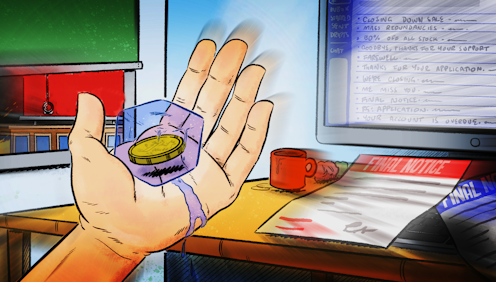
Australia’s Reserve Bank has hit pause on interest rates after ten successive hikes, but for many Australians, the pain it has inflicted is about to begin.
The Bank says more than one million households will come off ultra-low fixed-rate mortgages this year and the next, some of those rates fixed for as low as 1.95%. They will be pushed onto loans as high as 5%, meaning that if they borrowed $600,000, instead of paying $2,500 per month they’ll be paying $3,500.
That’s an extra $1,000 those borrowers will need to find each and every month – an extraordinary $250 they will need to find each week. The Bank says 880,000 fixed-rate mortgages will expire this year and another 450,000 next year.
How much harm will that do to the economy? Quite a lot. The Bank said the full effect of its interest rate increases to date was “yet to be felt”.
Fixed-rate borrowers face trouble
The Bank’s research finds fixed-rate borrowers are more likely to have larger loans relative to their incomes than other borrowers, and more likely to have high loan-to-valuation ratios, in part because they tend to be more recent borrowers.
Its rule of thumb is that borrowers who spend more than 30% of their income on scheduled payments run the risk of having problems paying. At the moment only one in ten fixed-rate borrowers is in such a situation. When those fixed loans expire and they switch to the higher variable rates, it will be one in four of them.
Which is a good reason for taking stock. The Bank may well increase interest rates again. It said it expected to on Tuesday. But it knows a lot of the damage from what it has already done is yet to come.
After its last meeting in March, the board produced a checklist of the things it said it would consider in April in deciding whether to hit pause. On this list were inflation, jobs, retail spending, business conditions and developments overseas.
Inflation easing
On inflation, the board says a range of information suggests the rate has peaked.
The official figures only come out four times a year, and the next ones aren’t due for some weeks. But since the last lot we have had two new readings of the quasi-experimental monthly index, and they have both been down.
On that monthly measure (which excludes 30% of the items in the quarterly measure, among them gas and electricity) inflation fell from 8.4% in the year to December to 7.4% in the year to January, to 6.8% in the year to February.
A further indication that price pressures are moderating is what trade unions asked for in the minimum wage case before the Fair Work Commission. They didn’t ask for the official inflation rate of 7.8%, but for 7%, which suggests they accept the monthly figures and believe inflation is coming down.
On employment (the second item on the Bank’s checklist), the official figures showed a jump in February after declines in December and January, but the Bank says this is more likely to reflect changing seasonal hiring patterns than a genuine surge. Job vacancies have been falling for six months.
Economy weakening
Retail spending (the third item on the checklist) grew just 0.2% in February, much less than price growth of 0.6%, at a time when Australia’s population grew quickly, suggesting what was bought per person went backwards. ANZ card data for the first two weeks of March shows a further weakening.
The Bank says the combination of higher interest rates, cost-of-living pressures and a decline in housing prices is leading to a “substantial slowing in spending”. While some households have savings buffers, others are experiencing a “painful squeeze on their finances”.
Read more: The Lowe road – the RBA treads a 'narrow path'
Business conditions (the fourth item of the checklist) remained healthy in February according to the National Australia Bank survey, although confidence slipped into negative territory (meaning pessimists outweighed optimists).
So weak was Australia’s overall economy on the last reading that gross domestic product (spending and income) grew just 0.5% in the three months to December, by about as much as population, meaning GDP per person didn’t grow.
The Bank says it expects “below trend” growth for the next couple of years.
Overseas headwinds
Overseas developments (the last item on the checklist) have been grim since the last board meeting.
The Bank says the international outlook is “subdued” with below-average growth likely in the years ahead, weighed down by bank crises in the US and Switzerland.
Lowe’s moment of truth
Governor Philip Lowe will address the National Press Club on Wednesday.
It’s likely to be his last chance to explain what he is doing before Treasurer Jim Chalmers releases the report of the independent review of the Bank he received in March.
That report is likely to suggest big changes to the organisation of the bank (such as more experts and fewer business figures on the board) and a more open culture.
But in something of a vindication for Lowe, it is set to find little reason to change either the Bank’s targets (2–3% inflation and full employment) or the single tool it uses to achieve them, which is adjusting the so-called cash rate.
After Chalmers makes changes as a result of the review, The Bank is likely to continue attempting to do what it is attempting to do now, which is using monthly (or perhaps less frequent) reviews of the cash rate to try to get inflation and employment somewhere near where it wants them. It won’t be easy.
Authors: Peter Martin, Visiting Fellow, Crawford School of Public Policy, Australian National University