

the great Aussie invention helping flying possums cross the road
- Written by: Brendan Taylor, Adjunct Research Fellow in the Faculty of Science & Engineering, Southern Cross University
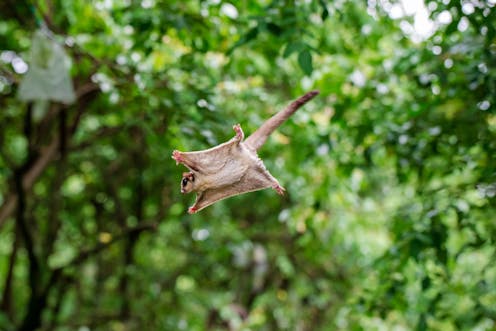
Next time you’re road-tripping along the east coast, keep an eye out for a little-known Aussie invention piercing the skyline: glide poles. For Australia’s gliding possums, or gliders, they’re the next best thing since tall trees.
These tall timber structures, with timber cross arms near the top, give gliders a way to cross big roads. They can shimmy up a pole on one side of the road and then leap to another (and another) to get to the other side.
After witnessing the earliest experiments with glide poles decades ago, it’s heartening to see the design refined and replicated up and down the east coast.
The world’s largest gliding marsupial, the greater glider, was listed nationally as endangered a year ago this month. That’s because their populations had declined by 80% in just 20 years. As land-clearing and bushfires continue to destroy old growth forests with tall trees and hollows, gliders need all the help they can get.
Watch squirrel gliders getting used to their new road crossing device in Forster, New South Wales (2022)Biomimicry with wooden poles
From the match-box sized feathertail glider to the small cat-sized greater glider, Australia’s 11 species each have a gliding membrane, or patagium. This a thin area of skin stretching from the ankles to the wrists or hands.
When a glider leaps from a tree (or glide pole), it extends its front and hind limbs, stretching out its patagium, which allows it to glide.
Read more: Marsupials and other mammals separately evolved flight many times, and we are finally learning how
In 1993 Ross Goldingay, one of Australia’s leading glider ecologists, came up with the idea of using tall wooden power poles (without wires) as road-crossing stepping-stones for gliders. The glide poles would act as substitutes for tall trees, so it was a very simple and elegant form of what’s known as “biomimicry”.
Ross directed the placement of glide poles on either side of a powerline easement at Bomaderry Creek near Nowra in southern New South Wales. The trial aimed to ensure yellow-bellied gliders could still cross the easement if it was developed into a local road.
Unfortunately, the Bomaderry Creek glide poles were never monitored. More than ten years later, a series of successful trials at Mackay and Compton Road in Brisbane demonstrated gliders would readily use glide poles. I recall showing Ross early images of squirrel gliders shimmying up the smooth, hardwood poles on the Compton Road land bridge soon after we installed cameras. We were blown away!
The poles needed to be tall enough to enable a comfortable glide crossing of the intervening gap. This is where trigonometry and the laws of physics come in, to get the calculations right for the species being targeted.
Since then, glide poles have become a fixture of upgrades along the Hume Highway in Victoria, the Pacific Highway in NSW and the Bruce Highway in Queensland.
Do the poles reconnect glider populations?
We are gradually gathering more evidence of glide pole use. Squirrel gliders, sugar gliders and feathertail gliders have been recorded using glide poles to cross roads at several locations.
Mahogany gliders, yellow-bellied gliders and southern greater gliders have also been recorded using glide poles.
Most notably, retrofitting a glider crossing into a road that previously presented a barrier to squirrel glider movement restored gene flow between populations on either side within five years.
Celebrating some of Australia’s most iconic wildlife crossings
Glide poles are one of many structures designed to provide safe road crossing opportunities for wildlife.
Pipes and box culverts can provide safe passage under the road, while land bridges and rope canopy bridges offer an alternative pathway over the road.
When combined with fencing, these structures reduce roadkill, provide access to resources on both sides of the road, and enable gene flow.
My new book combines an exploration of the how, when, where and why wildlife crossings evolved in eastern Australia with a travel guide to 57 of its most iconic sites.
Here’s a great example of a land bridge that’s created a successful wildlife corridor on Gardening Australia.The road ahead
We need to conserve, protect and restore our natural landscapes. This is especially the case in a rapidly changing climate. Our unique native species need to be able to move and adapt to the changing environment.
Carving up the landscape for road networks has been particularly bad for wildlife, with many populations becoming increasingly fragmented and increasingly isolated. But roads no longer need to act as roadblocks for the movement of many native species.
Engineers and ecologists have come together over recent years to find new ways to support the safe passage of animals from one side of the road to another. Their efforts deserve to be celebrated. Especially glide poles. They may not be as famous as the good old Hills Hoist clothesline, but they certainly deserve a gong as a great Australian invention. Certainly worth a nod when you pass by on your next great Aussie road trip.
Authors: Brendan Taylor, Adjunct Research Fellow in the Faculty of Science & Engineering, Southern Cross University


















