

4 reasons echidnas really are remarkable
- Written by Kate Dutton-Regester, Lecturer, Veterinary Science, The University of Queensland
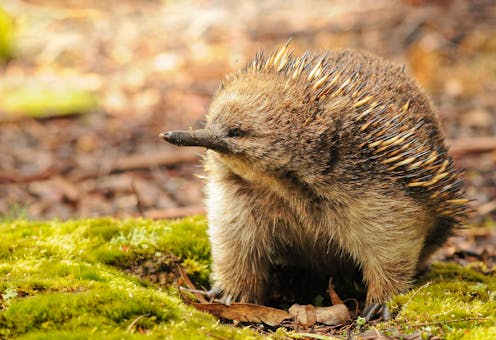
Many of us love seeing an echidna. Their shuffling walk, inquisitive gaze and protective spines are unmistakable, coupled with the coarse hair and stubby beak.
They look like a quirky blend of hedgehog and anteater. But they’re not related to these creatures at all. They’re even more mysterious and unusual than commonly assumed.
Australia has just one species, the short-beaked echidna (Tachyglossus aculeatus), which roams virtually the entire continent. But it has five subspecies, which are often markedly different. Tasmanian echidnas are much hairier and Kangaroo Island echidnas join long mating trains.
Here are four things that make echidnas remarkable.

1: They’re ancient egg-laying mammals
Short-beaked echidnas are one of just five species of monotreme surviving in the world, alongside the platypus and three worm-eating long-beaked echidna species found on the island of New Guinea.
Our familiar short-beaked echidnas can weigh up to six kilograms – but the Western long-beaked echidna can get much larger at up to 16kg.
These ancient mammals lay eggs through their cloacas (monotreme means one opening) and incubate them in a pouch-like skin fold, nurturing their tiny, jellybean-sized young after hatching.
Scientists believe echidnas began as platypuses who left the water and evolved spines. That’s because platypus fossils go back about 60 million years and echidnas only a quarter of that.
Remarkably, the echidna still has rudimentary electroreception. It makes sense the platypus relies on its ability to sense electric fields when it’s hunting at the bottom of dark rivers, given electric fields spread more easily through water. But on land? It’s likely echidnas use this ability to sense ants and termites moving through moist soil.
It probably got its English name in homage to the Greek mythological figure Echidna, who was half-woman, half-snake, and the mother of Cerberus and Sphinx. This was to denote the animal’s mix of half-reptilian, half-mammal traits. First Nations groups knew the echidna by many other names, such as bigibila (Gamilaraay) and yinarlingi (Warlpiri).
Read more: Curious Kids: How does an echidna breathe when digging through solid earth?
2: From deserts to snow, echidnas are remarkably adaptable
There are few other creatures able to tolerate climate ranges as broad. You can find echidnas on northern tropical savannah amid intense humidity, on coastal heaths and forests, in arid deserts and even on snowy mountains.
The five subspecies of short-beaked echidna have distinct geographic regions. The one most of us will be familiar with is Tachyglossus aculeatus aculeatus, widespread across Queensland, New South Wales, South Australia and Victoria. You can think of this as “echidna classic”.
Then there’s Kangaroo Island’s T. aculeatus multiaculeatus, Tasmania’s T. aculeatus setosus, the Northern Territory and Western Australia’s T. aculeatus acanthion and the tropical subspecies T. aculeatus lawesii found in Northern Queensland and Papua New Guinea.
You might think subspecies wouldn’t be too different – otherwise they’d be different species, right? In fact, subspecies can be markedly different, with variations to hairiness and the length and width of spines.
Kangaroo Island echidnas have longer, thinner, and paler spines – and more of them, compared to the mainland species. Tasmanian echidnas are well adapted to the cold, boasting a lushness of extra hair. Sometimes you can’t even see their spines amidst their hair.
3: Mating trains and hibernation games
Remarkably, the subspecies have very different approaches to mating. You might have seen videos of Kangaroo Island mating trains, a spectacle where up to 11 males fervently pursue a single female during the breeding season. Other subspecies do this, but it’s most common on Kangaroo Island. Scientists believe this is due to population density.
Pregnancy usually lasts about three weeks after mating for Kangaroo Island echidnas, followed by a long lactation period of 30 weeks for the baby puggle.
But Tasmanian echidnas behave very differently. During the winter mating season, males seek out hibernating females and wake them up to mate. Intriguingly, females can put their pregnancy on hold and go back into hibernation. They also have a shorter lactation period, of only 21 weeks.
What about the echidna subspecies we’re most familiar with? T. aculeatus aculeatus has a similarly short lactation period (23 weeks), but rarely engages in mating train situations. After watching the pregnancies of 20 of these echidnas, my colleagues and I discovered this subspecies takes just 16–17 days to go from mating to egg laying.
 Echidna puggles are not often seen.
Perth Zoo/AAP
Echidna puggles are not often seen.
Perth Zoo/AAP
4: What do marsupials and monotremes have in common?
Marsupials bear live young when they’re very small and let them complete their development in a pouch. Despite this key difference with monotremes, there’s a fascinating similarity between Australia’s two most famous mammal families.
At 17 days after conception, the embryo of the tammar wallaby (Macropus eugenii) hits almost exactly the same developmental milestone as echidna embryos. Both are in the somite stage, where paired blocks of tissue form along the notochord, the temporary precursor to the spinal cord, and each have around 20 somites.
What’s remarkable about this? Monotremes branched off from other mammals early on, between 160 and 217 million years ago. Marsupials branched off later, at around 143–178 million years ago.
Yet despite millions of years of evolutionary pressure and change, these very different animals still hit a key embryo milestone at the same time. This striking parallel suggests the intricate process has been conserved for over 184 million years.
In echidnas, this milestone is tied to egg-laying – the embryo is packaged up in a leathery egg the size of a grape and laid into the mother’s pouch. The baby puggle hatches 10–11 days later. In tammar wallabies, the embryo continues to develop in-utero for another 9–10 days before being born.
So the next time you spot the humble echidna, take a moment to appreciate what a remarkable creature it is.
Read more: Dig this: a tiny echidna moves 8 trailer-loads of soil a year, helping tackle climate change
Authors: Kate Dutton-Regester, Lecturer, Veterinary Science, The University of Queensland

















