What’s the difference between MSG and table salt? A chemist explains
- Written by Nathan Kilah, Senior Lecturer in Chemistry, University of Tasmania
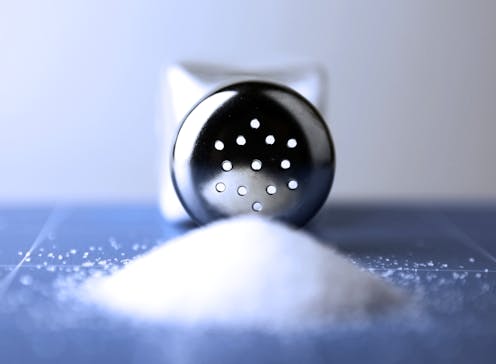
It’s dinner time. You’ve worked hard to prepare a nutritious and tasty meal. But after taking your first bite you feel something is missing. Perhaps you should have added more salt? Pepper? Or maybe even something more exotic like monosodium glutamate, better known as MSG?
There are many food additives used in both home cooking and commercial products. These ingredients improve the flavour, smell, texture, appearance and longevity of foods.
Salt and MSG are two well-known food additives. Both contain sodium, but there are plenty of differences which you can use to your benefit.
What is a salt?
Salts are made of positively and negatively charged components called ions. Salts generally dissolve in water, and are brittle. The names of salts often feature a metal (positively charged) followed by a non-metal (negatively charged).
The common kitchen ingredient we call “salt” is just one type of salt. To distinguish it from all other salts, we should more specifically refer to it as “table salt”. Chemically, it’s sodium chloride.
Sodium chloride
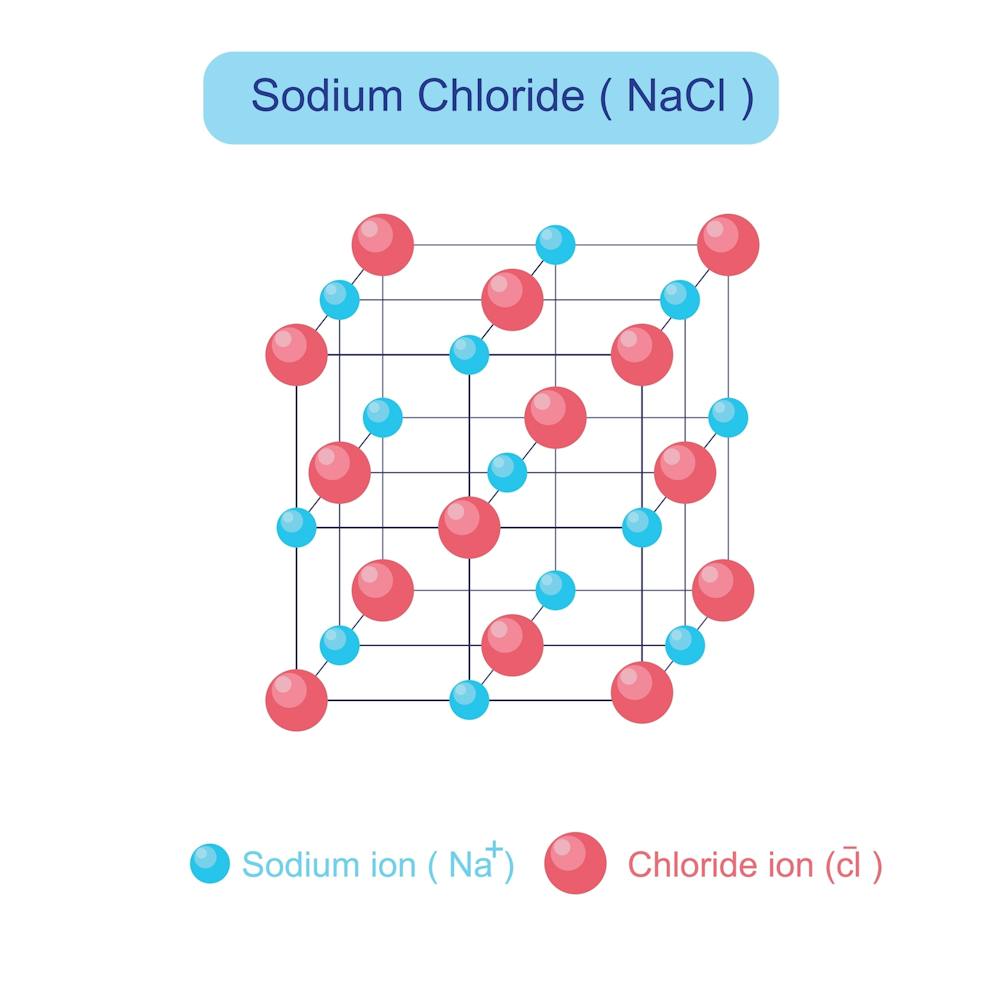
After the quick chemistry lesson above, we can see that table salt, sodium chloride, contains a positively charged sodium and a negatively charged chlorine.
These charged components are arranged in crystals of salt in a regular repeating pattern. Each sodium ion is surrounded by six chloride ions and each chloride ion is surrounded by six sodium ions. This arrangement gives the crystal a “cubic” form. If you look closely at salt, you may see cube-shaped crystals.
Sodium chloride is very abundant. It is found dissolved in Earth’s oceans. Mineral deposits of salt, known as halite or rock salt, formed from the evaporation and crystallisation of ancient seas.
Depending on the source, the salt may contain many other trace minerals that can even add colour to it, such as the pink-coloured Himalayan salt from Pakistan. Salt can also be fortified with sodium iodide as a public health measure.
Describing the taste of salt is quite difficult without using the word “salty”. It’s a very common food additive, as it is so abundant and versatile. It is an essential ingredient for many traditional food preservation techniques for meats (pork and fish), vegetables (kimchi, sauerkraut and pickles), and dairy (cheese and butter).
Salt is considered a universal flavouring agent. It can mask bitter flavours and bring out sweet, sour and umami (savoury) ones.
Despite popular depictions of taste maps, there is no one place on the tongue where we taste salt. Other sodium salts can also give a “salty” taste, but the effect declines (and can even turn to bitter) with negatively charged components other than chloride.
 Pickling traditionally involves a salty brine.
Moleql/Shutterstock
Pickling traditionally involves a salty brine.
Moleql/Shutterstock
MSG or monosodium glutamate
Monosodium glutamate is also a salt. The glutamate is the negatively charged form of glutamic acid, an amino acid that is found in nature as a building block of proteins.
MSG, and more generally glutamates, are found in a wide range of foods including tomatoes, Parmesan cheese, soy sauce, dried seaweeds, Worcestershire sauce and protein-rich foods. All of these foods impart umami flavours, which are described as savoury or meaty.
Commercial MSG is not extracted from the environment but produced by bacterial fermentation. Glucose is converted to glutamic acid, which is further processed by adding sodium hydroxide to form MSG (and water).
MSG is sold as crystals, but they have a long, prismatic shape rather than the cubic form of sodium chloride. It’s worth tasting a few crystals of MSG directly to experience the native taste of umami.
 MSG crystals are elongated in shape, as opposed to the more cubic table salt crystals.
Namning/Shutterstock
MSG crystals are elongated in shape, as opposed to the more cubic table salt crystals.
Namning/Shutterstock
Despite decades of bad press and concern, MSG is considered safe to consume in the concentrations typically found in or added to foods.
Table salt and MSG both contain sodium, but at different percentages of the total weight: table salt has around 40% sodium, versus just 14% in MSG. You are also more likely to be routinely adding table salt to your food rather than MSG.
Eating too much sodium is well known to be unhealthy. Potassium-enriched substitutes have been suggested for a range of health benefits.
A flavour enhancer
The flavour of MSG can be elevated further by combining it with other food additives, known as sodium ribonucleotides.
Japanese and Korean cooks figured this secret out long before chemists, as boiling dried fish and seaweed produces foundation stocks (dashi) containing a mix of naturally sourced glutamates and ribonucleotides.
Ribonucleotides are classified as “generally considered as safe” by food standards authorities. Humans consume many grams of the natural equivalent in their diets.
What can be more problematic are the carbohydrates- and fat-rich foods that have their flavours enhanced, which can potentially lead us to eat excessive calories.
The combination of MSG and ribonucleotides produces a more-ish sensation. Next time you see a bag of potato chips or instant noodles, have a quick look to see if it contains both MSG (E621) and a ribonucleotide source (E627–E635).
I personally keep a jar of MSG in my kitchen. A little goes a long way to elevate a soup, stew or sauce that isn’t quite tasting the way you want it to, but without adding too much extra sodium.
Authors: Nathan Kilah, Senior Lecturer in Chemistry, University of Tasmania