

We need a national renewables approach, or some states – like NSW – will miss out
- Written by Scott Hamilton, Strategic Advisory Panel Member, Australian-German Energy Transition Hub, University of Melbourne
Australia’s primary federal renewable energy target – to have 33 terawatts of renewable energy by 2020 – has essentially been achieved. There is much uncertainty as to what is next.
In the absence of a new national target, the states have been leading the way and driving renewable energy in Australia. Victoria, New South Wales and Queensland between them have invested some A$20 billion into building 11,400 megawatts of generation capacity.
While the states have worked admirably to advance renewable energy – and federal energy policy has long been politically toxic – there is a clear cost to pursuing many fragmented policies instead of a unified vision.
Our research, modelling the effect of state versus national renewable energy targets in the National Energy Market system found there was little difference in the overall cost, but that states without strong renewable targets tended to miss out on investment.
We need national thinking
Most jurisdictions have net zero emissions targets by 2050. States also have ambitious but achievable shorter-term renewable energy targets and programs.
There are plenty of arguments for states pursuing their own renewable energy targets, not least because they can fill the policy vacuum left at the national level.
States are responding to the immediate need to replace retiring power stations and can explore innovation with greater ambition. It makes perfect sense for states to compete to attract jobs and investment.
But Australia’s federal government has a domestic and international obligation to reduce greenhouse gas emissions from fossil fuels. National policies are more efficient, can harness better resources across our diverse geography and maximise returns for the whole system.
What’s more – as many column inches have pointed out – strong federal policy improves investment certainty and reliability, lowering the cost of inevitable infrastructure upgrades. And those upgrades can be better integrated into our existing national electricity system if the building (and money) doesn’t stop at internal borders.
To provide some insight and help move the debate forward, the University of Melbourne, Monash University and the Australian-German Energy Transition Hub have collaborated on research that was presented at an international conference in Denmark earlier this year.
Quantifying the difference
We simulated two scenarios: first, that all states implement polices to achieve their respective renewable energy and net zero emissions targets by 2050.
The second scenario assumed a national target would be used to result in the “same outcome” of 100% renewable energy by 2050.
The model calculates required energy investments with 5-year increments from today to 2050, including considering the existing generation currently operating. The model simultaneously optimises the mix of generation, transmission and storage to minimise the total system cost from 2020 to 2050.
A key difference in results is where and when new generation is built. Under the state-driven approach, unsurprisingly, investment shifts towards states with more ambitious targets.
The two figures below show how state-based targets drive more investment into Queensland than would be the case under a national target scheme.
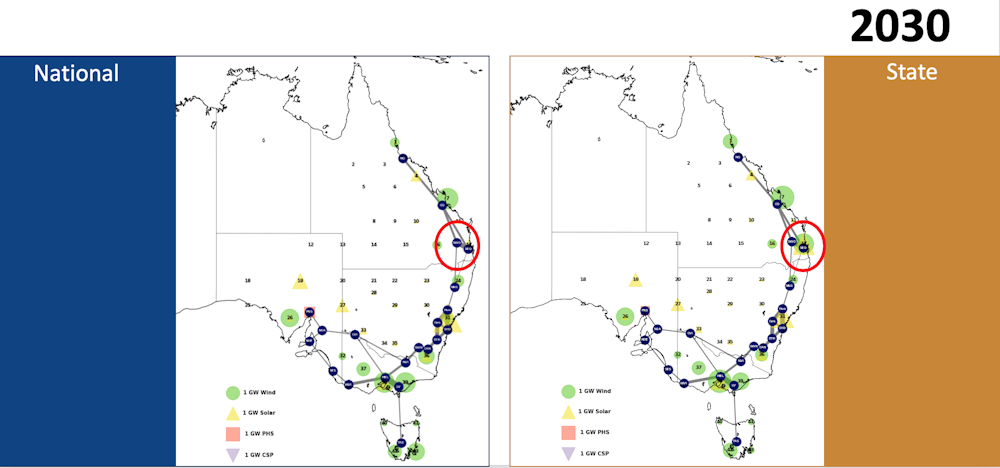 Spatial distribution of renewable generation
Broadly speaking, under a national target, we see more efficient use of renewable energy and associated resources. NSW – with net zero 2050 target but no interim renewable energy target – would get a greater share of the renewable energy investment.
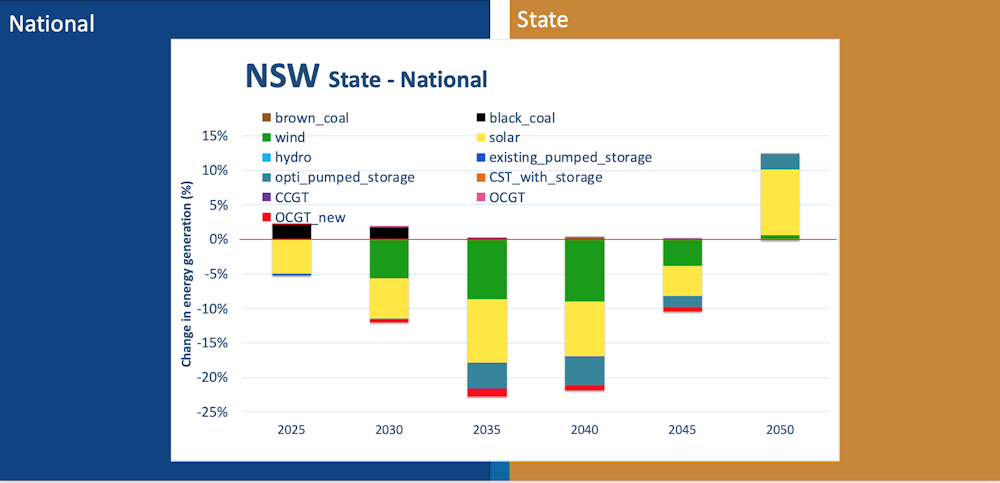 Change in energy generation %
NSW would consistently see substantially more investment under a national target scheme. This would be around 20% more generation in the 2030s in NSW, and up to 20 terawatt-hours more energy generated in the years 2030 to 2045.
The rollout of “where and when” to build new renewable and other generation to replace ageing fossil fuel power plants also impacts heavily on the sequencing and timing for major transmission upgrades across the NEM – especially interconnectors between states.
 Transmission networks modelled.
The graph shows that under a state target based approach we build more transmission infrastructure earlier than under a national approach. Under a national target approach, we would end up building more transmission infrastructure – albeit later.
Again, broadly speaking, we would build more generation at renewable energy resource-rich areas such as NSW which happen to be near major demand centres like cities. This would delay the need for some infrastructure spend.
What about system reliability and energy costs?
The good news is it appears under either a state-based or a national target approach the outcome in 2050 is similar. The difference in total system costs is only about 1% higher in the state-based targets scenario – so, virtually nothing.
 Evolution of electricity generation – total system.
State-based renewable energy targets lead to redistribution of renewable investments in favour of the states with a mid-term renewable energy target.
In the Australian context, the current state-based renewable energy targets have no impact on undermining power system reliability and virtually negligible impact on pushing up power prices.
Perhaps NSW should take particular note – as it would appear that it would benefit greatly from either a national target approach or an interim state target for itself.
The debate about state versus national approaches to energy policy has been going for the past 30 years and no doubt will be around for another 30. In the meantime, we need a stronger hand on the transition tiller or we will waste precious resources and time, and likely have major unintended consequences.
Read more: Making Australia a renewable energy exporting superpower
Authors: Scott Hamilton, Strategic Advisory Panel Member, Australian-German Energy Transition Hub, University of Melbourne

















