

Australian teens do close to the least physical activity in the world
- Written by Brendon Hyndman, Senior Lecturer in Personal Development, Health & Physical Education / Course Director of Postgraduate Studies in Education, Charles Sturt University
In a study published in The Lancet today, we find out how 1.6 million adolescent school students from across 146 countries are faring in terms of the World Health Organisation’s (WHO) physical activity recommendations.
The answer: pretty dismally. And Australia is among the worst, ranked 140 out of the 146 countries studied.
The WHO guidelines for this age group recommend a minimum of one hour of moderate to vigorous physical activity each day. That’s a jogging-like intensity that gets you sweating and puffing.
Read more: How much physical activity should teenagers do, and how can they get enough?
This benchmark has been set based on what we know about the benefits of regular movement for good physical health (fitness, strong muscles and bones) and preventing disease (such as type 2 diabetes, cancer, and heart disease). Not getting enough physical activity is one of the leading causes of death worldwide.
So if young Australians are losing out on these benefits, it’s concerning. While it’s a huge problem to tackle, we can take important steps at school and at home.
The study
The researchers analysed data from students aged 11 to 17 provided in surveys. Although movement devices (such as accelerometers and pedometers) are generally the most accurate way to measure physical activity, surveys can reach large populations and provide valuable insights on a national and even global scale.
The study provided figures for two time points – 2001 and 2016. In 2016, an average of just one in five adolescents across the 146 countries met the recommended physical activity levels. More boys meet these guidelines than girls.
Australia came in seventh from the bottom when it came to the proportion of adolescents not getting enough physical activity. This placed Australia ahead of only Cambodia, Philippines, South Korea, Sudan, Timor-Leste and Zambia.
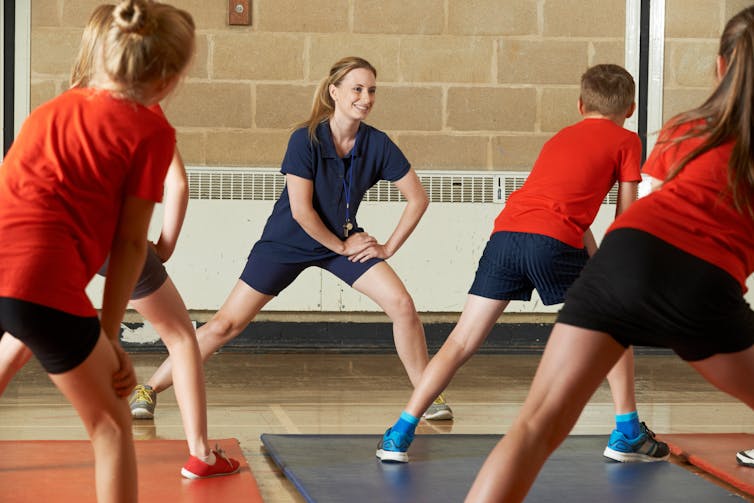 Kids’ physical activity levels tend to decline when they move from primary school to high school.
From shutterstock.com
Kids’ physical activity levels tend to decline when they move from primary school to high school.
From shutterstock.com
These findings align with recent national report cards that graded Australian adolescents’ physical activity as a lowly “D-”.
The researchers predicted just over one in ten Australian adolescents were meeting global physical activity recommendations in 2001 (87% were not) and in 2016 (89% were not). So if anything, things are getting worse.
Read more: How physical activity in Australian schools can help prevent depression in young people
Why is this age group doing so poorly?
Research continues to show a child’s physical activity participation has often peaked in primary school, before they transition into secondary school.
In high school, there tend to be less areas conducive to outdoor physical activities, like playgrounds. High school students are often exposed to more spaces for sitting and socialising, and research shows they can start to develop negative attitudes towards physical education.
Sedentary behaviour also increases during secondary schooling, with a higher proportion of students using electronic devices for longer than the recommended two hours per day for recreation and entertainment.
Read more: Teenagers who play sport after school are only 7 minutes more active per day than those who don't
By secondary school, teenagers have had seven years of primary schooling to develop fundamental movement skills, so will require more advanced movement opportunities to test themselves. This can be difficult if schools don’t prioritise facilities to encourage physical activity.
The blocks of recess time for physical activity can be less in secondary school, with guidance for 30 minute periods, compared with an hour for primary. This can vary according to the priorities of each school, particularly when recess time is competing with lessons, time to eat, and other activities.
Health and physical education requires improved status, resources and time allocation across the board.
How can we improve things?
The WHO is aiming to increase the number of young people meeting physical activity guidelines by 15% in 2030. So we need to consider how we can make some positive changes.
A new national physical literacy framework and campaign is a good start.
According to Sport Australia, physical literacy is about more than playing sport – it’s about holistic development.Here are some other things we should be focusing on:
we need to place more value on recess periods by ensuring there is at least one hour of mandatory recess time scheduled each day for teenagers to be as active as possible. We also need to prioritise quality and accessible facilities for students to test themselves physically (for example, climbing and fitness facilities)
families should dedicate one hour after school each day to turning off electronic devices with the goal of moving more
school teachers should work to identify teenagers’ physical activity interests, levels and needs as they enter secondary school, looking to provide more physical challenges. If facilities are not available, they should plan for and include relevant excursions
schools should encourage more opportunities for safe active transport (travelling to and from school by walking or cycling), organised sport and recreation, student-centred PE classes (promoting choice for more enjoyable activities), and activity opportunities before and after school
during unavoidable and prolonged periods of using digital devices (like during classroom lessons), teachers should provide short bursts of movement tasks for even one minute, such as moving to music
school staff and training teachers should receive professional development for learning about, accommodating and encouraging physical activities within the context of secondary schools (especially beyond scheduled classes)
schools should be engaged with stakeholders such as families and community leaders in a collective effort to improve and model the value of physical activity opportunities in secondary schools.
Read more: Adapting to secondary school: why the physical environment is important too
Leaders from across sectors need to prioritise the development of physical activity strategies and resources for secondary schools. This is not a new concept, but the findings of this research make it impossible to ignore. Trialled programs or policies that encourage physical activity in secondary schools should now be brought in on a larger scale.
Authors: Brendon Hyndman, Senior Lecturer in Personal Development, Health & Physical Education / Course Director of Postgraduate Studies in Education, Charles Sturt University

















