

Modern Australian
Men's Weekly

.

Red flowers have a ‘magic trait’ to attract birds and keep bees away

  • Written by Adrian Dyer, Associate Professor, Department of Physiology, Monash University

For flowering plants, reproduction is a question of the birds and the bees. Attracting the right pollinator can be a matter of survival – and new research shows how flowers do it is more intriguing than anyone realised, and might even involve a little bit of magic.

In our new paper, published in Current Biology, we discuss how a single “magic” trait of some flowering plants simultaneously camouflages them from bees and makes them stand out brightly to birds.

How animals see

We humans typically have three types of light receptors in our eyes, which enable our rich sense of colours.

These are cells sensitive to blue, green or red light. From the input from these cells, the brain generates many colours including yellow via what is called colour opponent processing.

The way colour opponent processing works is that different sensed colours are processed by the brain in opposition. For example, we see some signals as red and some as green – but never a colour in between.

Many other animals also see colour and show evidence of also using opponent processing.

Bees see their world using cells that sense ultraviolet, blue and green light, while birds have a fourth type sensitive to red light as well.

Red flowers have a ‘magic trait’ to attract birds and keep bees away
Our colour perception illustrated with the spectral bar is different to bees that are sensitive to UV, blue and green, or birds with four colour photoreceptors including red sensitivity. Adrian Dyer & Klaus Lunau, CC BY

The problem flowering plants face

So what do these differences in colour vision have to do with plants, genetics and magic?

Flowers need to attract pollinators of the right size, so their pollen ends up on the correct part of an animal’s body so it’s efficiently flown to another flower to enable pollination.

Accordingly, birds tend to visit larger flowers. These flowers in turn need to provide large volumes of nectar for the hungry foragers.

But when large amounts of sweet-tasting nectar are on offer, there’s a risk bees will come along to feast on it – and in the process, collect valuable pollen. And this is a problem because bees are not the right size to efficiently transfer pollen between larger flowers.

Flowers “signal” to pollinators with bright colours and patterns – but these plants need a signal that will attract birds without drawing the attention of bees.

We know bee pollination and flower signalling evolved before bird pollination. So how could plants efficiently make the change to being pollinated by birds, which enables the transfer of pollen over long distances?

Avoiding bees or attracting birds?

A walk through nature lets us see with our own eyes that most red flowers are visited by birds, rather than bees. So bird-pollinated flowers have successfully made the transition. Two different theories have been developed that may explain what we observe.

One theory is the bee avoidance hypotheses where bird pollinated flowers just use a colour that is hard for bees to see.

A second theory is that birds might prefer red.

But neither of these theories seemed complete, as inexperienced birds don’t demonstrate a preference for a stronger red hue. However, bird-pollinated flowers do have a very distinct red hue, which suggests avoiding bees can’t solely explain why consistently salient red flower colours evolved.
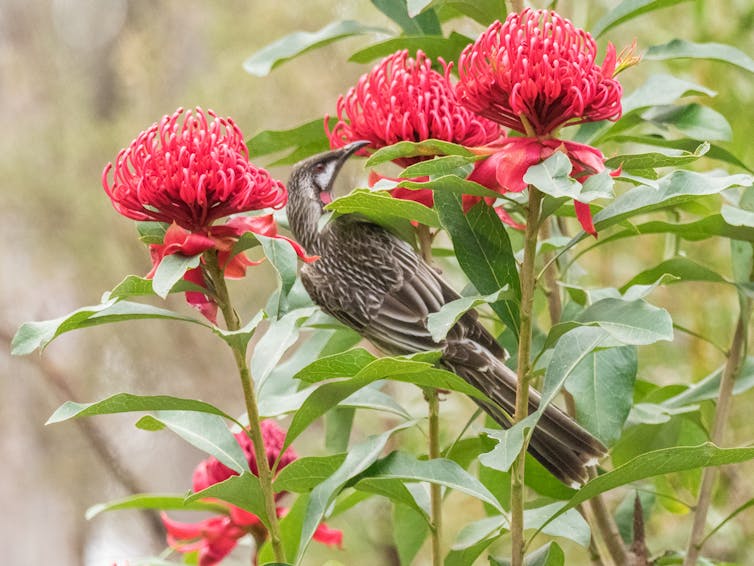
A bird eating nectar from red flowers.
Most red flowers are visited by birds, rather than bees. Jim Moore/iNaturalist, CC BY

A magical solution

In evolutionary science, the term magic trait refers to an evolved solution where one genetic modification may yield fitness benefits in multiple ways.

Earlier this month, a team working on how this might apply to flowering plants showed that a gene that modulates UV-absorbing pigments in flower petals can indeed have multiple benefits. This is because of how bees and birds view colour signals differently.

Bee-pollinated flowers come in a diverse range of colours. Bees even pollinate some plants with red flowers. But these flowers tend to also reflect a lot of UV, which helps bees find them.

The magic gene has the effect of reducing the amount of UV light reflected from the petal, making flowers harder for bees to see. But (and this is where the magic comes in) reducing UV reflection from a petal of a red flower simultaneously makes it look redder for animals – such as birds – which are believed to have a colour opponent system.

Red flowers have a ‘magic trait’ to attract birds and keep bees away
Red flowers look similar for humans, but as flowers evolved for bird vision a genetic change down-regulates UV reflection, making flowers more colourful for birds and less visible to bees. Adrian Dyer & Klaus Lunau, CC BY

Birds that visit these bright red flowers gain rewards – and with experience, they learn to go repeatedly to the red flowers.

One small gene change for colour signalling in the UV yields multiple beneficial outcomes by avoiding bees and displaying enhanced colours to entice multiple visits from birds.

We lucky humans are fortunate that our red perception can also see the result of this clever little trick of nature to produce beautiful red flower colours. So on your next walk on a nice day, take a minute to view one of nature’s great experiments on finding a clever solution to a complex problem.

Authors: Adrian Dyer, Associate Professor, Department of Physiology, Monash University

Read more https://theconversation.com/red-flowers-have-a-magic-trait-to-attract-birds-and-keep-bees-away-274033

How Professional Cleaning Improves Indoor Air Quality

Indoor air quality (IAQ) plays a crucial role in our health, comfort, and overall wellbeing. Australians spend nearly 90% of their time indoors-at hom...

Solar and Solar Battery Systems: Powering Smarter Homes in Victoria

As energy prices continue to rise and sustainability becomes a priority for Australian homeowners, more families are investing in Solar and Solar Ba...

Plumbing Emergency Melbourne: What to Do When Every Minute Counts

A sudden plumbing issue can quickly turn into a major disaster if not handled promptly. From burst pipes and overflowing toilets to leaking gas line...

Why Older Melbourne Homes Require Detailed Building & Pest Inspections

Older homes make up a large part of Melbourne’s housing stock. Victorian terraces, Edwardian houses, Californian bungalows, and post-war brick hom...

7 Essential Tips for Choosing Reliable Moving Services in Perth

Moving to a new home or office can be exciting, but it also comes with stress, planning, and plenty of decisions. One of the most important choices yo...

How to Find the Best Real Estate Agent Near You on the Central Coast

Choosing the right real estate agent can make a major difference to your final sale price, days on market, and overall experience. The Central Coast...

Unlock Durability And Beauty With Burnt Timber Cladding Solutions

Imagine a home or commercial space that not only stands the test of time but also tells a story through its very facade. In the world of architectur...

Offroad Caravans: Built for Adventure Beyond the Beaten Track

Australia’s vast and varied landscapes invite travellers to explore far beyond sealed roads and crowded parks. Offroad caravans are purpose-built ...

The Expert's Guide to Understanding Large Bore Steel Pipe Specifications

When it comes to infrastructure, construction, and various industrial applications, the choice of materials is paramount. Among the options availabl...

Preparing for Your First Trip to San Francisco in 2026

San Francisco has long occupied a particular place in the Australian imagination. It is compact yet complex, progressive but historic, and visually st...

Modern Office Painting in Australia - It's the Real Game Changer

Walk into any modern Australian office today and you'll be struck by the fact it's a whole different beast from the ones we grew up with. Gone are t...

How to Choose the Right Suburb for Your Lifestyle

Choosing the right suburb is one of the most important decisions you’ll make when buying or renting a home. Beyond the property itself, the suburb...

Considering Cryolipolysis Fat Freezing? Here’s What You Need to Know

Body confidence can shift over time, and sometimes even good diet and training can still leave a stubborn area of fat that won’t budge. If you’r...

From Local Tradie to Digital Leader: The Strategy Behind Auto Gate Guys Sydney’s Growth

For many small trade businesses, digital marketing still feels like a buzzword, not a necessity. They rely on word-of-mouth referrals, repeat clients...

Electric Automation System: Smarter Control for Modern Electrical Infrastructure

Modern buildings and industrial facilities are increasingly dependent on intelligent control and efficiency. An electric automation system brings t...

The Damp Truth: Why Your Overflowing Gutters Are an Open Invitation for Termites

When it comes to protecting your home, most people think about visible threats — storm damage, cracked tiles, break-ins. But one of the most destruc...

Is Your Inventory a Sitting Duck? 2 Critical Upgrades to Protect Your Business Assets and Your Bottom Line

Imagine this: you finish a long day on the job, lock up your tools, materials, and work vehicle in the garage, and head home. But overnight, someone b...

Electrician in Melbourne: Reliable Electrical Solutions for Homes and Businesses

Finding a dependable electrician Melbourne is essential when safety, efficiency, and long-term performance matter. Electrical systems form the back...
















