

Do trees prevent landslides? What science says about roots, rainfall and stability
- Written by Martin Brook, Professor of Applied Geology, University of Auckland, Waipapa Taumata Rau
In the days since last week’s fatal landslides at Mount Maunganui, there has been widespread discussion about what may have caused the slopes above the campground to fail, including the possible role of recent tree removal on Mauao.
In the aftermath of such tragedy, it is natural to search for clear explanations. But landslides typically reflect a complex combination of factors – from geology and long-term slope evolution to weather, climate and land use.
A landscape prone to failure
The Tauranga region is underlain by volcanic materials that are well known for their instability. Over time, volcanic rock weathers into clay-rich soils, including a problematic mineral known as halloysite.
During heavy rainfall, water infiltrates these clay-rich soils, increasing porewater pressure between soil particles. This reduces the soil’s shear strength, making slopes more prone to failure.
Similar processes have driven devastating landslides elsewhere: dozens of people were killed in rainfall-triggered landslides in Indonesia’s West Java region just days ago, on comparable volcanic clay soils.
Recognising this risk, Tauranga City Council commissioned landslide susceptibility mapping following the extreme weather events of 2023. These datasets allow the public to view landslide-prone areas and “relic slips” – ancient landslides that still leave visible imprints on the landscape.
Importantly, they indicate where land has failed in the past – and remains potentially vulnerable during intense rainfall or after land-use changes.
While most of the Tauranga district is comprehensively covered by these mapping tools, there is one notable omission: the area west of Adam’s Avenue, where Mauao and the campground are located. Landslide hazard layers for this zone are absent from public web portals, despite Mauao being particularly landslide-prone.
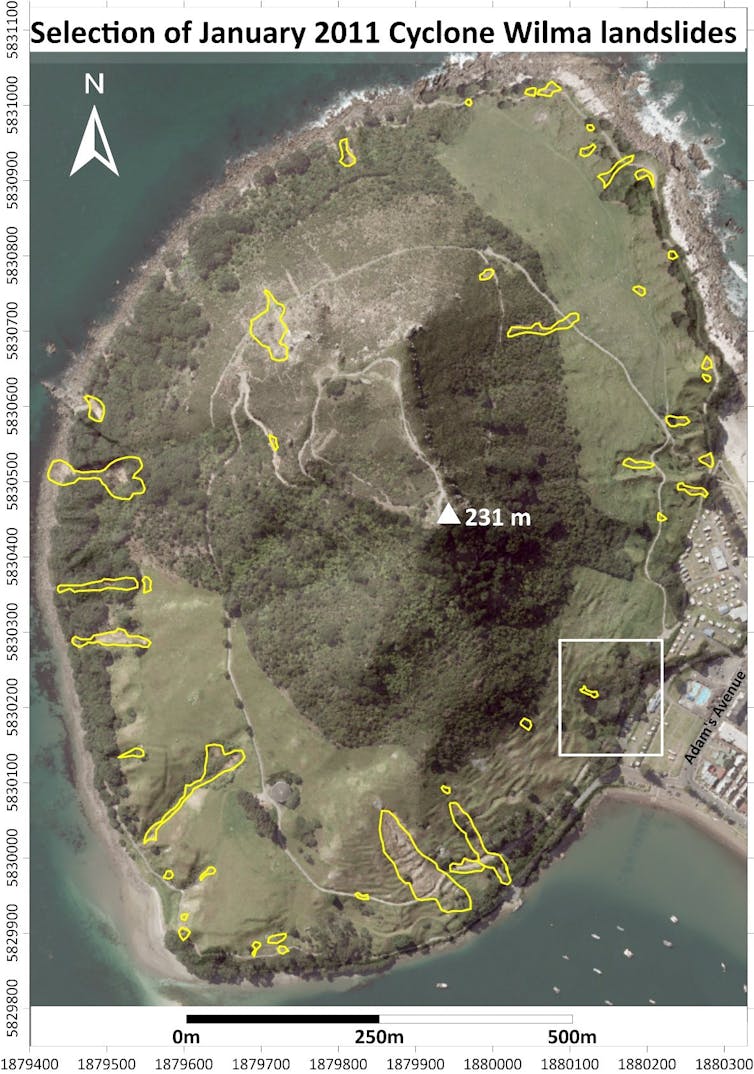
Historical aerial imagery dating back to 1943 reveals dozens of landslides on Mauao’s slopes. Some of the most significant occurred during Cyclone Wilma in January 2011, when 108mm of rain fell in 24 hours.
A detailed University of Auckland study identified at least 80 landslides from that single storm, including debris avalanches extending up to 120 metres downslope. Some of these failures have partially reactivated since, following later heavy rainfall.
Trees, slopes and stability
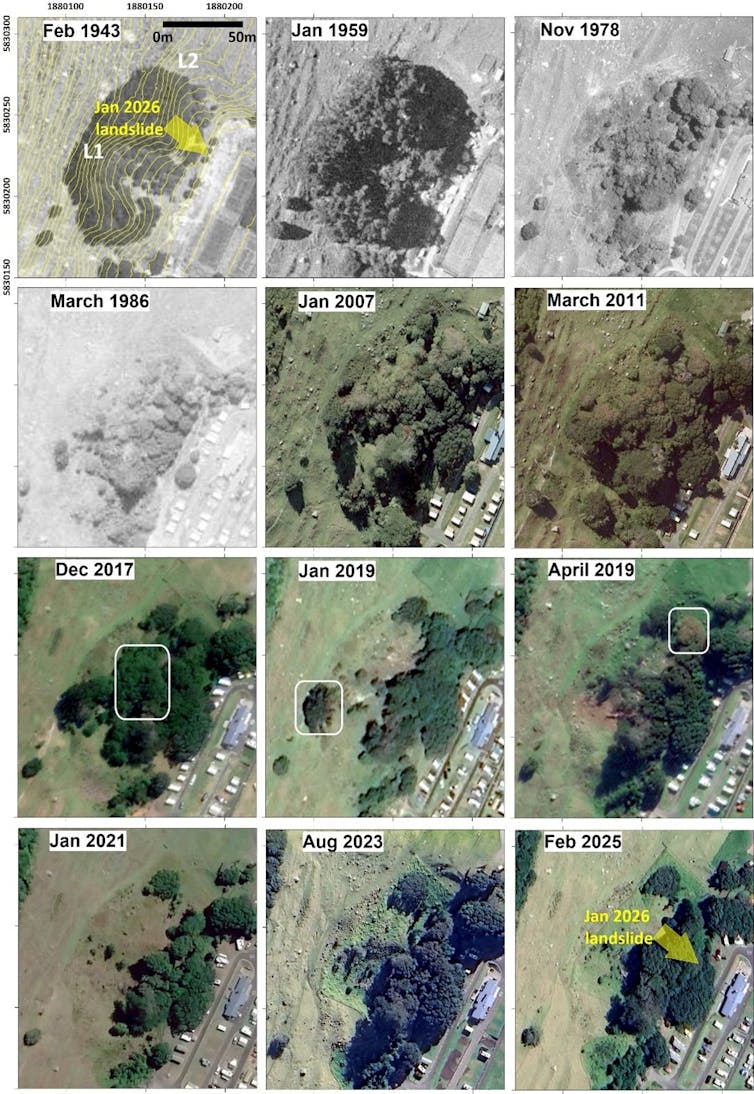
In addition to these historic events, older “paleo-landslides” exist on Mauao, including two on slopes above the campground. It was from this general zone that the January 22 landslide appears to have initiated – and much online discussion has also centred on tree removal within it.
Some media reports have pointed to vegetation clearance during 2022–23, but historical imagery suggests removal in this specific area likely occurred earlier, around 2018–19. More broadly, vegetation cover above the campground has declined gradually since the mid-20th century.
However, the relationship between vegetation and landsliding on Mauao is not straightforward. During Cyclone Wilma, major landslides occurred across both densely vegetated slopes and grass-covered areas.
Trees typically enhance slope stability in two main ways: their canopy intercepts rainfall, slowing water infiltration, and their roots reinforce soil strength. This is why widespread landsliding associated with forestry harvesting – particularly radiata pine – has long been a serious problem in parts of New Zealand.
But trees can also contribute to slope failure under certain conditions. Large leafy trees can act like sails during extreme winds, transmitting powerful forces into saturated soils.
After the 2023 Auckland Anniversary storm, research showed wind loading likely initiated some landslides on the slopes of Maungakiekie/One Tree Hill, as trees were rocked back and forth until they uprooted, dragging soil downslope.
As well, when trees grow near the tops of steep slopes, their weight – known as “surcharge” – can increase destabilising forces. In some clay soils, this effect may exceed the stabilising benefit of root reinforcement. Tree roots can also promote long-term weathering by growing into fractures in underlying rock.
All of this means vegetation is only one factor among many.
Why simple explanations fall short
Landslides in New Zealand’s hilly terrain typically result from a combination of preconditioning factors, many of which are influenced by human activity.
These can include reshaping slopes to create building platforms, cutting into slope toes for roads or structures, loading slopes with buildings, redirecting stormwater onto vulnerable terrain, and constructing poorly designed retaining walls that trap water within slopes.
While some trees were certainly removed from the broader source area of last week’s landslide, their role in destabilising the slope remains uncertain.
The slope had already experienced multiple historical failures, was underlain by volcanic clays and was subjected to intense rainfall – conditions that together are well known to trigger landsliding.
There is still much we do not yet know about the precise mechanisms that caused last week’s failures on Mauao. That is precisely why independent investigations and technical reviews are so important.
Authors: Martin Brook, Professor of Applied Geology, University of Auckland, Waipapa Taumata Rau

















