Modern Australian
Men's Weekly

.

Natural hydrogen can make decarbonising industry cheaper – NZ’s turbulent geology could give it an edge

  • Written by Ian Wright, Professor in Marine Geology, University of Canterbury

Hydrogen is emerging as a critical part of the low-carbon transition for industries where electrification is not a straightforward solution.

This includes the production of steel, fertiliser and methanol as well as long-haul transport. In New Zealand, these industries account for about 17% of total emissions.

Hydrogen could replace these emissions but this would require annual production of 600,000 to one million tonnes. The cost of producing low-carbon hydrogen is a critical factor.

Currently, “green” hydrogen – made by splitting water with renewable electricity – costs more than NZ$12 per kilogram.

Long-haul transport companies have already invested in green hydrogen, but it remains too expensive for heavy industry or large-scale chemical production. For these industries, the tipping point for economic viability is closer to $4–5 per kilogram.

But New Zealand could be uniquely placed to explore a potentially cheaper option – “natural” or geological hydrogen which the Earth produces and, in some cases, traps in underground reservoirs.

Around the world, researchers and companies are already turning their attention to natural hydrogen.

Near-pure hydrogen has been extracted at a single gas field in Mali, attracting interest from governments in the United States, Canada and Australia.

There is also interest from major international resource companies. By the end of 2023, 40 companies were exploring natural hydrogen globally.

One key process in the accumulation of natural hydrogen is “serpentinisation” – a reaction between water and iron-rich ultramafic rocks. When water alters these minerals, it converts ferrous iron to ferric iron, releasing hydrogen in the process.

The richer the rock is in iron, the more hydrogen is produced. Under the right conditions, these rocks can generate hydrogen at potentially economic scales.

Laboratory-based research shows that at the right temperature and pressure conditions, up to 0.6 kilograms of hydrogen can be released from a cubic metre of ultramafic rock (if it contains the right iron-rich minerals).

New Zealand’s turbulent geological history provides an unusual advantage.

The landscape has been shaped by major episodes of tectonic collision. Rapid and complex uplift of mountain ranges, active plate subduction and regular ruptures of faults that penetrate through the crust create exactly the kinds of geological settings where natural hydrogen can potentially form and accumulate.

Four promising geological situations stand out.
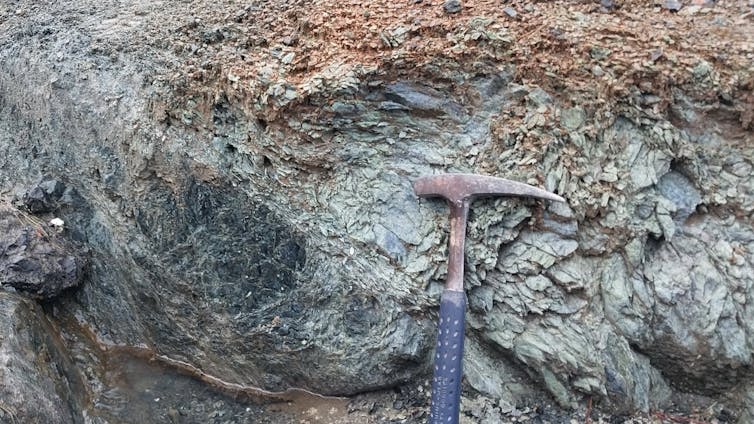
Exposed ultramafic rocks within the West Dome quarry.
Ultramafic rocks, such as this exposed within the West Dome quarry in the South Island, can be a source of hydrogen. Paul Viskovic, CC BY-NC-ND

1. Belts of ancient ultramafic rock have been pushed up from deep in the Earth’s crust on both islands. In the North Island, many of these rocks lie beneath major industrial centres, raising the possibility of local “on-demand” hydrogen production close to where it would be used.

2. High-temperature geothermal systems drive powerful circulations of groundwater, enabling the generation and transport of hydrogen from magma.

3. Off the east coast of the North Island, the Pacific plate is being forced under New Zealand in a region known as the Hikurangi subduction zone. As it sinks, chemical reactions including serpentinisation produce methane and hydrogen.

Observed phenomena of this process include the presence of methane hydrates and seeps as well as plume emissions, mud volcanoes, hot springs and localised seeps of hydrogen.

Natural hydrogen can make decarbonising industry cheaper – NZ’s turbulent geology could give it an edge
Hyper-saline seep and mud volcano at Glenburn along the Hikurangi subduction margin. Paul Viskovic, CC BY-NC-ND

4. Major faults in the South Island, including the Alpine Fault, act as deep conduits, allowing water to interact with ultramafic rocks.

In Fiordland, a remarkable site has vented gas that is 76% hydrogen for at least 40 years. This is one of the more notable seeps of natural hydrogen known worldwide.

These factors make New Zealand unusually well suited to natural hydrogen exploration. The country’s active geology, often thought of as a hazard, could also be a critical resource.

Researchers and industry are beginning to investigate whether these sources could provide hydrogen at $4–5 per kilogram or less. If natural hydrogen proves viable, New Zealand’s unique geology could put the country at the forefront of a new global energy frontier.

The authors acknowledge contributions by University of Canterbury colleagues David Dempsey, Jannik Haas, Rebecca Peer and Matt Watson.

Authors: Ian Wright, Professor in Marine Geology, University of Canterbury

Read more https://theconversation.com/natural-hydrogen-can-make-decarbonising-industry-cheaper-nzs-turbulent-geology-could-give-it-an-edge-273210

How a Burleigh Heads Plumber Tests for Pipe Leaks

Pipe leaks can be deceptively difficult to spot. Some announce themselves with a steady drip under the sink, but many develop quietly behind walls, ...

What Local Businesses Should Expect from IT Services in Melbourne?

If you run a Melbourne business with roughly 7–100 staff, you have probably noticed something over the last couple of years. The IT problems got m...

How Professional Cleaning Improves Indoor Air Quality

Indoor air quality (IAQ) plays a crucial role in our health, comfort, and overall wellbeing. Australians spend nearly 90% of their time indoors-at hom...

Solar and Solar Battery Systems: Powering Smarter Homes in Victoria

As energy prices continue to rise and sustainability becomes a priority for Australian homeowners, more families are investing in Solar and Solar Ba...

Plumbing Emergency Melbourne: What to Do When Every Minute Counts

A sudden plumbing issue can quickly turn into a major disaster if not handled promptly. From burst pipes and overflowing toilets to leaking gas line...

Why Older Melbourne Homes Require Detailed Building & Pest Inspections

Older homes make up a large part of Melbourne’s housing stock. Victorian terraces, Edwardian houses, Californian bungalows, and post-war brick hom...

7 Essential Tips for Choosing Reliable Moving Services in Perth

Moving to a new home or office can be exciting, but it also comes with stress, planning, and plenty of decisions. One of the most important choices yo...

How to Find the Best Real Estate Agent Near You on the Central Coast

Choosing the right real estate agent can make a major difference to your final sale price, days on market, and overall experience. The Central Coast...

Unlock Durability And Beauty With Burnt Timber Cladding Solutions

Imagine a home or commercial space that not only stands the test of time but also tells a story through its very facade. In the world of architectur...

Offroad Caravans: Built for Adventure Beyond the Beaten Track

Australia’s vast and varied landscapes invite travellers to explore far beyond sealed roads and crowded parks. Offroad caravans are purpose-built ...

The Expert's Guide to Understanding Large Bore Steel Pipe Specifications

When it comes to infrastructure, construction, and various industrial applications, the choice of materials is paramount. Among the options availabl...

Preparing for Your First Trip to San Francisco in 2026

San Francisco has long occupied a particular place in the Australian imagination. It is compact yet complex, progressive but historic, and visually st...

Modern Office Painting in Australia - It's the Real Game Changer

Walk into any modern Australian office today and you'll be struck by the fact it's a whole different beast from the ones we grew up with. Gone are t...

How to Choose the Right Suburb for Your Lifestyle

Choosing the right suburb is one of the most important decisions you’ll make when buying or renting a home. Beyond the property itself, the suburb...

Considering Cryolipolysis Fat Freezing? Here’s What You Need to Know

Body confidence can shift over time, and sometimes even good diet and training can still leave a stubborn area of fat that won’t budge. If you’r...

From Local Tradie to Digital Leader: The Strategy Behind Auto Gate Guys Sydney’s Growth

For many small trade businesses, digital marketing still feels like a buzzword, not a necessity. They rely on word-of-mouth referrals, repeat clients...

Electric Automation System: Smarter Control for Modern Electrical Infrastructure

Modern buildings and industrial facilities are increasingly dependent on intelligent control and efficiency. An electric automation system brings t...

The Damp Truth: Why Your Overflowing Gutters Are an Open Invitation for Termites

When it comes to protecting your home, most people think about visible threats — storm damage, cracked tiles, break-ins. But one of the most destruc...