

new research to map violence in the forgotten conflict in West Papua
- Written by: Camellia Webb-Gannon, Lecturer, University of Wollongong
Indonesia has recently indicated it is considering investigating the killings of hundreds of thousands of people in the 1965 “anti-communist” purge under authoritarian leader Suharto.
If the inquiry goes ahead, it would mark a shift in the government’s long-standing failure to address past atrocities. It is unclear if they will include other acts of brutality alleged to have been committed by the Indonesian regime in the troubled region of West Papua.
According to Amnesty International, at least 100,000 West Papuans have been killed since the Indonesian takeover of West Papua in the 1960s.
While the number of killings peaked in the 1970s, they are rising again due to renewed activism for independence in the territory. In September 2019, as many as 41 people were killed in clashes with security forces and Jihadi-inspired militia.
Clashes between security forces and the West Papua National Liberation Army have escalated since January, which human rights groups say have resulted in at least five deaths. At least two other civilians were killed in another incident.
The latest violence was sparked by racial attacks on Papuan university students in Java last year, which prompted thousands of Papuans to protest against the government. The protests brought renewed media attention to human rights violations in the region and Papuans’ decades-long fight for autonomy.
However, because the international media have been prohibited from entering West Papua, the broader conflict has received relatively little attention from the outside world. (This week’s feature by ABC’s Foreign Correspondent program in Australia was a rare exception.)
Read more: Riots in West Papua: why Indonesia needs to answer for its broken promises
New project to map past atrocities
Late last year, we embarked on a project to map the violence that has occurred in West Papua under Indonesian occupation.
This was in part inspired by the massacre mapping project of Indigenous people in Australia by the Guardian and University of Newcastle, and the Public Interest Advocacy Centre’s mapping of violence in Sri Lanka.
Our aim was to bring renewed attention to the protracted crisis in West Papua. We hope that by showing the extent of state-sanctioned violence going back decades, we might encourage the kind of international scrutiny that eventually led to intervention in East Timor.
Read more: Will Australia take a stand on West Papua?
The map only documents some of the massacres that have taken place in West Papua since the 1970s, as conditions in the territory make it difficult to accurately record and verify deaths. The challenges include a lack of resources for record-keeping, internal displacement and frequently destroyed properties, and a fear of reporting deaths. Others have disappeared, and their bodies have never been found.
We also encountered a relative dearth of data from the 1990s to 2010s, in part due to few journalists reporting on incidents during this period.
For the purposes of our project, we relied largely on reportage from the Asian Human Rights Commission and the International Coalition for Papua (both of which have strong connections within West Papua), as well as research by the historian Robin Osborne, Papuan rights organisation ELSHAM, Indonesian human rights watchdog TAPOL and a comprehensive report by academics at Yale Law School published in 2004.
Among the most recent attacks is the torture and murders of scores of protesters on Biak Island in 1998, according to a citizens’ tribunal held in Sydney. Some estimates say the death toll may have been as high as 200.
Though far from complete, our mapping project reveals several broad trends.
The majority of massacres have taken place in the West Papuan highlands, the region with the highest ratio of Indigenous to non-Indigenous West Papuans
many killings were committed while Papuans were peacefully protesting for independence from Indonesia
given the numbers of troops posted to West Papua and the types of weapons at their disposal, the government should have had full knowledge of the extent of devastation caused by attacks by security forces and militia groups. (Indonesian security forces are generally known for being out of the government’s control)
in the vast majority of killings, the perpetrators have never been held to account by the government.
The government claims the National Human Rights Commission (Komnas HAM) is conducting inquiries into some of the more recent incidents, although there are concerns the body doesn’t have sufficient powers and the government has previously been reluctant to accept findings of abuses.
Why has the world stayed silent?
Both Australia and New Zealand have been hesitant about intervening in human rights crises in the region, particularly when Indonesia is involved.
In 2006, Australia signed the Lombok Treaty, which assured Jakarta it would respect the sovereignty of the Indonesian state and not support “separatist movements”.
However, Australia – and the rest of the world – did finally act when it came to the independence referendum in East Timor.
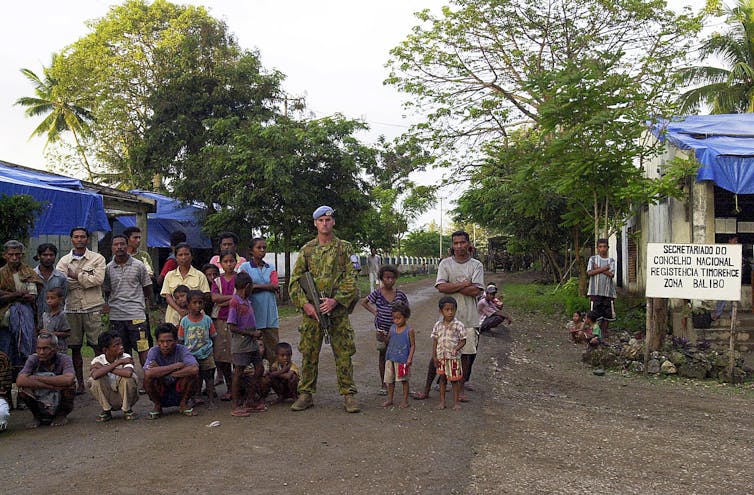 Australian troops serving on the East Timor/West Timor border with the UN peacekeeping force in 2000.
Dean Lewins/AAP
Australian troops serving on the East Timor/West Timor border with the UN peacekeeping force in 2000.
Dean Lewins/AAP
In his memoir, former Prime Minister John Howard mentioned East Timor independence as one of his key achievements. However, in office, he showed very little appetite for supporting East Timor independence and ruffling Indonesia’s feathers.
It was largely the diplomatic intervention at the international level by US President Bill Clinton, alongside the deployment of Australian Federal Police (AFP) working as unarmed civilian police for the UN mission in East Timor, that eventually secured the referendum.
 Co-author Jaime Swift serving in East Timor in 2006.
Author provided
Co-author Jaime Swift serving in East Timor in 2006.
Author provided
Media coverage played a critical role in persuading the world to take action. In West Papua, the media have not had the same effect.
This is in part due to what the Indonesian security forces learned from East Timor on how to control the media. The Indonesian government has frequently cut internet services in West Papua, enacted a complete ban on foreign journalists and denied requests from the UN Human Rights Commission to investigate human rights violations.
Despite this, mobile phone videos of abuse continue to leak out.
In the absence of extensive media coverage, Papuan pro-democracy advocates and their supporters have been calling for a UN-sanctioned human rights investigation. There is also significant support from human rights defenders in Indonesia for such an inquiry.
As it now has a seat on the UN Human Rights Council, Indonesia should fully support such a move. However, the military retains considerable influence in the country, and holding commanders suspected of human rights abuses to account remains politically difficult.
Read more: Joko Widodo looks set to win the Indonesia election. Now, the real power struggle begins
In fact, President Joko Widodo last year appointed as his new defence minister Prabowo Subianto, who himself has been accused of human rights abuses.
Given these challenges, what will it take for the world to show enough moral courage to force change in West Papua?
The right way forward is clear. As a member of the UN Human Rights Council, Indonesia needs to put an end to the media ban in West Papuan, support an independent UN investigation and hold accountable those responsible within the government for violent acts.
If Indonesia does not take this course of action, then diplomatic pressure from the world will be required.
Authors: Camellia Webb-Gannon, Lecturer, University of Wollongong


















