

heaviest stellar black hole in the Milky Way is more massive than we thought
- Written by James Miller-Jones, Professor, Curtin University
When one of us (Ilya Mandel) started grad school at the California Institute of Technology 20 years ago, he was greeted with a series of bets hanging on the wall outside the office of his PhD advisor, Kip Thorne.
One bet from 1974 was a wager with theoretical physicist Stephen Hawking, on whether an observed galactic X-ray source known as “Cygnus X-1” was actually a black hole feeding on hot gas.
Hawking bet it wasn’t, as a consolation prize in case black holes turned out not to exist (since this would mean a lot of the work he had done would be wasted).
At the time, black holes were exclusively theoretical predictions of Albert Einstein’s theory of general relativity: singularities in the fabric of space-time that prevented anything (including light) from escaping.
By 1990, astronomers were convinced Cygnus X-1, a binary star system, indeed hosted a black hole. Hawking conceded his bet against Thorne.
Three decades later, Cygnus X-1 is a gift that keeps on giving. In a paper published today in Science, our team reports the Cygnus X-1 black hole is heavier than previously thought, weighing about 21 times the mass of the Sun.
This makes it the heaviest stellar black hole — formed from the collapse of a star — ever detected without the use of gravitational waves. As it turns out, perhaps in line with a black hole not wanting to divulge its secrets, Cygnus X-1 still contains many mysteries.
Updated measurements from it are forcing us to revise our understanding of the most massive stars — particularly the rate at which they lose mass in stellar winds.
Introducing Cygnus X-1
Cygnus X-1 is located inside the Milky Way about 7,200 light years from Earth. It comprises what we now know to be a black hole in a 5.6-day orbit around a massive supergiant companion star.
Some of the gas blown off the surface of the star by its strong stellar wind is captured by the black hole. The gas spirals in towards the black hole, forming what’s known as an “accretion disk”.
Powerful jets (the contents of which are still debated) are also launched outwards from near the black hole, travelling close to the speed of light.
We wanted to measure the mass of the black hole. But to do so, we first needed to know how far away it was from Earth.
How do you weigh a black hole?
As Earth moves around the Sun, we see Cygnus X-1 from different vantage points. It appears to move back and forth very slightly against stationary background objects, in an effect we call “parallax”.
The amount of this tiny motion lets us calculate the distance between us and Cygnus X-1. But for an accurate measurement, we also had to take into account the orbital motion of the black hole around its companion star.
With a network of radio telescopes, we mapped out the black hole’s orbit, with a positional accuracy the equivalent of localising an object on the Moon to within ten centimetres.
By using our distance to Cygnus X-1 and the brightness and temperature of the star, we computed the size of the star. With this knowledge and the measured motion of the star during its orbit around the black hole, we could determine the black hole’s mass.
It is almost 50% more massive than previously thought, with a mass that’s 21 times that of the Sun.
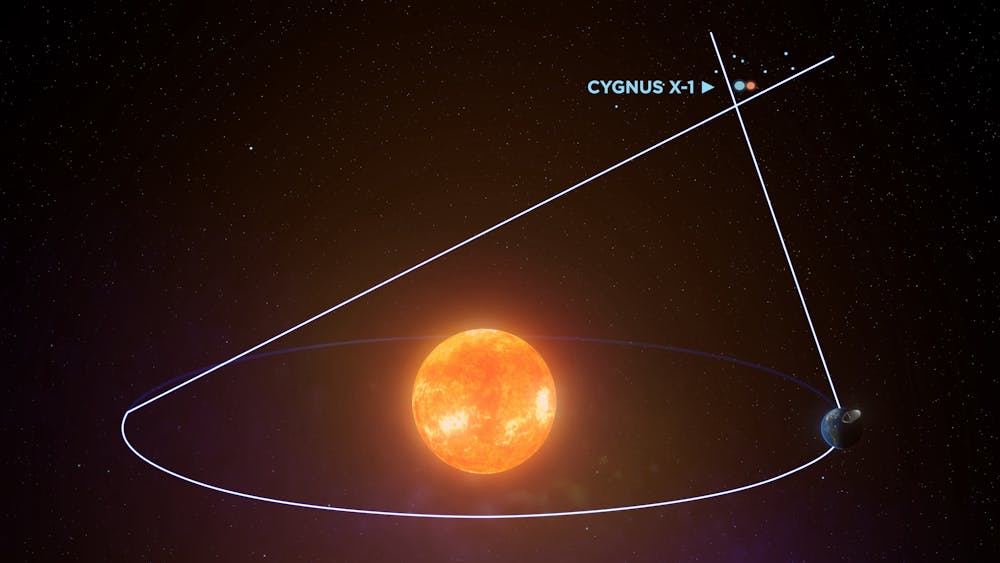 Astronomers observed the Cygnus X-1 system from different angles, using the orbit.
of the Earth around the Sun to measure the perceived movement of the system
against background stars.
International Centre for Radio Astronomy Research, Author provided
Astronomers observed the Cygnus X-1 system from different angles, using the orbit.
of the Earth around the Sun to measure the perceived movement of the system
against background stars.
International Centre for Radio Astronomy Research, Author provided
Why do we care about its mass?
Seeing a stellar remnant this heavy in our own galaxy offers insight into how much mass stars can lose to stellar winds. In general, the larger and more luminous a star is, the faster its rate of mass loss.
Some stars lose the equivalent of an Earth’s mass of gas (or more) each day. Mass is lost faster if the star has a high concentration of heavy elements, particularly iron.
Black holes are created when massive stars collapse in on themselves. Thus, the heaviest black holes are expected to form from the deaths of massive stars with the lowest iron concentrations, as these would have retained the most mass up until death.
The current iron concentration in our Milky Way galaxy suggests even stars that weigh hundreds of times the mass of the Sun at birth could lose enough of it to leave behind a fairly pedestrian remnant — only a few times the mass of the Sun.
Now, finding a black hole with a mass that’s 21 times the Sun’s tells us these stellar winds can’t be that strong, after all. So it means we need to slightly retune our models of how stars lose mass through their winds.
Likely not a gravitational wave source
Cygnus X-1 is also interesting because it could potentially be a frame from a film showing the formation of pairs of black holes, which later merge to produce gravitational-wave signals.
These waves can be observed using advanced instruments, such as the Laser Interferometer Gravitational-wave Observatory (LIGO) in the United States.
According to our new measurements, the star in Cygnus X-1 weighs more than 40 times the mass of the Sun. It’s therefore massive enough to one day form a black hole in its own right.
Read more: Gravitational waves are helping us crack the mystery of how pairs of black holes form
However, while it’s tempting to say Cygnus X-1 provides a link between pairs of stars and merging black holes, that would come with its own challenges.
For example, as described in a companion paper to our Science paper, published in the Astrophysical Journal, the Cygnus X-1 black hole is spinning on its own axis almost as rapidly as general relativity allows.
By comparison, the merging black holes in LIGO sources have far slower spins. This suggests the pathway by which those black holes formed may have been somewhat different.
In another companion paper we argue Cygnus X-1 won’t make a gravitational-wave source because, after the collapse of the companion star, the resulting two black holes would be too far apart to merge.
Still, many questions remain regarding the history and the formation of Cygnus X-1, as well as its future. There may be a few more bets to be made and resolved, yet.
Authors: James Miller-Jones, Professor, Curtin University

















