The James Webb Space Telescope has taken its first aligned image of a star. Here's how it was done
- Written by: Themiya Nanayakkara, Chief Astronomer at the James Webb Australian Data Centre, Swinburne University of Technology
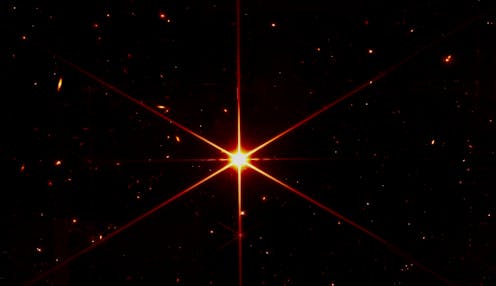
In a huge milestone, the James Webb Space Telescope (JWST) has finally been aligned to produce the first unified image of a single star.
Most traditional telescopes these days (like one you might have in your backyard) have a single primary mirror that collects distant light from stars. But the JWST has 18 mirrors! These had to be aligned extremely precisely to capture the image NASA released today.
The challenge with JWST
The JWST is the largest telescope humans have ever sent into space. It’s so big that none of our rockets can carry it when fully extended. As such, it was designed to be neatly folded to fit inside the cargo hold atop an Ariane 5 launch vehicle.
The telescope uses segmented mirror technology. This technology has been in use for a few decades now, by some of the largest optical telescopes in the world, including the Keck Observatory in Hawaii (which has two 10m-diameter mirrors, each made of 36 hexagonal segments).
The main challenge with the JWST was being able to unfold it to its fully extended form in space, under extreme conditions of heat and cold, and with no human assistance.
This process began in January. Once the mirror segments were unfolded, they had to be aligned so all 18 combined to form a single 6.5m-diameter curved mirror.
The JWST has now completed this alignment process, giving us the first unified image. The image was taken using the near infrared camera (NIRCam), one of the telescope’s four key science instruments.

But how was this done?
There are seven small motors fixed behind each of the JWST’s 18 slightly curved hexagonal mirrors. Their purpose is to move and reshape the curvature of each segment so that all 18 can act as a single large mirror.
Six of these motors are grouped in pairs, equally distanced and located around each mirror segment. These are used to move the mirror.
The seventh motor is at the centre and is connected to the mirror’s six corners with struts. This motor can adjust the tension of the struts to optimise the curvature of that mirror segment.
The motors can move the mirrors very precisely, to within about 1/10,000th of the diameter of a human hair. This precision (to within a fraction of a wavelength of light) is important for obtaining high quality images from the telescope.
NASA scientists used a mathematical analysis called “phase retrieval” to study how the movement of each individual segment changed the sharpness of the final image.
Once they had this information, there were two crucial tasks to complete before the segments could function as a single, monolithic mirror: coarse alignment and fine alignment.
Coarse and fine alignment
In coarse alignment, the mirror segments were moved vertically (up and down) until they aligned to form one giant mirror. However, there were still minute alignment errors that needed to be corrected to obtain the best possible image.
This is where the fine alignment happens. In this process, rather than moving the mirror segments, the small optics inside NIRCam are moved instead.
When the telescope is pointed at a star, the light from the star first hits the primary mirror, in which the individual segments are now aligned reasonably well.
The light then continues its path through the secondary and tertiary mirrors inside the telescope and enters the NIRCam instrument. During the fine alignment, the optics inside NIRCam are very carefully adjusted until the star is completely in focus.
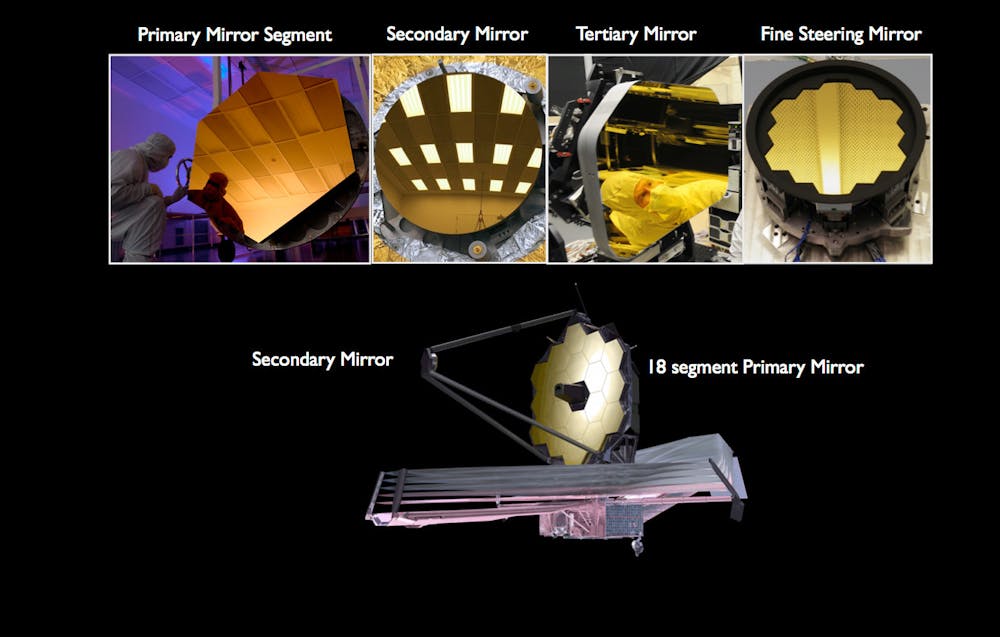 There are four different types of mirrors on the Webb telescope: primary mirror segments, the secondary mirror, tertiary mirror and the fine steering mirror.
NASA/Ball Aerospace/Tinsley, CC BY
There are four different types of mirrors on the Webb telescope: primary mirror segments, the secondary mirror, tertiary mirror and the fine steering mirror.
NASA/Ball Aerospace/Tinsley, CC BY
The coarse and fine alignment steps are both repeated until the sharpest image can be obtained. The image released by NASA this week shows how a star looks when these steps are completed.
Prior to this, NASA released a “stacked” image (likely of the same star) back in February.
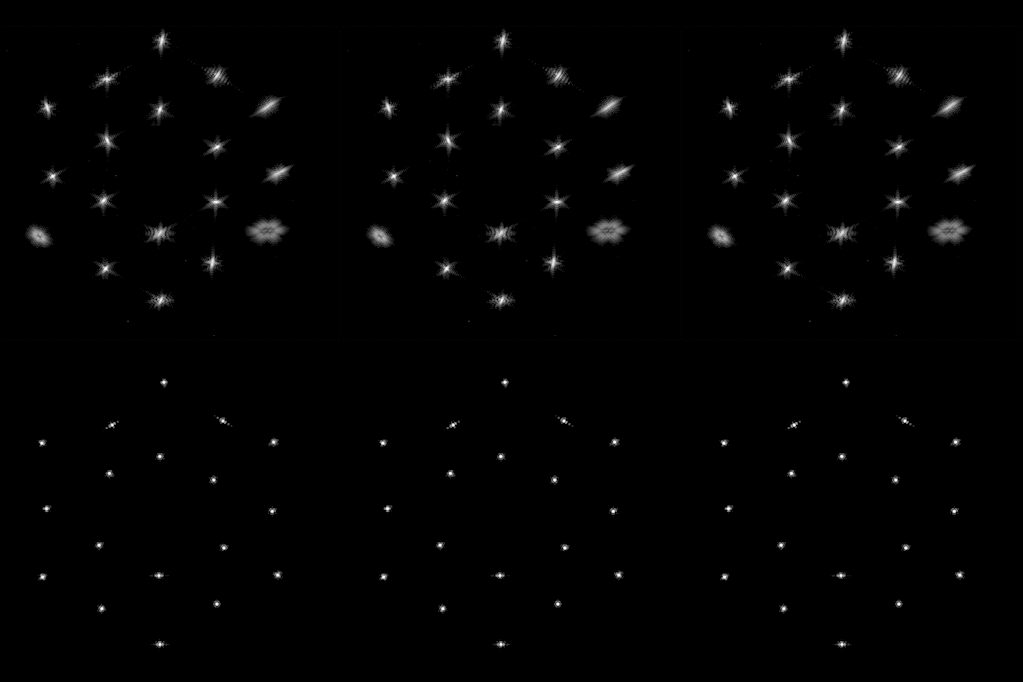
For this, each of the individual mirror segments were fine-tuned to create 18 sharp images of the star, but each from a slightly different vantage point. The 18 images were then stacked to produce the image below.
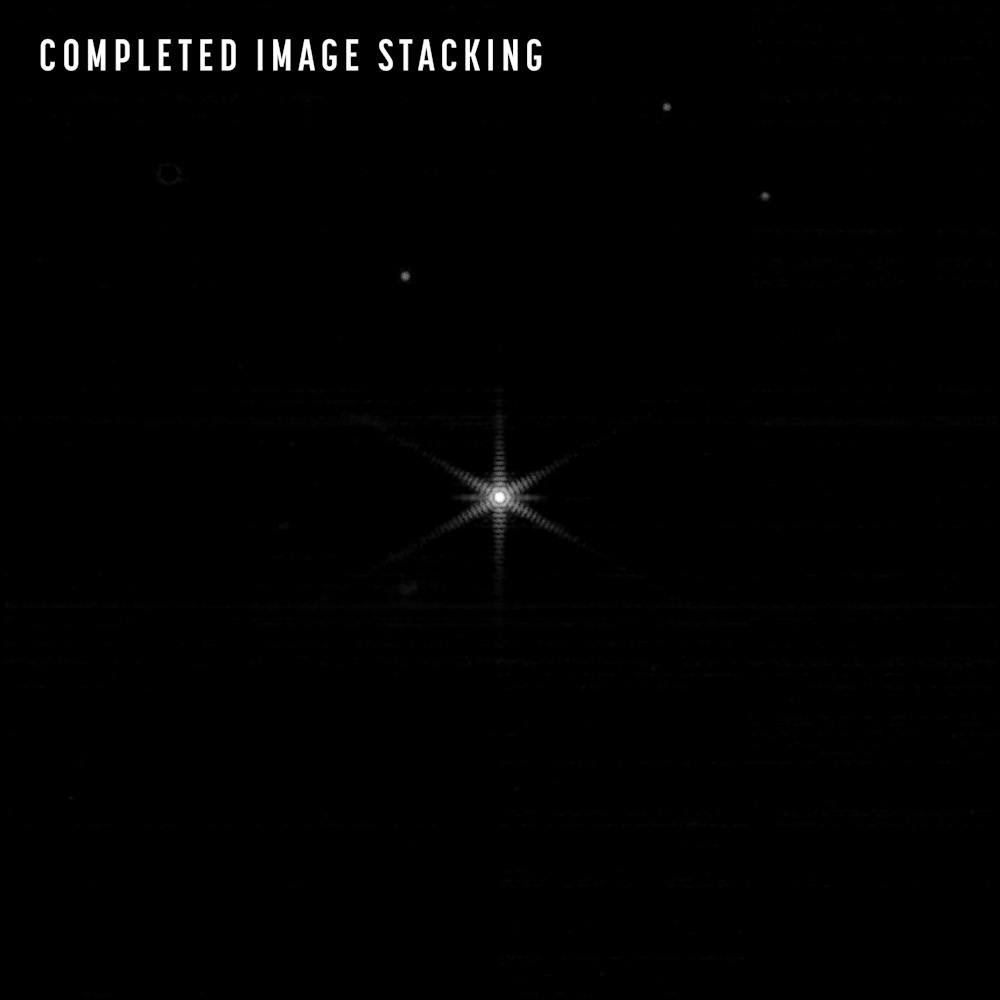 NASA scientists stacked the 18 individual images captured by the primary mirror segments to create a stacked image.
NASA
NASA scientists stacked the 18 individual images captured by the primary mirror segments to create a stacked image.
NASA
The next steps
While the successful testing of the NIRCam is a breakthrough for the JWST, there are many more steps to be completed before it can fulfil its potential.
Next NASA will look at how the other instruments perform with images of stars, and do further fine tuning to the optics in those instruments. After this, the instrument commissioning phase will start. Apart from NIRCam, there are three other instruments on board the JWST: NIRSpec, NIRISS, and MIRI.
While NIRCam will primarily provide images of the Universe over the near-infrared part of the electromagnetic spectrum, NIRSpec can split that light to study different signatures (variations in the properties of the incoming light).
NIRISS will provide similar functionality to NIRCam, while MIRI will look at the Universe at much higher wavelengths (reaching the mid infrared range).
All the instruments will be brought to their working temperatures and tested. Some initial steps have already begun and all indications so far are good. Many of the steps also have redundancies built into them, which means if a system should fail, there will be another way to achieve the same objective.
You can keep up to date with the JWST’s activities online.
Authors: Themiya Nanayakkara, Chief Astronomer at the James Webb Australian Data Centre, Swinburne University of Technology