

Prompt and accurate information is vital in a pandemic – the climate and biodiversity crises demand the same urgency
- Written by: Mark John Costello, Professor, Nord University

Denying the severity of a crisis neither removes nor lessens the problem. Sticking to the status quo because it doesn’t suit our work practices, or social and economic norms, not only delays the inevitable, it compounds the problem.
The crisis, whether a pandemic or climate change, must dictate the timetable. Given the urgency of the crises we face, that timetable needs to be equally urgent. The world needs much more regular reporting on progress (or lack of it) for action and adaptation to keep pace.
Society’s response to the COVID-19 health crisis demonstrated the ability of citizens and governments to adapt rapidly when provided with information daily. The chronic crises of climate change and biodiversity loss require similar treatment: global assessments should be published annually, not once every few years.
The pace of the pandemic, with half-a-billion people infected and over six million deaths to date, demanded daily epidemiological data from the outset to manage the response. Failures in timely or accurate monitoring and reporting, and naïve responses, led to more deaths and illness, and many suffering with long COVID for years.
Nature will not wait for changes in scientific knowledge or public opinion, nor for electoral cycles to shift politicians’ priorities. The lessons of the pandemic should now be applied to other global crises.
Interrelated crises
Decades of evidence of fossil-fuel-driven climate change means it is now accepted as fact by the Intergovernmental Panel on Climate Change (IPCC).
While regionally variable, the frequency, intensity and duration of extreme events related to climate change – including wildfires, droughts, floods, landslides and heatwaves – have international consequences for human health, property loss and food security. In turn, these may lead to mass migration, government instability and military conflict.
Most citizens now grasp the interrelated nature of the climate crisis and the loss of the biodiversity on which food security and healthy ecosystems depend.
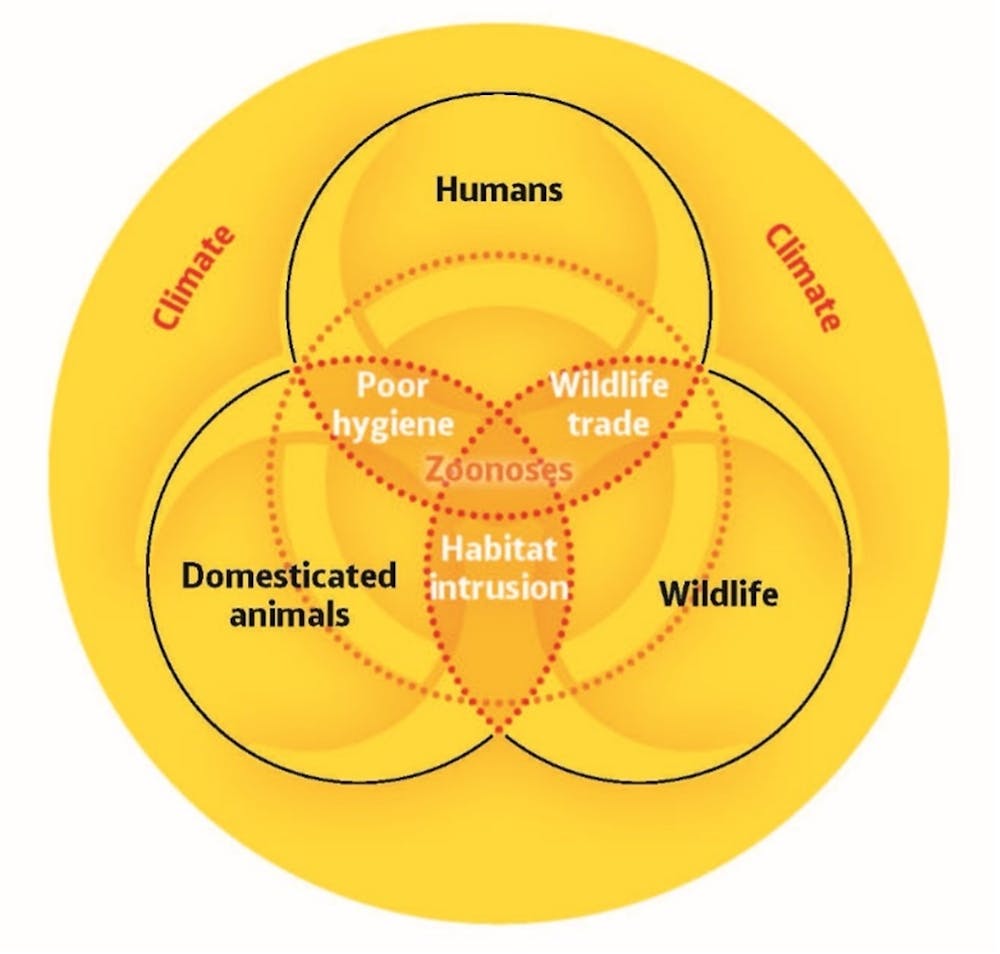
The pandemic, climate and biodiversity crises are interconnected (see diagram below). One study lists 52 interactions covering equity, governance, public health, food systems, water availability, hygiene, urbanisation and infrastructure. These are symptoms of the unsustainable human impacts on the planet and its biodiversity.
Since its inception in 1988, the IPCC has scheduled rigorous assessments of scientific data and knowledge of climate change. This work involves thousands of scientists and numerous meetings, at five- to eight-year intervals. Most importantly, these form a scientific consensus approved by governments.
The Intergovernmental Panel on Biodiversity and Ecosystem Services (IPBES) follows a similar path. Special reports and assessments from both organisations provide salient and up-to-date scientific information to governments worldwide. These run to thousands of pages and are expensive to produce.
Read more: Rising authoritarianism and worsening climate change share a fossil-fueled secret
But the accelerating pace of climate change, loss of biodiversity and now regular extreme events dictate that the IPCC and IPBES must shift their assessment cycles from once every few years to yearly. The transformational adaptation of society called for by the IPCC should also apply to its own scientific reporting.
Annual reports may not need to be as detailed and comprehensive and could have fewer authors, while still maintaining breadth of expertise, geographic representation and diversity. Workloads and costs would be reduced by the data-gathering and analysis covering just one year.
Accountability and action
Reports could be more succinct, with less jargon, by focusing on the facts and their meaning. This would streamline production and increase efficiencies. Annual assessments could then be synchronised with government and business budgeting and planning, as the climate and biodiversity crises are also economic problems.
In turn, this would enable governments to adjust policies and funding priorities, investments, taxes and fines on an annual basis. Crucially, they could highlight any failures to meet the previous year’s promises.
Even before the pandemic, nearly all the United Nations Sustainable Development Goals for 2020 had yet to be met, including the failure to protect 10% of the oceans by 2020 under the Convention on Aichi Biological Diversity Targets.
Still only 2.8% of the ocean is designated to be fully protected from human impacts, and 3.2% partially. Despite international commitments under the United Nations Law of the Sea in 1982, it seems 94% of the ocean is not being managed in an environmentally sustainable way. We are a long way from the new target of 30% by 2030.
Action can never be guaranteed, but annual accessible assessments and a better-informed population would mean greater accountability, particularly as election cycles would cover multiple reports.
Social and political change
There have been calls, too, for monthly data on emissions on top of annual national reporting on progress to climate change targets. And while some agree that the present IPCC assessment process is untenable, their proposal is to halt further IPCC assessments altogether.
We argue that more frequent assessments will lead to the societal and political change needed. Other shifts in societal behaviour – reducing smoking, alcohol abuse, healthy diets, drunk driving and promoting recycling – took years of convincing scientific evidence to take hold.
Read more: Without a better plan, New Zealand risks sleepwalking into a biodiversity extinction crisis
This process of shifting individual behaviour that then translates into government action is well under way with the climate and biodiversity crises. We’re optimistic that increased government efforts can address the crises, with their delays making action to reduce greenhouse gas emissions a higher priority every year.
Shortening and simplifying the process to make primary data more accessible to society, as demonstrated during the pandemic and commonly seen in the reporting of weather and climate (though sadly not for biodiversity data) is a starting point.
A globally representative and diverse panel of scientists can oversee the process, interpreting the observations in the light of peer-reviewed research, as already happens with assessments. All of this will guide solutions to ensure the health of our planetary ecosystem and the future of all its inhabitants.
Authors: Mark John Costello, Professor, Nord University


















