

Proof positive. Real wages are shrinking, Wednesday's figures put it beyond doubt
- Written by: Jim Stanford, Economist and Director, Centre for Future Work, Australia Institute; Honorary Professor of Political Economy, University of Sydney
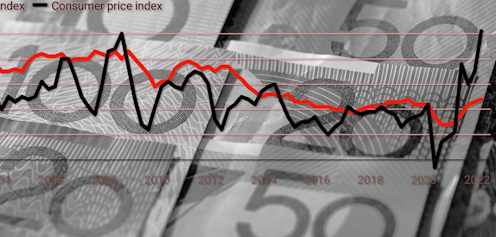
Every three months the Bureau of Statistics releases the lesser-known cousin of the consumer price index. It’s called the Wage Price Index (WPI) and it records changes in the overall level of wages, in the same way the price index records changes in the overall level of consumer prices.
Rarely does it generate headlines, but coming three days before an election and showing the worst performance ever compared with the consumer price index, it has provided concrete evidence that the buying power of wages is shrinking.
Contrary to hopes that lower unemployment would spark higher wages growth, the WPI barely budged in the year to March: climbing 2.4%, up from 2.3% in the year to December.
The consumer price index for the year to March grew twice as fast, by 5.1%
It means real wages (the buying power of wages) shrank 2.7% over the year to March in aggregate - one of the fastest and steepest declines ever.
Since March, during the election campaign, interest rates have been pushed up, further adding to the cost of living.
Read more: Are real wages falling? Here's the evidence
Coming right at the end of the campaign, the news reinforces a traditional Labor concern (living costs) and diminishes a traditional Coalition selling point (superior economic management).
And it’s a full frontal challenge to conventional economics.
Here are just three of the conventional thoughts it has thrown into doubt.
Wages are determined by supply and demand
Conventional economics treats the price of labour like the price of any other commodity (such as fruit at a market), determined by supply (if there’s too much the price will fall) and demand (if a lot of people want it the price will rise).
That is held to mean that, even if there is still some unemployment, wages will grow faster if employers find it hard to find workers (as they are now) and slower if workers find it hard to find jobs (as was the case when unemployment was higher).
There is said to be a special unemployment rate – the Non-Accelerating Inflation Rate of Unemployment, NAIRU – below which wages will start to grow quickly, entrenching accelerating inflation.
The problem is that the NAIRU can’t easily be observed, and moves around.
Read more: Despite record vacancies, Australians shouldn't expect big pay rises soon
The Treasury and Reserve Bank once believed NAIRU was close to 7%, then 6%, then 5% or lower. Now they are not sure it exists.
With unemployment well below the rates they once believed would push up the growth rate, there is growing doubt about whether it can.
Part of the reason is that unlike the market for fruit (or pork bellies or flat whites), institutions and bargaining power affect what happens to wages in addition to supply and demand. De-unionisation, insecure work, and deregulation of the wage-setting process have shifted the balance of power away from workers.
Labour markets are flexible
Decades of changes to Australia’s wage-setting system were sold as allowing labour markets to respond more smoothly to changes in supply and demand, ensuring workers were more closely paid in accordance with what they produced (productivity).
But a lot of (anti-worker) rigidity remains. One source is punitive public sector pay caps, which even the Reserve Bank says are contributing to weak wage growth.
Another is greenfield enterprise agreements, which lock in predetermined pay rates for years.
Inflation originates in the labour market
Anthony Albanese sparked an important debate when he said wages should at least keep up with inflation.
Scott Morrison said this would be like “throwing throwing fuel on the fire” of inflation. But Wednesday’s figures seem to indicate that inflation has a life of its own. It is soaring while wages growth is not.
And after adjusting for productivity growth (which has been surprisingly resilient, averaging 2% per year for the past two years), unit labour costs have grown the slowest in years, by just 1.5% per year since 2019.
Whatever is causing inflation, it isn’t firms passing on higher wage costs to their customers. Some are passing on higher profit margins. If anything, what we are experiencing is more like profit-price inflation than wage-price inflation.
During the COVID crisis, profits climbed to a record high as a share of GDP while labour compensation (mainly wages) fell to its lowest point in postwar history.
While economic truisms are being reassessed, voters are in the process of coming to grips with what stubbornly low wages growth means for them. Many more of them make their living by selling their labour than by taking profits.
Authors: Jim Stanford, Economist and Director, Centre for Future Work, Australia Institute; Honorary Professor of Political Economy, University of Sydney


















