A mammoth meatball hints at a future of exotic lab-grown meats, but the reality will be far more boring, and rife with problems
- Written by Hallam Stevens, Professor of Interdisciplinary Studies, James Cook University
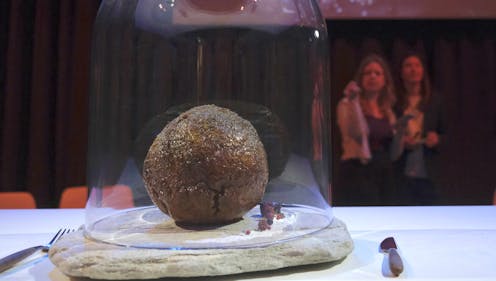
Last week, an Australian “cultured meat” company called Vow made headlines with a meatball made from the flesh of a woolly mammoth – or something very much like it. Combining the technologies of lab-based cell culture and “de-extinction,” Vow scientists grew muscle proteins based on DNA sequences from the long-dead proboscideans.
The meatball was not intended for human consumption, but Vow hoped the gimmick would highlight the lighter environmental footprint of lab-grown meats, using the mammoth as a “a symbol of diversity loss and a symbol of climate change”. The meatball also hinted at a possible new variety and playfulness in meat consumption.
But is lab-grown meat really likely to put mammoths, dodos and other exotica on the menu? Taking into account the safety and economic hurdles the industry will have to clear, the result seems more likely to follow the pattern of genetically modified crops: less diversity, and unforeseen social and environmental effects.
Healthy and safety risks
As Queensland scientist Ernst Wolvetang, who helped to engineer the mammoth-ball, acknowledged:
We haven’t seen this protein for thousands of years, so we have no idea how our immune system would react when we eat it.
Wolvetang thinks any such problems could quickly be solved. But even for lab-grown meat that uses conventional livestock such as beef or chicken, the health and safety risks are far from understood.
Existing concerns include the use of growth hormones in cultured meat, the potential for new or unexpected allergens, the way lines of cultured cells change their shape and function over time, the likelihood of microbial contamination, and uncertainty around the nutrient content.
Even changing the texture or composition of meat may have health effects for our digestive system. These problems are likely to be exacerbated for foods based on resurrected proteins from the distant past.
Consider the ‘meat-systems’
But health and safety aren’t the only issues.
Critics of the de-extinction movement have argued that reintroducing animals like the woolly mammoth into the environment may have unpredictable and disruptive effects.
Would predators adapt? Would grasslands be trampled to oblivion? Should we devote our efforts to preserving still-live animals like rhinoceroses instead? Does the possibility of de-extinction make us less worried than we should be about the effect of humans’ actions on biodiversity?
We should also think in similarly broad terms about the impacts of lab-grown meats. In other words, we shouldn’t just think about meat itself, but about the “meat-systems” that produce it.
What will the economic system of lab-grown meat production look like? How will lab-grown meat disrupt farming and farming communities? How might it affect consumption? Will we eat more meat or less if we can gain access to “ethical” meat?
The lesson of GMOs
The development and rollout of genetically modified organisms (GMOs) over the past three decades can give us some important clues as to how such things may play out. Like lab-grown meats, GMOs at first promised the possibilities of diverse crops that would offer health benefits (like Golden Rice) or benefits to the consumer (like the Flavr Savr tomato).
Few of these possibilities were realised. Instead, most of the benefits of GMOs accrued to agricultural companies who developed and sold the seeds.
Rather than increasing the diversity of foods, GMOs have increased monocultures and reduced the variety of foods. This, in turn, has led to negative environmental and social consequences for agricultural communities.
Read more: The race to protect the food of the future – why seed banks alone are not the answer
Lab-grown meats face a similar risk. Despite the promise of Vow’s mammoth, in the short-term at least, it is likely that lab-grown meats will only become economical for consumers when produced at scale.
This suggests the most likely cultured meats on our menus won’t be alligator or dodo, but standardised versions of beef, chicken or pork. Production is also likely to focus on muscle tissue, rather than offal, feet, bone marrow, or the other diverse parts of animals many of us consume.
The most likely outcome of lab-grown meat is not more diversity in protein, but significantly less.
The Italian response
Just as the mammoth meatball was making its debut, the Italian government moved to ban lab-grown meat, citing health and the nation’s food heritage. Synthetic foods, government ministers argued, would undermine Italian food traditions, threatening mortadella, pancetta and guanciale.
Coldiretti, an Italian farmers’ association that supported the ban, added the move would protect agriculture from “the attacks of multinational companies”.
Read more: Ultra-processed foods are trashing our health – and the planet
Italy’s proposed ban has been branded “anti-innovation” and a setback for animal rights, but they are right to be cautious about the disruption that lab-grown meat could cause.
The history of GMOs has also shown how turning food into a technology has not only made produce less diverse but also consolidated corporate control over the food supply. Even if lab-grown meats are shown to be physiologically safe, we need to establish that they are economically, politically and culturally safe too.
Authors: Hallam Stevens, Professor of Interdisciplinary Studies, James Cook University