how Gaza became one of the great intellectual hubs of the Roman Empire
- Written by Christopher Mallan, Associate Professor in Classics and Ancient History, The University of Western Australia
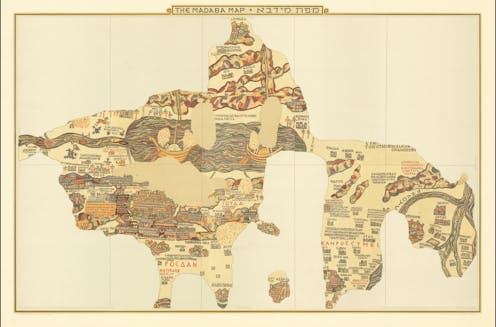
The years 2023 and 2024 will certainly be remembered as some of the darkest in the long and often violent history of Gaza.
The recent destruction of schools and universities in the Gaza strip has attracted the attention of the media and concern from the United Nations, which has raised the question of whether the damage may be considered “scholasticide”.
Such reports are cause for reflection on the intellectual history of the city – something rarely discussed outside academic circles. This is a shame, as there was a period in the late Roman Empire (5th and 6th centuries CE) when Gaza was one of the great intellectual centres of the Mediterranean world.
Gaza and the Roman Empire
This history of Gaza under the Roman Empire dates from the re-foundation of the city in the 60s BCE, after it had been destroyed decades earlier by Alexander Jannaeus (the ruler of the neighbouring Kingdom of Judaea), as narrated by the Jewish historian Josephus.
Under the relative peace of the Roman Empire, the city was no longer prey to the imperial attentions of its more powerful neighbours, be they Egyptian, Greek, Judaean, or indeed Roman. Gazans were able to capitalise on their position on one of the great geographical crossroads.

Gaza was positioned on the major route from Egypt to the historic cities of the Levant, which correspond to modern-day Lebanon, Jordan, Israel and Syria. It also provided access to the Mediterranean Sea at the end of one of the major trade routes from Arabia, via the city of Petra.
Gaza seems to have primarily been a commercial centre until sometime in the 5th century, at which point it became noteworthy for its schools as well as its trade.
Between pagan and Christian
The Late Roman Middle East was a hotbed of intellectual activity.
During this time the schools of Alexandria (in Egypt), Constantinople (Istanbul), Antioch (Antakya) and Gaza can be thought of as the Ivy League of their day.
Although there were no formal universities as we think of them today, these ancient intellectual centres hosted famous teachers who would attract the best and brightest of the Roman elite.
If you wanted to make it in the Late Roman World (and if you didn’t command an army of Goths), your entry into the civil administration of the newly powerful Christian Church was largely determined by your education.
We know quite a bit about the educational syllabus of the Gazan schools. At the heart of this elite ancient education was the study of literature and rhetoric.
The curriculum focused on Classical Greek texts (as opposed to Latin or Syriac ones). Young men would be taught how to compose speeches on various topics.
In some instances these speeches would address the emperor. But these speeches were not only exercises in flattery; we know of one school teacher, Timothy of Gaza (or grammatikos, to use his Greek title), who wrote a speech addressed to the Emperor Anastasius (who reigned between 491–518 CE) petitioning him to abolish the tax on merchants.
 The emperor Anastasius (centre) alongside his wife Ariadne (right) on a 517 CE diptych of his grandnephew (bottom).
Wikimedia
The emperor Anastasius (centre) alongside his wife Ariadne (right) on a 517 CE diptych of his grandnephew (bottom).
Wikimedia
Other examples of Gazan eloquence were less obviously political. The bulk of the curriculum involved writing on themes suggested by ancient Greek literature, mythology or history.
The retention of pagan (in this case non-Christian) elements in the syllabus is important. As a rule, the Later Roman Empire was not noted for its religious tolerance, whether between Christians and non-Christians, or between Christians of differing theological persuasions.
We know from an ancient biography of a 5th-century bishop named Porphyry that this bishop participated in the demolition of the remaining pagan temples in Gaza. Yet, as a whole, Gazan intellectuals were able to balance their Christian beliefs with their love of Classical (pagan) culture.
At least two Christian Gazan intellectuals, whose works survive, explore Biblical accounts of creation written in the style of Plato’s dialogues from the 4th century BCE. These works incorporate predominantly pagan neo-Platonic philosophy with Christian interpretations.
Procopius and the wondrous clock
The greatest, or at any rate the most influential, of the Gazan intelligentsia was Procopius of Gaza. Procopius was a prolific writer and teacher. He is thought to have invented a type of biblical commentary, known as a catena, which linked passages of earlier scholars in a sort of precursor to today’s Bible commentaries.
However, if there is one work that sums up the educational endeavours of the schools of Gaza while also presenting a picture of the city, it is Procopius’ description of Gaza’s clock.
One of the important exercises in Roman education was learning how to describe an object, something called ekphrasis. Procopius’ ekphrasis of the clock became something of a textbook example of this and caught the attention of ancient readers.
The clock itself was a mechanical marvel. Situated in Gaza’s main marketplace, it seems to have been a monumental version of a cuckoo clock with a figure of Hercules appearing on the hour.
Hercules’ appearance at each hour corresponded to one of his mythical labours, whether that be the slaying of the Nemean lion or the clearing of the Augean stables.
Procopius likens the (otherwise unknown) inventor of this clock to a latter-day Hephaestus – the Greek god of craft. The clock’s mechanism was driven by water power.
This clock, like the famous schools of Late Roman Gaza, eventually disappeared. We don’t know when this occurred, but the centuries after Gaza’s intellectual golden age saw a return of conflict.
Almost 1,500 years have passed since the days of Procopius, his students and the engineer who designed the clock. Yet Gaza remains a living city, with poets and teachers.
One may hope that in the near future the modern schools of Gaza will reopen and intellectual life will once more be allowed to flourish.
Authors: Christopher Mallan, Associate Professor in Classics and Ancient History, The University of Western Australia