Biochar doesn’t just store carbon – it stores water and boosts farmers’ drought resilience
- Written by Sirjana Adhikari, Associate Research Fellow in Mineral Processing, Deakin University
As the climate changes, large parts of southern Australia are projected to get drier. Extreme rains are also becoming more common.
For farmers, these changes pose big risks. What can we do to manage changes already locked in? One adaptation is ensuring water soaks into spongy soils rather than evaporates or runs off into waterways.
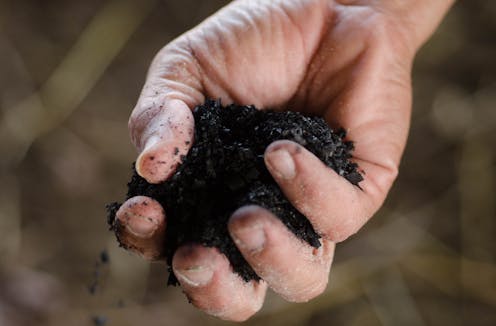
This is where biochar comes in. You might be familiar with the use of this charcoal-like substance to store more carbon in soil. But biochar has another very useful property: it’s often highly porous. If you add it to soils, it can store water from rain or irrigation until plants draw it out. It can also help unlock soil nutrients and restore soils degraded from overuse.
This year, biochar experts released a farmers’ guide covering how to use biochar to boost drought resilience, maximise crop yields and increase disease resistance.
But how do you make it sustainably and at scale? Our new research has found one answer – use green waste from our gardens and also mix it with other suitable sources.

What’s so good about biochar?
Biochar looks like traditional charcoal. But charcoal comes from wood and is used for fuel. Demand for charcoal drives deforestation in some countries.
Biochar can be made from everything from food waste to wastewater biosolids, to forestry waste or agricultural waste such as wheat straw and nut shells. It’s made by heating organic matter in low oxygen, a process called pyrolysis.
Pyrolysis typically produces more energy than it uses, meaning biochar manufacturing can also produce bioenergy. Pyrolysis has far lower carbon emissions than if the waste was incinerated or left to decompose in landfill.
Biochar came to global notice as a promising way to combat climate change. In 2018 it was recognised for the first time as a possible negative emissions technology.
This is because the biochar process locks up its existing carbon and adds to it by increasing soil carbon. If scaled up, biochar could store substantial amounts of carbon which cannot be lost to wildfires or microbial breakdown.
But biochar has another key benefit: it can store a surprisingly large volume of water. A single kilo of biochar can store up to 4 litres of water.
 Biochar looks like charcoal - but it’s made for a different purpose.
Gulthara/Shutterstock
Biochar looks like charcoal - but it’s made for a different purpose.
Gulthara/Shutterstock
When rain falls or when farmers irrigate, biochar-improved soil holds water for longer. In sandy soils where water drains quickly, biochar can hold it for more than ten days and slowly release it as crop roots need moisture.
When we add good quality biochar to soil, we make soil more porous. This provides space to hold water, for soil microbes to colonise, and for air to circulate. In turn, this improves access to soil nutrients for plants.
What are the downsides? At present, we don’t know enough about whether pyrolysis removes all chemicals of concern, or if some risks outweigh the benefits over the long-term. So-called “forever chemicals” may not be completely destroyed by pyrolysis. And if pyrolysis is not designed properly, toxic dioxins can form.
In some circumstances, biochar could nudge soil microbes to produce chemicals that are not beneficial. Biochar could also add salts, trace metals or other toxins to the soil if contaminated organic waste is used.
These issues can largely be avoided with careful design of biochar engineering processes and testing.
 Burning organic matter in low oxygen environments produces biochar.
Sirjana Adhikari, Author provided (no reuse)
Burning organic matter in low oxygen environments produces biochar.
Sirjana Adhikari, Author provided (no reuse)
Different feedstocks materials?, different biochar
Earlier this year, we published research confirming good quality biochar stores carbon for hundreds of years.
The choice of raw materials for biochar makes a big difference. When manufacturers used woody materials, we found the biochar was highly stable. But biochar from biosolids (solids derived from wastewater) was less stable.
A particularly good type of biochar is made from wood, branches and grasses. This biochar boosts access to potassium and calcium in loamy or sandy soils, tackles salty soils and gives plants better access to nitrogen. Using biochar doesn’t mean you stop using fertilisers – but it can help farmers get more out of soil additives. It also has a very high water-holding capacity of up to 60% of its volume.
Using certified biochar is a good way to ensure you’re getting a high quality product.
If used well, biochar has real promise. Our new life cycle assessment found by spreading around 58 million tonnes of biochar on our farms would remove the equivalent greenhouse gas emissions of every Australian household (68 million as of 2017) for a year.
Perfecting biochar
There are ways to optimise how we make biochar. For instance, aging biochar for a year enables it to hold more water.
Different particle sizes suit different soils. Recent research shows fine-grained biochar works best for clay soils, while coarser biochar is best for sandy soils.
 Different feedstocks produce different types of biochar. On the left is garden waste biochar and on the right is biosolids biochar.
Sirjana Adhikari, Author provided (no reuse)
Different feedstocks produce different types of biochar. On the left is garden waste biochar and on the right is biosolids biochar.
Sirjana Adhikari, Author provided (no reuse)
Biochar availability and use is growing. The global market next year is forecast to reach almost A$5 billion. Larger biochar production facilities can maximise the benefits of the heat energy released, and also control any risky emissions. But you can make biochar in your garden with a simple setup.
There’s work to do figuring out the best biochar, soil and microbe interactions for plants, and adding biochar to broader sustainable farming practices.
The world is full of good ideas that don’t get traction. What makes biochar more likely to succeed is the fact it can work for farmers and for the planet.
Authors: Sirjana Adhikari, Associate Research Fellow in Mineral Processing, Deakin University