Humans are killing off the old and wise animals that hold nature together. Here’s what must change
- Written by Keller Kopf, Senior Lecturer in Ecology, Charles Darwin University
In humans and other animals, ageing is generally associated with a decline in biological function. But scientists are now discovering older animals perform vital roles in populations and ecosystems.
Unfortunately, however, old animals can suffer the most from human activity such as over-fishing and trophy hunting. And the value of old, wise animals is not usually considered when we manage animal populations and seek to protect biodiversity.
Our new review, published today in Science, draws on evidence from around the world to argue for a new approach called “longevity conservation”.
The loss of old and wise animals has devastating global consequences. Clearly, more must be done to prioritise their survival.
Benefits of a long life
Cold-blooded (ectothermic) animals such as fish and reptiles tend to keep growing throughout their life. This means older individuals are generally larger than younger individuals.
Being bigger has benefits, especially when it comes to feeding and reproduction. It’s widely known the number of offspring increases with age in fish and many other ectotherms. But it’s only recently been discovered that older mothers of some fish and sea turtles produce exponentially more offspring as time goes on. Their young may also have better chances of survival.
Survival rates are can be higher in offspring from older mothers in other species too. For example, in birds older parents and their helpers often provide more food and better habitat for their chicks, improving fledgling survival rates.
Females from a range of species tend to select older males as mates. These males commonly assume crucial social roles, such as leading long distance movements like migration, and regulating social structures, such as reducing aggressive behaviour. These behaviours influence decision-making with direct consequences for group and offspring survival.

With age comes wisdom
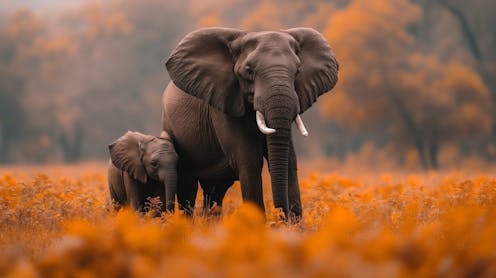
Some animals draw on experience accumulated over the course of their lifetime in order to make better decisions. In elephants, mothers and grandmothers are repositories of knowledge.
This “grandmother effect”, first studied in humans, also occurs in whales. Wise grandmother killer whales, which no longer reproduce, help their families find food when it is scarce and this benefits survival.
In a wide range of species, new research is showing how older individuals transmit their knowledge to others via a process called cultural transmission. The benefits of old age extend to animals such as migratory birds, pack-hunting carnivores, and even fish. For example, taking all the big fish from some populations has diminished their collective group memory often needed for migration and knowledge of spawning areas.
 This family group of African elephants has been the subject of research into older animals.
Phyllis Lee
This family group of African elephants has been the subject of research into older animals.
Phyllis Lee
Examining the loss of older animals
Our research set out to build understanding of the ecology and conservation of old animals.
We assembled an interdisciplinary team of experts who work on different animals and diverse ecosystems. Our team included behavioural and wildlife ecologists as well as freshwater, marine and fisheries scientists.
We searched the literature and wrote a review. In addition, we used a machine learning topic model to delve into more than 9,000 peer-reviewed papers.
Most research has focused on the negative aspects of ageing, particularly in humans, and short-lived animal models such as fruit flies. Yet emerging evidence is showing how old wild animals contribute to populations and ecosystems.
Many of these functions benefit people too, but are being lost as old individuals are removed from the wild.
Fishing has caused a systematic decline in the abundance of old fish, with these aged individuals reduced in 79-97% of the ocean populations examined.
Old African elephants and other trophy animals are commonly poached or hunted, both legally and illegally.
But the loss of old individuals is not limited to large enigmatic species. Deep-sea coral and Antarctic sponges – which can live for thousands of years – are being harvested, damaged by fishing gear, and affected by climate change. These species cannot be replaced within our lifetime.
Species that live to advanced ages are often large, slow-growing, and slow to mature. These traits can make these species more vulnerable to extinction if older adults are killed by humans.
But when humans spare old individuals, these long-lived species are more resistant to environmental change and provide more stable ecosystem services, such as fisheries which supply protein to feed the world.
Retaining old animals tends to protect populations from poor environmental conditions such as drought and other extreme climate events, allowing species to persist against the odds. This buffering capacity is increasingly important in the face of global climate change.
 Very old animals, like this 100+ year-old bigmouth buffalo, are declining because of over-harvesting and river regulation. This species is native to rivers of North America.
Alec Lackmann
Very old animals, like this 100+ year-old bigmouth buffalo, are declining because of over-harvesting and river regulation. This species is native to rivers of North America.
Alec Lackmann
Introducing ‘longevity conservation’
Old animals play vital roles in the maintenance of biodiversity and ecosystem services.
Yet harvest management and conservation practices tend not to focus on preserving age structures within populations. And the loss of old individuals is not yet recognised by the International Union for Conservation of Nature as a means of listing threatened species, or as a type of over-fishing.
To protect old individuals and maintain or restore the age structure of wild populations, we propose “longevity conservation” measures.
Decisive new policy and actions are needed to protect and restore the crucial ecological roles and services old, wise, and large animals provide. For example, formally recognising and avoiding “longevity overfishing” should be incorporated into fisheries management to help ensure the long-term sustainability of fisheries.
Biodiversity conservation and threatened species policies should protect age structure. This is particularly important in long-lived species that produce more offspring with age, or where migration, social networks and cultural transmission of knowledge are required for survival.
Authors: Keller Kopf, Senior Lecturer in Ecology, Charles Darwin University