

a history of what the royals ate for Christmas, from the exotic to the everyday
- Written by: Lisa J. Hackett, Lecturer, Humanities, Arts and Social Sciences, University of New England
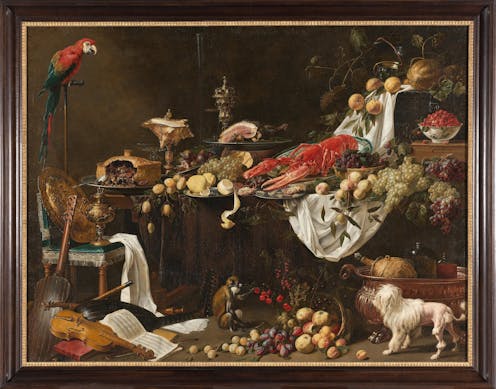
As we prepare our Christmas fare – a hot roast with all the trimmings, a seafood smorgasbord or a beach-side barbecue – it is timely to think about what others have on their Christmas menus.
We’ve been questioning: do the British royals eat what we do?
Mostly, they probably do today, but in the past not so much.
Medieval and Georgian Christmas fare
While the Victorian era is the one most associated with modern Christmas traditions, Christmas was celebrated by earlier monarchs too.
During the medieval period in England, Christmas was time for reflection rather than fun and the Catholic Church banned gift giving. But mince pies emerged in this period. The addition of cinnamon, cloves and nutmeg to meat pies was meant to symbolise the gifts bestowed by the three wise men on Jesus. By the late Victorian period, the meat was replaced by dried fruit dressed in the traditional spice combination, which continues today.
Game pies were also popular in the era for Christmas, with goose and venison the preferred filling of royals.

In 17th century England, Oliver Cromwell’s Puritanical government banned Christmas. In 1647, Christmas feasting, alcohol and singing was banned – but many continued Christmas traditions in secret. King Charles II, on his restoration, reinstated Christmas in 1660.
Under the Georgians, Christmas celebrations reached new heights with feasts typically lasting for 12 nights.
The 12th Night Cake, a fruit cake with frosting and sugar paste embellishments, likely stemmed from the tradition of both Christmas and wedding cake.
A typical Georgian-era royal Christmas feast consisted of cheeses, soups, turkey, goose, duck, and mince pies. George I’s love of the Christmas plum pudding earned himself the nickname “Pudding King”.
Celebrating 12th Night was later banned by Queen Victoria in 1860 due to its association with paganism.
Queen Victoria’s 1894 Christmas dinner
In 1894, Queen Victoria hosted Christmas at Osborne House on the Isle of Wight. Dinner started at 9pm, the menu written in French.
The tradition of composing menus in French for royal occasions has its origins in the Norman Conquest of the 11th century, which established French as the official language of the English court. This practice continues by the royal family today, particularly for formal dinners and state occasions.
On the menu in 1894 was a calf’s head consommé garnished with truffle quenelles, cockscombs and mushrooms, followed by carrot soup flavoured with celery and ham, then salmon steaks dressed with hollandaise sauce.
 Thomas Webster (1800–1886), The Christmas Pudding; from The Art Journal, November 1868.
© The Trustees of the British Museum, CC BY-NC-SA
Thomas Webster (1800–1886), The Christmas Pudding; from The Art Journal, November 1868.
© The Trustees of the British Museum, CC BY-NC-SA
Next served were crumbed fried fillets of sole and moulds of puréed pheasant meat, macaroni with tomato sauce, cheese, ham, pickled tongue, mushrooms, and truffles.
Also served were roast beef with Yorkshire puddings and roast turkey served with braised chestnuts, glazed pearl onions, mushrooms, bacon and chipolata sausage, and a chine (backbone) of pork. Asparagus spears dressed in a white sauce accompanied the meat.
Mince pies, plum puddings and jellied orange flavoured custards served with cream were served for dessert.
As was the custom in historical royal courts, a sideboard of assorted meats was also available. The sideboard included a baron of beef (sirloins joined at the backbone) and a wild boar’s head, a gift from the Emperor of Germany Wilhelm II, the eldest of Victoria’s 42 grandchildren.
 James Stephanoff (1786–1874), The Kitchen at Windsor Castle, 1819.
Wikimedia Commons
James Stephanoff (1786–1874), The Kitchen at Windsor Castle, 1819.
Wikimedia Commons
The Lord Lieutenant of Ireland Lord Cadogan gave a gift of a woodcock pie, accompanied by a game pie, brawn (a terrine made of pork or veal) and a terrine of foie gras.
The meal was served with 12 bottles of wine – a gift from the Emperor of Austria, from his personal vineyards.
Dinner concluded with Stilton cheese and plates of fruit, in case anyone was still hungry.
The meal was prepared at Windsor Castle and then transported by royal yacht to Osborne, arriving on Christmas Eve. The menu for Victoria’s New Year’s Day meal likely featured remnants from the Christmas lunch – something we can relate to, if not the eating of cockscombs or calf’s head consommé.
Modern royal Christmas menus
Today’s royal family have a more familiar Christmas menu.
On Queen Elizabeth II’s 2014 dinner menu was roast turkey with sage and chestnut stuffing, Brussels sprouts, buttered carrots, roast parsnips and potatoes. Iced gingerbread with oranges in syrup was served for dessert.
Under King Charles III in 2023, the family ate a typical roast turkey lunch, followed by afternoon tea of cake, scones, mince pies, sandwiches and Christmas fruit cake with royal icing and marzipan.
 The modern royals eat a much more familiar Christmas meal.
Claudio Schwarz/Unsplash, FAL
The modern royals eat a much more familiar Christmas meal.
Claudio Schwarz/Unsplash, FAL
The final meal of today’s Christmas is the evening buffet, more elaborate than Christmas lunch. It includes Stilton cheese and decorated York ham. It is also the only time the head chef will go into the dining room to carve the meat. One thing missing from the table today is foie gras: on becoming king, Charles banned foie gras at all royal residences.
Despite the menu, which may seem more common to us, the royal family do have some unusual habits. On Christmas day, the royal men and women have breakfast separately. The royal men are served a full English breakfast. The royal women are served fruit, toast and coffee in their rooms. Royal children eat in the nursery with their nannies, which they will continue to do each year until they are considered “old enough to conduct themselves properly at the dining table”.
Authors: Lisa J. Hackett, Lecturer, Humanities, Arts and Social Sciences, University of New England



















