

Baghdadi's death is a huge blow to Islamic State, but history suggests it won't guarantee a safer world
- Written by Greg Barton, Chair in Global Islamic Politics, Alfred Deakin Institute for Citizenship and Globalisation, Deakin University
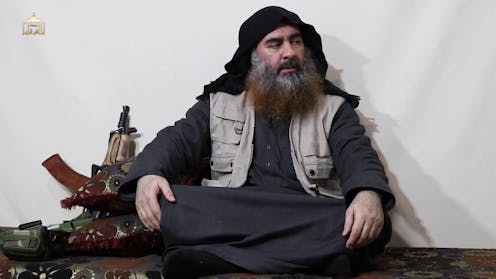
“A very bad man” has been killed and “the world is now a much safer place”. The sentiment behind US President Donald Trump’s announcement of the death of Islamic State (IS) leader Abu Bakr al-Baghdadi is difficult to argue with. Baghdadi was certainly a very bad man. And under his decade-long leadership of the Islamic State (IS) movement, many thousands of people in the Middle East and around the world suffered terrible brutality or death.
Common sense would suggest the world is indeed now a much safer place with Baghdadi’s passing. Unfortunately, however, there is no guarantee this will prove to be true in practice.
The 18 year-long so-called Global War on Terror in the wake of the September 11 attacks – the international military campaign to fight al-Qaeda, and then IS – has been almost entirely reactive and tactical.
It has lacked any consistent strategic purpose, whether in Afghanistan, Iraq, Syria, Somalia, the Philippines or anywhere else.
The strongest military coalitions the world has ever seen have fought the largest and most powerful terror networks that have ever existed. And this has led, directly and indirectly, to hundreds of thousands of lives lost, trillions of dollars spent and remarkably little progress overall.
Read more: US retreat from Syria could see Islamic State roar back to life
The special forces raids targeting Baghdadi, in Idlib, and his deputy, IS spokesperson Abul-Hasan al-Muhajir, in Aleppo, were undoubtedly significant achievements representing tactical victories of great consequence.
IS has been dealt an enormous blow. But just how long its impact will last is not clear. The lessons of the past two decades make it clear this will certainly not have been a fatal blow.
The IS insurgency, both on the ground in Iraq and Syria, and around the world, was rebuilding strength before these strikes and will not be stopped in its tracks by losing its two most senior public leaders.
Baghdadi as IS leader
Baghdadi may not be irreplaceable but in many respects he was uniquely suited to the times in which he led. He oversaw the rebuilding of IS from its previous low point a decade ago. He played a key role in expanding into Syria, replenishing the leadership ranks, leading a blitzkrieg across northern Iraq, conquering Mosul and declaring a caliphate. In the eyes of his support base, his credibility as an Islamic scholar and religious leader will not easily be matched.
He was not a particularly charismatic leader and was certainly, as a brutal, fundamentalist loner, not truly inspirational. But he played his role effectively, backed up by the largely unseen ranks of former Iraqi intelligence officers and military commanders who form the core of the IS leadership.
He was, in his time, the caliph the caliphate needed. In that sense, we will not see his like again.
Incredibly, 15 years after Abu Musab al-Zarqawi established al-Qaeda in Iraq, and almost ten years after Baghdadi took charge of the Islamic State in Iraq, there is so much about the leadership of IS we don’t understand.
What is clear is the insurgent movement benefited enormously from so-called “de-Baathification” - the ridding of Arab nationalist ideology – in the wake of the 2003 invasion of Iraq and toppling of the authoritarian regime of Saddam Hussein. The sacking of thousands of mostly Sunni senior military leaders and technocrats proved to be a windfall for the emerging insurgency.
IS has always been a hybrid movement. Publicly, it presents as a fundamentalist religious movement driven by religious conviction. Behind the scenes, however, experienced Baathist intelligence officers manipulated religious imagery to construct a police state, using religious terror to inspire, intimidate and control.
This is not to say Zarqawi and Baghdadi were unimportant as leaders. On the contrary, they were effective in mobilising religious sentiment first in the Middle East and then across the world. In the process, more than 40,000 people travelled to join the ranks of IS, inspired by the utopian ideal of religious revolution. Baghdadi was especially effective in playing his role as religious leader and caliph.
An optimistic take on Baghdadi’s denouement is that IS will be set back for many months, and perhaps even years. It will struggle to regain the momentum it had under his leadership.
Realistically, the extent to which this opportunity can be capitalised upon turns very much upon the extent to which the emerging leaders within the movement can be tracked down and dealt with before they have a chance to establish themselves.
What might happen now?
It would appear IS had identified the uncontested spaces of north-western Syria in Idlib and Aleppo, outside of the control of the Assad regime in Damascus, of the Syrian Democratic Forces (SDF) in Northeast Syria, and beyond the reach of the Iraqi government in Baghdad, as territory in which its leadership could relocate and rebuild.
Continuing the optimistic take, there is the slim hope that the success of Sunday’s raids in which the partnership between US special forces and the SDF was so critical will lead to Trump being persuaded to reverse his decision to part ways with the SDF and pull out their special forces partners on the ground, together with accompanying air support.
Read more: The 'ceasefire' in Syria is ending – here's what's likely to happen now
The fact Baghdadi and Muhajir were both found within five kilometres of the Turkish border suggests Turkish control of northern Syria is, to say the least, wholly unequal to the task of dealing with emerging IS leaders.
A reset to the pattern of partnership established over the past five years with the largely Kurdish SDF forces in north-eastern Syria could prove critically important in cutting down new IS leaders as they emerge. It’s believed the locations in northern Syria of the handful of leaders most likely to step into the void left by Baghdadi’s passing are well-known.
But even in the best-case scenario, all that can be realistically hoped for is slowing the rebuilding of the IS insurgency, buying time to rebuild political and social stability in northern Syria and northern Iraq.
Authors: Greg Barton, Chair in Global Islamic Politics, Alfred Deakin Institute for Citizenship and Globalisation, Deakin University

















