

Modern Australian
Men's Weekly

.

In his last book, Julian Barnes circles big ideas and reflects on his shortcomings

  • Written by Patrick Flanery, Chair in Creative Writing, Adelaide University

Julian Barnes, author of 14 previous novels, ten volumes of nonfiction, and three collections of short stories under his own name, plus four crime novels under the pseudonym Dan Kavanagh, has announced that his new novel, Departure(s), will be his last. The narrator – who both is and is not Barnes – tells us this directly and the information has accompanied advance notice from his publisher. This kind of framing necessarily invites the reader to judge the book as a capstone to his career.

Review: Departure(s) – Julian Barnes (Jonathan Cape)

For more than four decades, in ways distinct from near contemporaries like Martin Amis and Ian McEwan, Barnes has tried to awaken the English novel from its long fantasy of isolation, reminding it of its relation to European – and particularly French – literature.

For many years, his novel Flaubert’s Parrot (1984) was a foundational work in undergraduate courses in postmodern literature. But it has always felt to me as though this obscured the importance of the intervention Barnes was making.

His close reading of French literature translated formal experiment from the continental into the late-20th century English novel. Doing so, he opened the avant-gardism of anglophone late-modernism once again to the possibilities of a more European sensibility.

Illness and memory

It is no surprise to open Departure(s) and find Barnes employing fragmentation, lists, notes and quasi-philosophical musings, while refusing almost entirely to engage with any narrative structure that might resemble a plot.

There is a story of sorts, and the narrator tells us early on that one will be coming, though it is, he says, a story with no middle. Indeed, the five-part form of Departure(s) bookends and bisects the “story”. There is a central section about Barnes himself, and meditative opening and closing sections that reflect on larger questions – not only in relation to literature, but life more broadly.
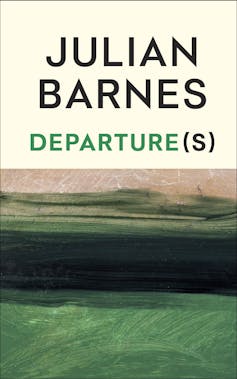
In his last book, Julian Barnes circles big ideas and reflects on his shortcomings
This makes sense for a writer whose life over the past 25 years has been marked by great career successes – including the Booker Prize for The Sense of an Ending (2011), after a succession of shortlistings – as well as the tragedy of his wife Pat Kavanagh’s sudden death from brain cancer in 2008 and, more recently, his own chronic illness. In 2020, Barnes, and the semi-fictional Barnes who narrates Departure(s), learned he had a form of blood cancer. He tells us that it will be with him until the end of his life, even if it is not the disease that kills him. Grappling with this new condition, he turns to last things: to an accounting of his own shortcomings and to memory more generally. Here we have reflections on Proust’s madeleine-induced stream of recollection, alongside Barnes’s thinking about the phenomenon of Involuntary Autobiographical Memory, or “IAM”. Barnes notes the case of a stroke victim, who claimed that eating a piece of pie released recollections of every pie he had ever eaten in order of consumption. He is at first horrified by the prospect of experiencing such a thing, until he realises that “IAMs would certainly help with autobiography”, particularly when recalling “moral actions and inactions”. The novel’s “story” proper, when we get to it, concerns the narrator’s role in twice bringing together a couple: Stephen and Jean. He met them when all three were students at Oxford in the 1960s, and they met again 40 years later. Their “friendship”, such as it was, lasted little more than two periods of a year and a half either side of that 40-year gap. The Barnes character had once been Jean’s lover, and his “moral actions and inactions” come to the fore in his account of these friends, now dead, for he promised Stephen and swore to Jean on a Bible that he would never write about them. There is here a return to some of Barnes’s longstanding interests as a novelist. Gaps in characters’ knowledge of one another become points of fixation or rupture. One of the fears besetting some novelists is that they may fall victim to their own Rumsfeldian “unknown unknowns”. We know what we know about characters, story, theme, and so on. And we think we know what we don’t know (the discernible limits of our knowledge). But there is always the risk of a work being fractured internally by a force whose presence has remained beyond thinkability. This might be as simple as a hole in a plot, or as significant as an ideological blind spot. Tics and irritants Though I suspect Barnes would assert that he was in total control of this book, there were moments when I wondered. For instance, odd tics create a distancing effect where they might have been intended to do the opposite. Barnes has a habit of addressing the reader with self-conscious asides (“don’t you find?”) that feel more conversational than writerly. There is also a curious refusal to name the male anatomy by its proper terms (though not so with the female). He uses schoolboy constructions such as “bum cancer”, rather than, say, “colon” or “rectal”. This is despite his being medically precise about his actual illness, its names, and its diagnosis and treatment. There are also a few uncomfortable moments referring to homosexuality. We have “old Muckface, who turned out gay in the end”. The narrator suggests it would have been especially disturbing to find “a collection of dildos with dried blood on them” in Stephen’s home and refers to “schoolmasters we thought dodgy”. The latter are the only examples of gay people the narrator claims to have encountered as a child. In his last book, Julian Barnes circles big ideas and reflects on his shortcomings
Julian Barnes. Urszula Soltys/Penguin Random House

Barnes hastens to welcome progress that makes society more accepting, but this does not, for this reader, counterbalance the implied equation of “dodgy” character or predatory habits with homosexuality, nor his vivid and horrified amusement when imagining his friend might have a secret inclination towards anal eroticism.

In another vein, we have the narrator choosing to call Uluru by its colonial name, almost intentionally, it seems, to irritate a certain kind of reader.

These demurs might suggest significant irritation, but this is not the case. What I want from a writer of Barnes’s intelligence, however, is a handling of identity and representation worthy of his mind and talent.

I’m on Barnes’s side for much – though certainly not all – of the book. It is refreshing to open a contemporary novel in English and find that story and plot are second-order concerns, and that revealing the story in a review would not risk ruining the pleasure – and interest – of reading the book. Spoilers spoil nothing here.

But then I reach a conundrum, for Barnes offers this summary of a writer’s aims:

All writers want their words to have an effect. Novelists want to entertain, to reveal truth, to move, to provoke reverie. And beyond? Do they want their readers to act as a result of their words? It depends.

This seems to sketch the limits of Barnes’ aspirations for his art, assuming he thinks of his novels as art and not as mere entertainments. What, for me, is missing from that list is the possibility that a novelist might want to make readers think about the larger questions in more than a state of “reverie”, a word that implies the amorphousness of daydream.

Barnes appears to be placing himself in a tradition running parallel to but separate from that of British novelists-of-ideas of an earlier generation like Iris Murdoch, or his contemporary Ian McEwan, and younger writers like Zadie Smith. For all of these writers, I suspect that provoking serious thought is as important – and likely more important – than producing an emotional response (its own kind of thought, to be sure) or simply to entertain.

It is an odd final manoeuvre because Barnes is a novelist interested in thinking and thought. He has made a career of circling big ideas. But in the end, assuming this is truly the end, it is hard not to feel that he seems embarrassed to find himself so seriously interested in those larger questions, or so interesting to the readers who may continue to turn to his books for more than mere reverie.

Authors: Patrick Flanery, Chair in Creative Writing, Adelaide University

Read more https://theconversation.com/in-his-last-book-julian-barnes-circles-big-ideas-and-reflects-on-his-shortcomings-270652

The Expert's Guide to Understanding Large Bore Steel Pipe Specifications

When it comes to infrastructure, construction, and various industrial applications, the choice of materials is paramount. Among the options availabl...

Preparing for Your First Trip to San Francisco in 2026

San Francisco has long occupied a particular place in the Australian imagination. It is compact yet complex, progressive but historic, and visually st...

Modern Office Painting in Australia - It's the Real Game Changer

Walk into any modern Australian office today and you'll be struck by the fact it's a whole different beast from the ones we grew up with. Gone are t...

How to Choose the Right Suburb for Your Lifestyle

Choosing the right suburb is one of the most important decisions you’ll make when buying or renting a home. Beyond the property itself, the suburb...

Considering Cryolipolysis Fat Freezing? Here’s What You Need to Know

Body confidence can shift over time, and sometimes even good diet and training can still leave a stubborn area of fat that won’t budge. If you’r...

From Local Tradie to Digital Leader: The Strategy Behind Auto Gate Guys Sydney’s Growth

For many small trade businesses, digital marketing still feels like a buzzword, not a necessity. They rely on word-of-mouth referrals, repeat clients...

Electric Automation System: Smarter Control for Modern Electrical Infrastructure

Modern buildings and industrial facilities are increasingly dependent on intelligent control and efficiency. An electric automation system brings t...

The Damp Truth: Why Your Overflowing Gutters Are an Open Invitation for Termites

When it comes to protecting your home, most people think about visible threats — storm damage, cracked tiles, break-ins. But one of the most destruc...

Is Your Inventory a Sitting Duck? 2 Critical Upgrades to Protect Your Business Assets and Your Bottom Line

Imagine this: you finish a long day on the job, lock up your tools, materials, and work vehicle in the garage, and head home. But overnight, someone b...

Electrician in Melbourne: Reliable Electrical Solutions for Homes and Businesses

Finding a dependable electrician Melbourne is essential when safety, efficiency, and long-term performance matter. Electrical systems form the back...

Rims and Tyres for Sale in Sydney: Performance, Safety, and Style Combined

Finding the right rims and tyres for sale Sydney is about far more than appearance. Tyres and rims directly influence how a vehicle handles, brakes...

Why Access to Doctors in Bundoora Is Essential for Ongoing Community Health

Reliable access to healthcare plays a vital role in maintaining physical wellbeing and peace of mind. Having trusted doctors in Bundoora available ...

Pendant Lights: Elevating Interior Spaces With Style and Purpose

Well-chosen pendant lights have the power to transform interiors by combining focused illumination with strong visual impact. More than just a ligh...

What Sets Professional Family Lawyers in Sydney Apart from General Lawyers?

Choosing the right legal support can make a noticeable difference when dealing with family-related matters. This article will explore what separates...

Balancing Teen Academic Expectations and Wellbeing

For many teenagers, school years are shaped by increasing expectations. Academic performance, future pathways, and comparison with peers can create pr...

Why Ceiling Fans Remain One of the Most Effective Solutions for Year-Round Comfort

Creating a comfortable indoor environment without relying heavily on energy-intensive systems is a priority for many households. Installing ceiling ...

Why an Industrial Air Compressor Is Vital for Modern Manufacturing

In many industrial environments, compressed air is as essential as electricity or water. An industrial air compressor provides the power needed to ...

Why Commercial Carpet Cleaning Services Matter for Professional Spaces

Clean carpets play a major role in shaping how a commercial space looks, feels, and functions. Commercial carpet cleaning services are essential fo...
















