What we know about croc numbers in the NT after surge in floodwater sightings
- Written by: Brandon Michael Sideleau, PhD student studying human-saltwater crocodile conflict, Charles Darwin University
Recent crocodile sightings in floodwaters in the Northern Territory have prompted widespread concern, particularly in the town of Katherine and along the Daly River.
Katherine Mayor Joanna Holden told media she had never seen so many crocodiles in local flood waters before:
“There was actually a saltwater crocodile on the AFL oval last night”, she said. “It just adds another element of danger to the whole cleanup”.
Despite what you might assume, this isn’t about a surplus of crocs. In fact, there has been no significant growth in crocodile numbers in the Top End as a whole in more than a decade. But this is the highest flood in 30 years for Katherine, meaning crocodiles can more easily swim to areas they do not usually go.
And not every crocodile brings the same level of risk, which is why it’s useful to know more about the two crocodile species that call the Top End home.
One territory, two species of croc
The NT is home to two native crocodilians, the name for the large, predatory and semi-aquatic reptiles belonging to the order Crocodilia, which includes alligators, crocodiles, caimans and gharials.
These are the saltwater crocodile, Crocodylus porosus, and the freshwater crocodile, C. johnstoni, known colloquially as “salties” and “freshies”, respectively.
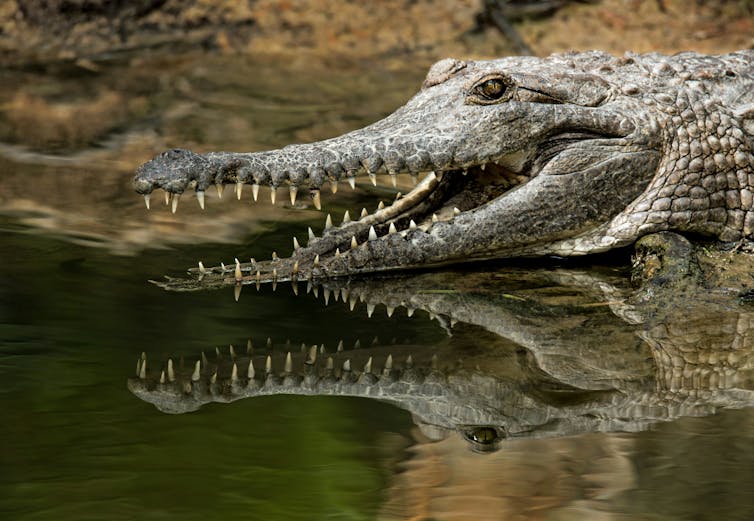
Freshies are slender animals that rarely exceed three metres, with a thin snout evolved for catching fish. They pose no real danger to humans, though they can certainly inflict a painful bite. Freshies are found in greatest numbers in freshwater habitat such as rivers, swamps and lakes, rather than tidal areas. And they are abundant in the Top End.
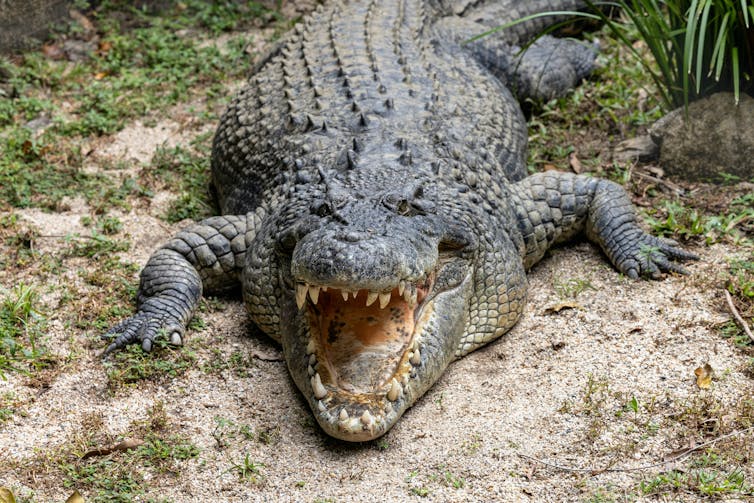
Salties are a different matter entirely. Male salties can exceed six metres on rare occasions. One 6.2m individual was found drowned in a fishing net in the Fly River of Papua New Guinea in 1980. It weighed more than a tonne. These reptiles can prey on virtually anything that enters their territory — including humans — and can be found in tidal and freshwater habitat throughout the Top End.
Salties were hunted almost to extinction during the postwar hide-hunting era. But legal protection introduced in the early 1970s allowed the population to recover dramatically.
Long-term spotlighting surveys for both types of crocodiles have been carried out across the NT’s major tidal rivers, using powerful lights to find the reflective eyes of half-submerged crocs. These have documented a recovery now approaching pre-exploitation levels, with a population of around 100,000 non-hatchlings. Growth is now levelling off as the wild population reaches its maximum size. The population has not significantly increased for more than a decade.
Despite their name, salties are not a marine species. They are freshwater animals and found in large numbers in tidal rivers and freshwater swamps. They get their name from the fact that they can, and do, move long distances at sea and along the coast.
Floods accelerate their range
Across their range, salties have been recorded travelling considerable distances up major river systems. In Papua New Guinea they are found far inland along the Fly and Sepik river basins, and in Borneo they have been documented more than 900km up the Kapuas river system.
Closer to home, salties have been recorded moving progressively further up freshwater rivers as the population has recovered. Animals have been recorded up to 235km inland.
Flooding can accelerate this process by allowing salties to move into new areas. A striking example occurred in 2019 when a 4m saltie was found at Kalkarindji, roughly 550km up the Victoria River from the NT coast. It had apparently moved inland during flooding the previous wet season.
What happened in Katherine?
The Katherine River is predominantly freshie habitat. Freshies are found in rivers, lagoons and billabongs upstream and away from the coast, including in elevated escarpment country.
Safety information at the NT government’s Nitmiluk (Katherine Gorge) National Park notes both saltwater and freshwater crocodiles inhabit the park. This area is designated as a “managed removal zone” under the NT Saltwater Crocodile management plan — meaning salties do periodically enter and are actively removed.
Salties had been absent from the freshwater Katherine River for more than two decades before beginning to reappear in the mid-1990s as the recovering population expanded its range upstream.
It’s likely most crocodiles being sighted around Katherine, which is 320km south of the coast, during the current flooding are freshies — including some large individuals.
But salties are also likely present to be there, albeit in fewer numbers. Residents and visitors should remember to be “crocwise” at all times. All flooded waterways in the Top End could potentially contain salties unless confirmed otherwise.
The situation near Nauiyu, south of Darwin on the Daly River, is very different. Salties of all sizes are common in the Daly River in large numbers. Their presence has been monitored since 1975. Attacks on humans in the Daly River region have occurred historically, so this area must be considered high-risk during current flooding.
Staying safe around crocodiles
Residents in affected areas should avoid all contact with floodwater wherever possible, and evacuation remains the safest option. If evacuation is not possible, maintain distance from floodwater. Large salties can attack in very shallow water, making wading through floodwater dangerous.
If access to floodwater cannot be avoided, do not use the same location repeatedly. Salties are known to observe and learn predictable human routines at the water’s edge. Livestock, pets and organic waste attract crocodiles and should be kept well away from floodwater.
Regardless where you are in the NT, treat floodwater as if a saltie could be in it.
Authors: Brandon Michael Sideleau, PhD student studying human-saltwater crocodile conflict, Charles Darwin University