

How the war in Iran has brought European countries closer together – without Trump
- Written by: Romain Fathi, Associate Professor, School of History, ANU / Chercheur Associé at the Centre d’Histoire de Sciences Po, Australian National University
The United States under President Donald Trump and the European Union have a complicated relationship. On one hand, European countries and the US have built some of the strongest alliances since the end of the second world war. On the other, since the start of Trump’s second term in 2025, they have openly clashed on significant issues: tariffs, NATO contributions, Palestinian statehood, Israel’s interventionism, Ukraine support levels and Greenland’s sovereignty.
Trump’s sudden war on Iran is the latest of these clashes, but it is distinctive because it is shaking the world’s economy. The US war on Iran, alongside Israel’s war on Lebanon, is accelerating a notable reshaping of European alliances and strategic thinking about the union’s future.
The EU has more than 450 million inhabitants, and its GDP is nearly on par with that of the US or China. Despite its polymorphic nature, and in fact perhaps because of it, it is a world player that can exercise considerable sway over international affairs.
European leaders are now attempting to drive a lasting ceasefire, and perhaps even peace, between the US and Iran, with the aim of reopening the strait of Hormuz as soon as possible.
A non-UN/NATO sanctioned conflict
EU countries believe in the rules-based order and international institutions. This is not only because of their democratic constitution and values, but also because they offer them better protection than “might makes right”.
Trump’s unilateral war on Iran sits well beyond international conventions. It was neither sanctioned by a UN mandate or resolution, nor approved by NATO. As a result, European leaders have refused to contribute.
Spain and Italy have outwardly refused to allow US weapon-carrying planes bound for the Iran conflict to use their bases. Meanwhile, France is taking a more case-by-case approach in authorising or declining use of its airspace as part of operations linked to the conflict.
Spain, Italy, Germany, France and the United Kingdom have also refused to send direct military support to contribute to Trump’s war. However, France and the UK are willing to deploy within a peace or maritime security framework once the war is over.
Europe united, at last?
Trump’s war on Iran has accelerated a much deeper, more significant process: the coordination of European leaders on central issues such as European strategic independence in defence, diplomacy and energy.
Since Trump’s return to the Oval Office, there has been a subtle but important diversification of the EU’s diplomatic and military agreements with regional partners. Six such agreements have been signed by the EU, followed by a dozen more bilateral agreements of its member states with other countries.
This greater European coordination is being validated and reinforced by the war in Iran. The global disruption in the production and circulation of petro-based products generated by the near total closure of the Straight of Hormuz is prompting urgent European responses.
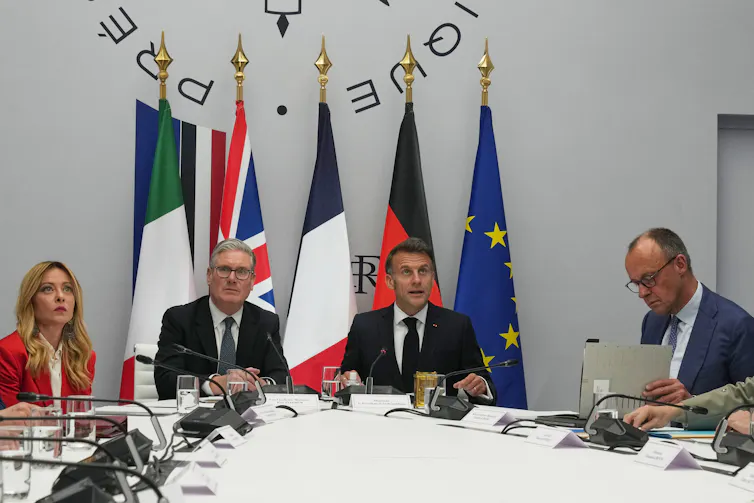
On April 17, in Paris, UK and French leaders Keir Starmer and Emmanuel Macron, flanked by their German and Italian counterparts Friedrich Merz and Giorgia Meloni, co-presided over a conference on navigation in the Strait of Hormuz. They were joined by 49 other countries, with more than half of the EU’s member states present alongside representatives of EU institutions and international organisations.
The meeting proposed the “full, immediate, and unconditional reopening of the Strait of Hormuz”. The leaders agreed to start planning, from London next week, a neutral mission to guarantee safety and free passage in the strait.
The war in Iran and Trump’s criticisms of the pope have ruptured Trump’s relationship with Meloni, whose electoral base has grown worried about the US president’s unpredictability.
A shifting tide
For a time, Trump and the MAGA movement had worked hard, and somewhat successfully, to drive a wedge between European leaders. They supported the far right in Germany, Viktor Orbán in Hungary, and Meloni in Italy.
But, just three days before Meloni arrived in Paris, Orbán faced an enormous electoral defeat. During the 16 years of his iron-fist rule in Hungary, the pro-Russian Orbán had been a critic of Europe, creating considerable headaches for the EU by blocking a range of initiatives and providing sensitive information to his friend Vladimir Putin. His replacement by a more moderate leader, Péter Magyar, has sparked significant hope in European chancelleries for greater unity.
Read more: What Viktor Orbán’s election loss means for Putin, Trump and the rise of right-wing populism
The internal divisions that Trump relied on to deal with Europe are eroding.
Furthermore, his threats to acquire Greenland only months ago were met by immediate European reactions such as putting a commercial agreement with the US on ice, launching operation “Arctic Endurance”, and affirming Danish and European sovereignty. The EU has once again shown its ability to resist Washington’s pressures and affirm its strategic autonomy.
Where now for Europe?
These episodes in national and international affairs have prepared the ground for a more united approach to the current crisis. European leaders, so often hampered by divisions exacerbated by Russia and the US, are now in a unique position to weigh in on the current Iran crisis and the shock it is delivering to the global economy.
This is because the concerns that unite them – energy security, potential inflation and unemployment – overrule any ideological affinity towards Moscow or Washington.
Besides greater diplomatic integration of European member states, the current crisis is also a catalyst for the European Commission to accelerate its efforts to limit consumption of fossil fuel, safeguard supply networks and accelerate the electrification of Europe’s economies through nuclear and renewables.
Paradoxically, the Iran and Hormuz crises have – as Russia’s invasion of Ukraine did in 2022 – driven further European integration. This renewed faith in a European voice is happening both between member states and between European institutions such as the European Parliament, the European Commission and the Foreign Affairs Council.
This rapprochement between European leaders is starting to yield outcomes beyond the Iranian crisis. Visiting Polish Prime Minister Donald Tusk on April 20, Macron declared he was “reasonably optimistic” for a “new era in Europe”, starting with more support for Ukraine, previously vetoed by the departed Orban.
The significant disruptions created by Trump’s attack on Iran may well have the side effect of a more autonomous and sovereign Europe. Despite the tensions between the US and European states, all have an interest in a peaceful Iran – and Ukraine.
For some in Europe, the war in Iran may be resolved amicably if further collaboration is achieved through US support in Ukraine.
Authors: Romain Fathi, Associate Professor, School of History, ANU / Chercheur Associé at the Centre d’Histoire de Sciences Po, Australian National University


















