













What do your earliest childhood memories say about you?
- Written by: Penny Van Bergen, Senior Lecturer in Educational Psychology, Macquarie University
We experience thousands of events across childhood, and yet as adults we recall only a handful. Some might be “firsts” (our first ice cream, our first day at school), or significant life events (the birth of a sibling, moving house). Others are surprisingly trivial.
So, what do your earliest childhood memories say about you? Do they reflect your early skill for remembering, your interests, or your individual experiences?
The answer to all three questions is yes – but this is not the whole story. Although we sometimes see memory as a video camera, recording our lives accurately and without bias, this is a myth.
Instead, our childhood memories are intricately shaped by our family and culture.
Read more: What outcomes parents should expect from early childhood education and care
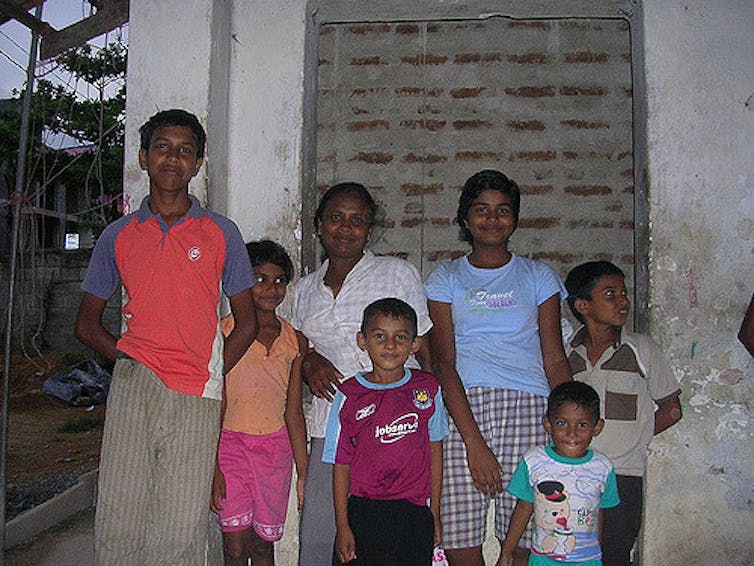 Most people don’t remember events that took place before the age of 3-4 years.
mikecogh/flickr, CC BY
Most people don’t remember events that took place before the age of 3-4 years.
mikecogh/flickr, CC BY
Our first memories
If you can’t remember life as an infant, you’re not alone.
As adults looking back to childhood, we cannot typically recall anything before age 3-4 years. This phenomenon is known as infantile amnesia.
Although some individuals report very early memories of being walked in their pram as a baby, or falling asleep in a cot, these memories are likely to be fictional.
One of the most important developments for the onset of memory is language. Research shows that language is needed not just for sharing our experiences, but for encoding them.
For example, young children invited to use a fictional “magic shrinking machine” could only recall this one year later if they had the appropriate vocabulary at the time of the event.
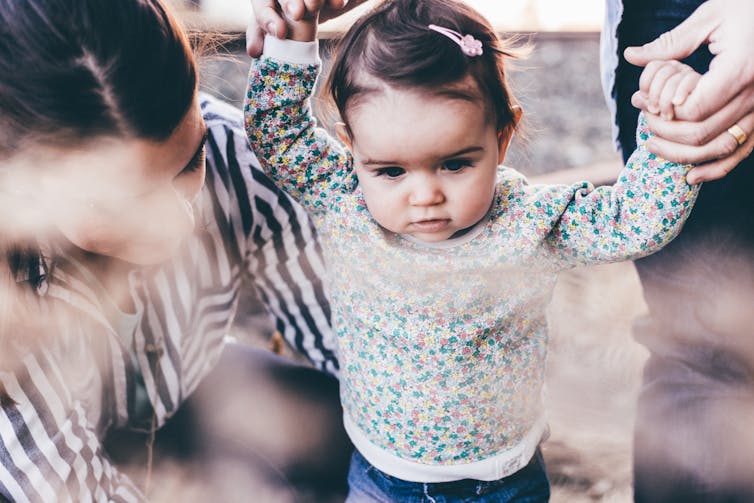 Vocabulary is an important component of memory formation.
Priscilla Du Preez/Unsplash
Vocabulary is an important component of memory formation.
Priscilla Du Preez/Unsplash
We also know that bilingual adults who immigrated as children recall early memories in the language they spoke at the time the memory was formed.
In addition to language, children must also develop a coherent sense of self, or of “who I am”. This emerging development allows them to pin events to a personal story that is continuous across time. The sense that “this happened” develops into a deeper understanding that “this happened to me”.
Read more: Learning languages early is key to making Australia more multilingual
Family factors
While the development of language and sense of self enable our earliest childhood memories to form, family factors shape their contents.
Within families, parents reminisce with their children multiple times a day – reliving family holidays, for example, or bonding over sibling hijinks, or reflecting on past transgressions to discuss the lessons learned. Interestingly, however, there are strong individual differences in the way they do so.
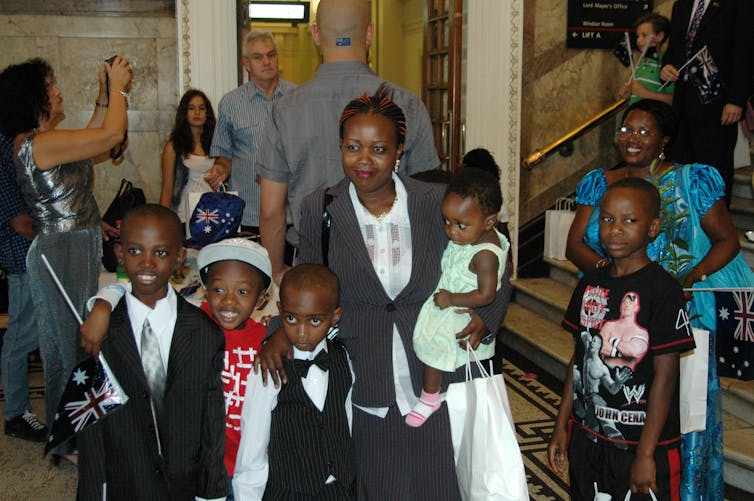 How we talk to our kids plays a big role in how they remember events.
David Barbeler/AAP
How we talk to our kids plays a big role in how they remember events.
David Barbeler/AAP
Some parents use a highly “elaborative” reminiscing style: asking questions and providing event detail and structure in a way that scaffolds and encourages the child’s own contribution. Others are less elaborative.
Some parents also focus particularly on emotional content (“She was really sad! Why did she start crying?”), while others focus more on factual details.
These individual differences have important implications, with children eventually coming to adopt the personalised style of their parents: first during shared reminiscing conversations, and later in their own independent memories.
Read more: Parents can promote gender equality and help prevent violence against women. Here's how
What style of parent are you?
Here’s an example of a conversation between a highly elaborative mother and her pre-school aged child.
Mother: You and Daddy put the Christmas tree up together, and then you put on decorations! What decorations did you put on?
Child: Um… the Christmas balls!
Mother: That’s right! Daddy bought Christmas balls and stars to hang on the tree. What colours were they?
Child: Red and gold.
Mother: Red and gold. Pretty red balls, and gold stars.
Child: And there was the paper circles too.
In contrast, below is a conversation between a less elaborative mother and her preschool aged child.
Mother: I’m going to ask you about your preschool Christmas concert. Was that good?
Child: Yeah
Mother: What happened there?
Child: Dad came
Mother: Yes, but what happened?
Child: I don’t know.
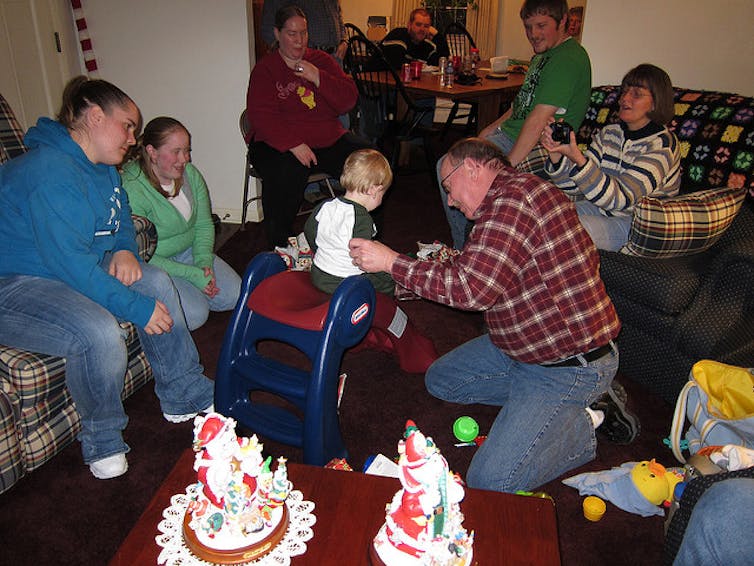 It’s unlikely you remember your first Christmas – but you may have heard stories about it.
sneakerdog/flickr, CC BY
It’s unlikely you remember your first Christmas – but you may have heard stories about it.
sneakerdog/flickr, CC BY
Broader family structures and experiences also play a role. In Italy, children growing up in intergenerational households tend to have both earlier childhood memories and more childhood memories than children growing up in traditional nuclear families. This probably occurs due to more opportunities to engage in rich and elaborative reminiscing conversations.
In contrast, parents and children experiencing depression may show a tendency for “overgeneral memory” – that is, difficulty recalling specific memory details. Poorer quality parent-child reminiscing is related to overgeneral memory among three- to six-year-olds.
Cultural factors
Just as our earliest childhood memories reflect our reminiscing conversations with our parents and our overarching family experiences, they also appear to reflect broader cultural practices and norms.
Consistent with the “individualist” values of Western culture, American college students’ earliest childhood memories are typically long, specific and self-focused.
Consistent with the “collectivist” values of Chinese culture, Chinese students’ earliest childhood memories are typically brief, and more likely to reference social responsibilities.
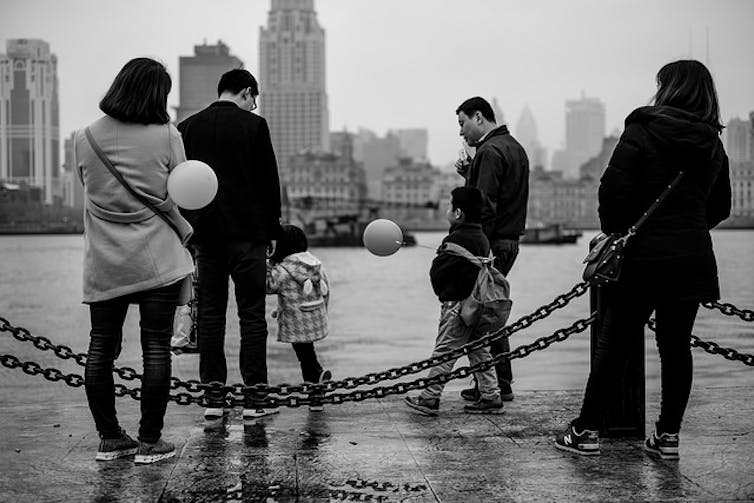 Social responsibilities are emphasised in Chinese culture.
56218409@N03/flickr, CC BY
Social responsibilities are emphasised in Chinese culture.
56218409@N03/flickr, CC BY
American mothers are also more likely than Chinese mothers to focus on their child’s own personal emotional experiences when remembering together, and it is likely that these early parent-child conversations serve as a mechanism for imparting cultural norms.
Read more: How children's picturebooks can disrupt existing language hierarchies
In New Zealand, where Māori culture includes a rich oral tradition in which stories are shared across generations, Māori mothers have been found to reminisce differently to Pākehā (European New Zealand) mothers about important life events. When talking with their children about their own birth stories, for example, Māori mothers include more elaborations, more references to emotion, and more references to relational time.
Interestingly, Māori also have the earliest average age of first memory on record. At 2.5, these earliest memories occur a full year earlier than in some other groups.
So the research is clear: our earliest childhood memories are intricately shaped by our experiences within our own families and cultures.
The process of memory formation is nothing like a video camera.
Authors: Penny Van Bergen, Senior Lecturer in Educational Psychology, Macquarie University
Read more http://theconversation.com/what-do-your-earliest-childhood-memories-say-about-you-101330


