

Jacinda Ardern promised transformation — instead, the times transformed her
- Written by Richard Shaw, Professor of Politics, Massey University
Three years ago everything felt so different. Our borders were open, no one knew what PPE stood for, and social distancing was something people did when they felt awkward at parties.
Jacinda Ardern had not long taken over leadership of the New Zealand Labour Party. Amid breathless talk of “stardust”, “Jacindamania” and “transformation”, she was busy hauling the party out of the polling doldrums towards 36.9% of the vote at the 2017 election — and the prime ministership.
Then a lot of things happened. A white supremacist murdered 51 of our people at two Christchurch mosques. Whakaari/White Island erupted, killing 21 and injuring more. And a global pandemic spread, leading to two extended periods of lockdown in New Zealand and a decision by Ardern to postpone the election from September 19 to October 17.
These three crises have defined Ardern’s first term in office. At least for now, a great many people are withholding judgement on her administration’s modest (at best) performance on reducing child poverty, replenishing the stock of public housing and shifting the dial on income and wealth inequality.
Instead, it is Ardern’s poise under pressure, calmness and ability not to rise to anything faintly resembling bait that has deeply resonated. As much as anything else, in times of crisis it has been her way with words that has registered: “They are us”, “The team of five million” and “Go hard and go early” are now part of the vernacular. Ardern’s language is one that New Zealanders intuitively understand.
Some of this may stem from Ardern’s understated background in what is colloquially described as the “real” New Zealand. It’s a misleading term, of course, because it implies there are parts of the country that are somehow not real.
But people know what it means: a modest upbringing in a small town, a bit of religion, some part-time work while at school. They hear these things in Ardern’s accent, and see them in her green Facebook sweatshirt. It makes her approachable — the nerdy kid you know would give you a hand with your homework if you needed it.
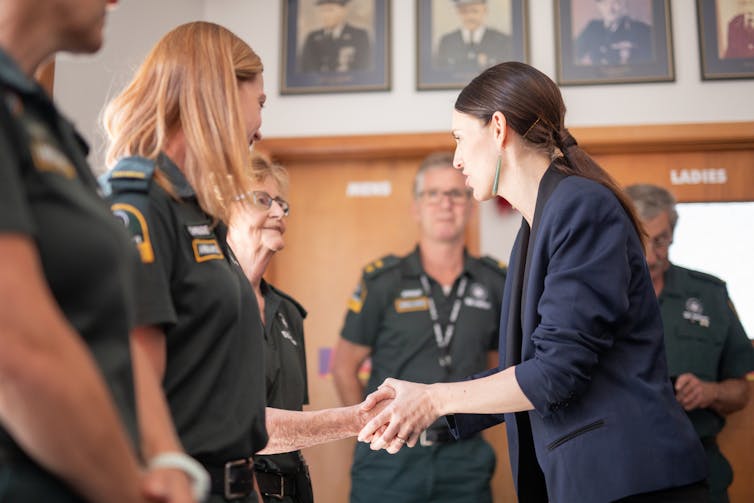 Authenticity and reassurance: Jacinda Ardern meets ambulance officers who helped those injured in the Whakaari/White Island volcano eruption.
GettyImages
Authenticity and reassurance: Jacinda Ardern meets ambulance officers who helped those injured in the Whakaari/White Island volcano eruption.
GettyImages
From transformation to recovery
This sense of authenticity goes at least some way to explaining why the prime minister and her party have polling figures to die for as they head into the final days of the election campaign.
Notwithstanding a second spell in lockdown, public confidence in the government’s handling of the COVID crisis remains high. As preferred prime minister, Ardern is streets ahead of her major rival, National’s Judith Collins. Despite some tightening in recent weeks, on present polling Labour is still within range of governing alone, something that has never happened under the country’s MMP electoral system.
Read more: NZ election 2020: as the ultimate political survivor, Judith Collins prepares for her ultimate test
Labour’s polling is just one thing setting this year’s election apart from the last one. The emotional climate is also strikingly different. Labour’s campaign slogan — Let’s Keep Moving — is just this side of beige. There are no big-ticket policy items to match 2017’s proposed capital gains tax, KiwiBuild or plans for light rail in Auckland. The rhetoric of transformation has been replaced by the language of recovery.
Yet transformation is not far off the mark, especially where Ardern herself is concerned. Three years ago she was the newly minted leader of her party and something of a political curiosity. Many doubted she had the ability to save her party from an electoral thrashing, let alone become prime minister.
Since then, she has become a mother, led the country through a series of crises, and made more hard calls and tough decisions than any New Zealand prime minister in recent memory. She has become a seasoned leader — and one of the most popular prime ministers in the nation’s history.
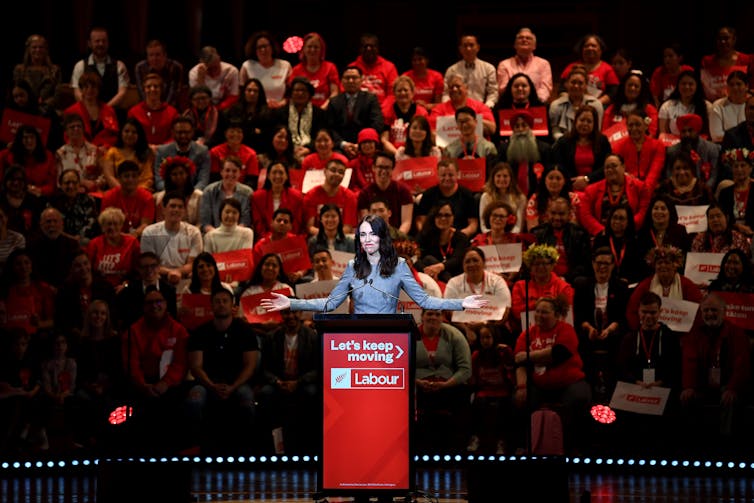 A slogan just this side of beige: Ardern speaks at the Labour Party election campaign launch in August.
GettyImages
A slogan just this side of beige: Ardern speaks at the Labour Party election campaign launch in August.
GettyImages
Pragmatism over ideology
Ardern’s personal trajectory mirrors — and to some degree has driven — a shift in the tone of New Zealand politics. Transformation is probably too strong a word for it, but something is happening and it is reflected in Ardern’s approach to leadership.
The prime minister appeals less to conviction than to disposition. Her approach resonates with people for whom politics is fundamentally relational rather than ideological.
Ardern is no ideologue. She gives people who don’t agree with her party’s policies permission to vote for her. It’s the kind of leadership that can change what counts as political common sense, and it appeals to a lot of people in times of stress and uncertainty.
Read more: Analysis shows how the Greens have changed the language of economic debate in New Zealand
Ardern’s pragmatism has led to accusations from the left that she has been insufficiently adventurous, that she has morphed from transformational candidate into conservative leader.
Exhibits A and B for the prosecution are Labour’s small-t tax policy and the response to the gendered employment effects of COVID: a disproportionate number of women have lost their jobs this year, but the bulk of the “shovel-ready” projects supported by the government as part of the COVID response are in industries in which women remain under-represented.
On the other hand, Ardern’s modus operandi is reassuring to those moderate, small-c conservatives who don’t do conviction politics but who do decide election outcomes in New Zealand. “Let’s keep moving” may not be all that uplifting, but it speaks to a pragmatism that lies deep in New Zealand’s sense of itself.
From Jacindamania to Aunty Jacinda
There’s a reason why Ardern has framed it as the COVID election — it legitimates a focus on leadership. One of the two major party leaders has led her party for just three months. The other has led the country through a series of crucibles. The polls indicate people know which one is which.
A focus on leadership also allows Ardern to dominate field position and play to her strengths. To the intense frustration of the opposition, the prime minister’s image is ubiquitous and her skills as a communicator on regular display.
And New Zealanders love a good underdog, especially if it’s us. We look out at the world and see more populous, powerful nations struggling, and take considerable pride in having kept the virus largely at bay. The prime minister and her administration are being given credit for allowing us to be the little country that could.
For all that the election may appear to be a foregone conclusion, there remains a lot to play for — much of it hinging on whether Labour will be in a position to govern alone once votes have been counted.
Read more: The rise of ACT in 2020 highlights tensions between the party's libertarian and populist traditions
A second term, this one in command of a parliamentary majority, could well give full expression to Ardern’s centrist political instincts. But if Labour is forced (or chooses) to govern with the Greens (and/or even the Māori Party, assuming it wins at least one of the seven Māori electorates), the likelihood of a shunt to the left increases. There would be pressure on Ardern to move back towards the socialism of her youth.
Either way, it was inevitable that the “stardust” of Ardern’s meteoric rise would dissipate. But it may have been replaced by something more powerful.
Here in Aotearoa New Zealand the term “Aunty” is often used to denote a woman of influence, standing and authority. Adopted from Māori practice, it is a term of respect as much as one of kinship, and a means of expressing affection and affinity. On social media and out on the campaign trail, it’s “Aunty Jacinda” they’re talking about now.
Authors: Richard Shaw, Professor of Politics, Massey University

















