

An act of God, or just bad management? Why trees fall and how to prevent it
- Written by: Gregory Moore, Doctor of Botany, The University of Melbourne
The savage storms that swept Victoria last week sent trees crashing down, destroying homes and blocking roads. Under climate change, stronger winds and extreme storms will be more frequent. This will cause more trees to fall and, sadly, people may die.
These incidents are sometimes described as an act of God or Mother Nature’s fury. Such descriptions obscure the role of good management in minimising the chance a tree will fall. The fact is, much can be done to prevent these events.
Trees must be better managed for several reasons. The first, of course, is to prevent damage to life and property. The second is to avoid unnecessary tree removals. Following storms, councils typically see a spike in requests for tree removals – sometimes for perfectly healthy trees.
A better understanding of the science behind falling trees – followed by informed action – will help keep us safe and ensure trees continue to provide their many benefits.
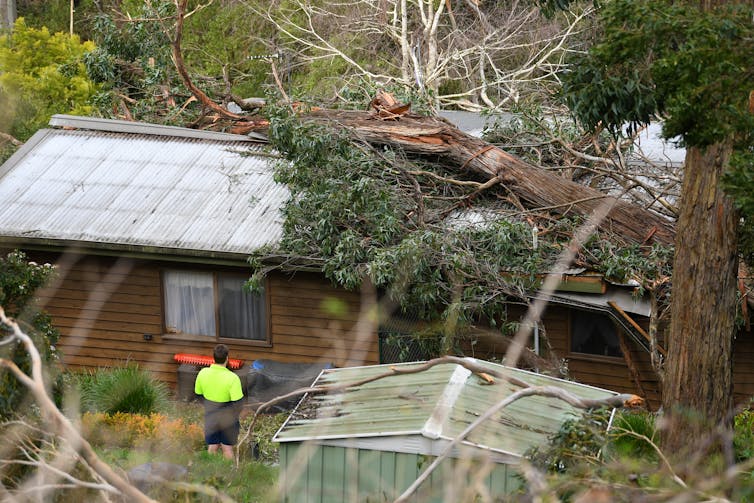 We must try to stop trees falling over to prevent damage to life and property.
James Ross/AAP
We must try to stop trees falling over to prevent damage to life and property.
James Ross/AAP
Why trees fall over
First, it’s important to note that fallen trees are the exception at any time, including storms. Most trees won’t topple over or shed major limbs. I estimate fewer than three trees in 100,000 fall during a storm.
Often, fallen trees near homes, suburbs and towns were mistreated or poorly managed in preceding years. In the rare event a tree does fall over, it’s usually due to one or more of these factors:
1. Soggy soil
In strong winds, tree roots are more likely to break free from wet soil than drier soil. In arboriculture, such events are called windthrow.
A root system may become waterlogged when landscaping alters drainage around trees, or when house foundations disrupt underground water movement. This can be overcome by improving soil drainage with pipes or surface contouring that redirects water away from trees.
You can also encourage a tree’s root growth by mulching around the tree under the “dripline” – the outer edge of the canopy from which water drips to the ground. Applying a mixed-particle-size organic mulch to a depth of 75-100 millimetres will help keep the soil friable, aerated and moist. But bear in mind, mulch can be a fire risk in some conditions.
Root systems can also become waterlogged after heavy rain. So when both heavy rain and strong winds are predicted, be alert to the possibility of falling trees.
Read more: Why there's a lot more to love about jacarandas than just their purple flowers
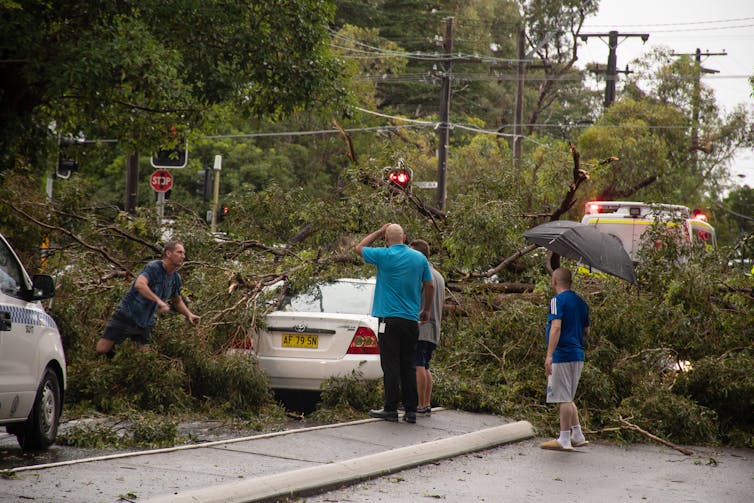 A combination of heavy rain and strong winds can cause trees to fall.
Shutterstock
A combination of heavy rain and strong winds can cause trees to fall.
Shutterstock
2. Direct root damage
Human-caused damage to root systems is a common cause of tree failure. Such damage can include roots being:
- cut when utility services are installed
- restricted by a new road, footpath or driveway
- compacted over time, such as when they extend under driveways.
Trees can take a long time to respond to disturbances. When a tree falls in a storm, it may be the result of damage inflicted 10-15 years ago.
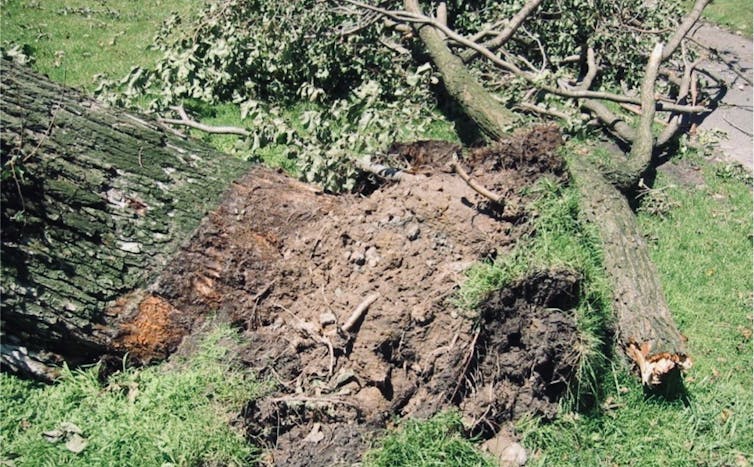 This elm, growing very close to a footpath, fell in Melbourne during a 2005 storm.
Author provided
This elm, growing very close to a footpath, fell in Melbourne during a 2005 storm.
Author provided
3. Wind direction
Trees anchor themselves against prevailing winds by growing roots in a particular pattern. Most of the supporting root structure of large trees grows on the windward side of the trunk.
If winds come from an uncommon direction, and with a greater-than-usual speed, trees may be vulnerable to falling. Even if the winds come from the usual direction, if the roots on the windward side are damaged, the tree may topple over.
The risk of this happening is likely to worsen under climate change, when winds are more likely to come from new directions.
4. Dead limbs
Dead or dying tree limbs with little foliage are most at risk of falling during storms. The risk can be reduced by removing dead wood in the canopy.
Trees can also fall during strong winds when they have so-called “co-dominant” stems. These V-shaped stems are about the same diameter and emerge from the same place on the trunk.
If you think you might have such trees on your property, it’s well worth having them inspected. Arborists are trained to recognise these trees and assess their danger.
Read more: The years condemn: Australia is forgetting the sacred trees planted to remember our war dead
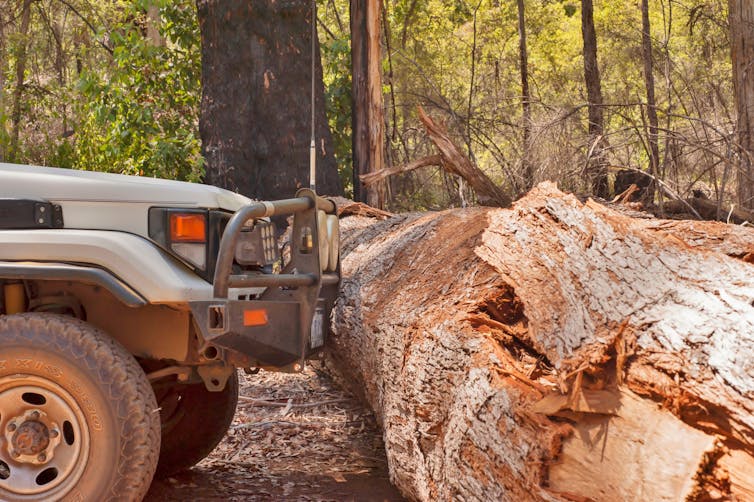 Storms can trigger falling trees which block roads.
Shutterstock
Storms can trigger falling trees which block roads.
Shutterstock
Trees are worth the trouble
Even with the best tree management regime, there is no guarantee every tree will stay upright during a storm. Even a healthy, well managed tree can fall over in extremely high winds.
While falling trees are rare, there are steps we can take to minimise the damage they cause. For example, in densely populated areas, we should consider moving power and communications infrastructure underground.
By now, you may be thinking large trees are just too unsafe to grow in urban areas, and should be removed. But we need trees to help us cope with storms and other extreme weather.
Removing all trees around a building can cause wind speeds to double, which puts roofs, buildings and lives at greater risk. Removing trees from steep slopes can cause the land to become unstable and more prone to landslides. And of course, trees keep us cooler during summer heatwaves.
Victoria’s spate of fallen trees is a concern, but removing them is not the answer. Instead, we must learn how to better manage and live with them.
Read more: Here are 5 practical ways trees can help us survive climate change
Authors: Gregory Moore, Doctor of Botany, The University of Melbourne


















