

Some animals have excellent tricks to evade bushfire. But flames might be reaching more animals naive to the dangers
- Written by Dale Nimmo, Associate Professor in Ecology, Charles Sturt University
The new report by the Intergovernmental Panel on Climate Change paints a sobering picture of the warming climate in coming decades. Among the projections is an increase in fire weather, which will expose Earth’s landscapes to more large and intense megafires.
In our paper, published today in Global Change Biology, we considered what this fiery future might mean for the planet’s wildlife. We argue a lot can be learned by looking at how wildlife responds to a very different threat: predators.
Australia has seen the brutal consequences that occur when native wildlife is exposed to introduced predators. Australian animals have not evolved alongside introduced predators, such as cats and foxes, and some are what scientists call “predator naive” — they simply aren’t equipped with the evolutionary instincts to detect and respond to introduced predators before it’s too late.
Now, let’s take that idea and apply it to fires. Some animals have evolved excellent tricks to detect when a bushfire is nearby. But some areas where infernos were once rare are growing increasingly bushfire-prone, thanks to climate change. The wildlife in these spots may not have the evolutionary know-how to detect a fire before it’s too late.
Just as being “predator naive” has decimated Australian wildlife, will being “fire naive” wreak havoc on our native species?
Behaviour forged in fire
A growing list of studies show the tricks animals from fire-prone areas use to survive the flames.
Sleepy lizards have been shown to panic at the smell of burnt pastry, reed frogs leap away from the crackling sounds of fire, and bats and marsupials wake from torpor after smelling smoke.
And one study found that, when exposed to smoke, Mediterranean lizards from fire-prone areas reacted more strongly than Mediterranean lizards from areas where fire was rare.
These studies show some animals can recognise the threat of fire, and behave in a way that increases their chance of survival. Those that can are more likely to live through fire and pass on those abilities to their offspring.
That’s where the parallels between fire and predation become striking — and potentially worrying.
Reading the cues
It’s well known predators and prey are in an ongoing evolutionary race to outmanoeuvre one another.
One tool prey draw upon to avoid becoming predator food is to recognise cues — such as smells, sights and sounds — that indicate a predator is lurking nearby. Once they do, prey can change their behaviour to minimise the risk of becoming dinner.
 Research has shown the Mediterranean skink can smell a fire.
By Balles2601 / Wikimedia Commons / CC BY-SA 4.0, CC BY-SA 4.0, CC BY
Research has shown the Mediterranean skink can smell a fire.
By Balles2601 / Wikimedia Commons / CC BY-SA 4.0, CC BY-SA 4.0, CC BY
Decades of research has shown that when prey evolve alongside a predator, they can become highly adept at recognising their predator’s cues, such as a scent markings or territorial calls.
But what about animals that haven’t evolved alongside these lethal threats?
When a new predator enters an ecosystem, prey that have not evolved with it can be naive to its cues. They might fail to recognise the threat implied by the new predator’s scents, signs, or sounds, placing them at substantial risk.
This “predator naivety” helps explain why introduced predators are global drivers of extinction. Naive prey just don’t hear, smell, or see them coming.
Read more: There's no end to the damage humans can wreak on the climate. This is how bad it's likely to get
Which species are ‘fire naive’?
Research on how animals respond to fire cues has focused on animals from fire-prone regions, probably because that’s where you’d expect to find the strongest responses. But more research is needed about animals from regions that rarely burn.
Do these animals also recognise the cues of fire as an approaching lethal threat?
Do they have finely tuned behaviours that help them survive fire?
Are they “fire naive”?
We don’t know. And that’s a worry because recent changes in global fire activity, triggered by a warming and drying climate, are seeing fires enter ecosystems long regarded as “fire-free”.
If they are naive to fire, species in these ecosystems might be more at risk than previously thought.
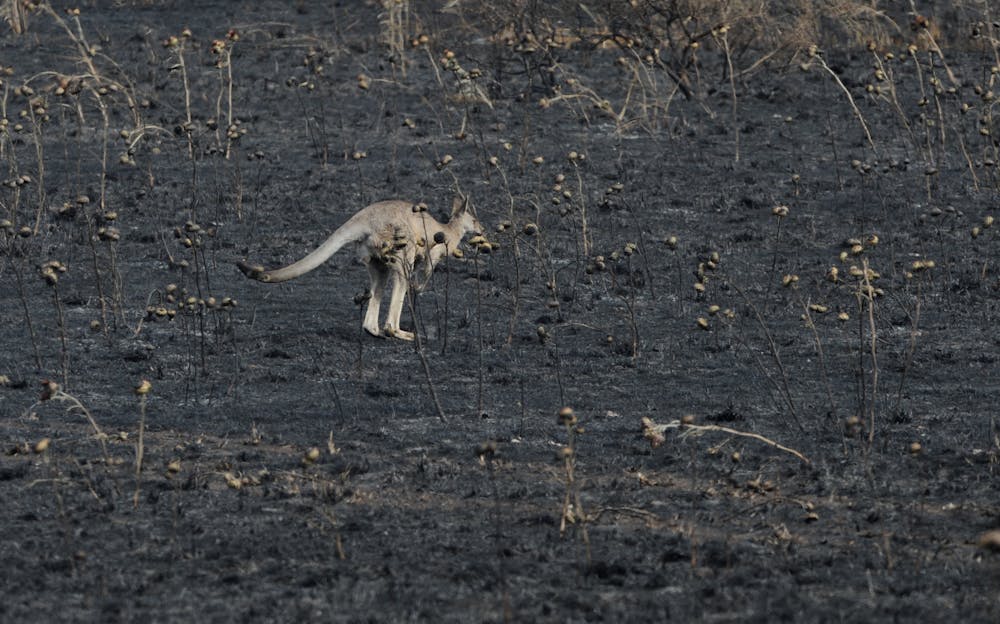 Some studies show some animals can recognise the threat of fire, and behave in a way that increase their chance of survival.
AAP Image/Julian Smith
Some studies show some animals can recognise the threat of fire, and behave in a way that increase their chance of survival.
AAP Image/Julian Smith
The search for fire naivety
We urge researchers around the world to assess fire naivety of animals, particularly in areas experiencing a change in their fire regimes, such as from rare to frequent fire or increased fire severity.
Evidence suggests recognition of predator cues is at least partly genetic. It will be important to determine whether the capacity to recognise and respond to fire also has a genetic basis.
If those behaviours can be passed on from one generation to the next, then perhaps we could take fire-savvy individuals from fire-prone areas and place them into fire naive populations, in the hope their favourable behaviours will spread rapidly via genes passed onto their offspring. Scientists call this “targeted gene flow”.
As the world continues to warm and megafires rage across the globe, we will need all the knowledge and tools at our disposal to help avoid an acceleration of Earth’s biodiversity crisis.
Authors: Dale Nimmo, Associate Professor in Ecology, Charles Sturt University

















