

Modern Australian
Times Advertising

Josh Frydenberg’s budget is an extraordinary turnaround – but leaves a $40 billion problem

  • Written by Richard Holden, Professor of Economics, UNSW Sydney

Made with Flourish

It’s often said in business circles that good companies manage their balance sheet, and bad companies manage their P&L (profit and loss account). That same aphorism applies to governments.

And by that standard, Josh Frydenberg’s fourth budget is a triumph. Net debt is forecast to peak at 33.1% of GDP in 2024-25, compared to 40.9% in last year’s budget. Net interest payments stay below 1% of GDP—a better result than every year from 1984 to 2000.

This is an extraordinary turnaround, and much of it comes in the year to the end of June this year. Rather than net debt of A$729 billion by June 2022 (as forecast in last year’s budget), it is expected to be $632 billion. This reflects the stronger economy.

Unemployment is lower so welfare payments are, too. High commodity prices have helped the budget bottom line, but so too have the tax receipts from increased employment and consumer spending.

At the start of the coronavirus pandemic in 2020, the government outlined a clear fiscal strategy: spend big to support the economy, and shrink away the debt involved through higher economic growth.

It worked. Australian GDP is 3.4% higher than it was pre-pandemic. Only the United States, at 3.2%, is close to that performance among the world’s seven largest economies. France is up just 0.9%, Canada 0.1%, while Germany, Japan, the United Kingdom and Italy have all shrunk.

Amid this good news is a lingering concern. By 2025-26, the budget deficit is still estimated to be 1.6% of GDP. That’s a $43.1 billion gap between government revenues and expenses.

It is a reminder that while two governments — one Liberal and one Labor — have steered the nation through the global financial crisis and the coronavirus pandemic, they have not repaired our structural deficit.

The next government — whichever party that is — faces a difficult task. It needs to close that $40 billion structural gap without a turn to austerity that would damage the economic growth engine that’s put us in this enviable position.

It’s something of a high-wire act. And it is the litmus test of good economic management.

Some big spending

It’s not hard to see why. Defence spending will grow from $35.8 billion this year to $44.5 billion by 2025-26. Given the global security outlook, it could easily go higher.

And spending on the National Disability Insurance Scheme (NDIS) will grow from $30.8 billion this year to $46.1 billion over the same time frame.

That’s growth of 10.6% per annum. In fact, by 2033 the NDIS is forecast to represent more than $70 billion in government spending.

Commonwealth budget papers That spending is life changing for half a million Australians. But those figures tell us such spending is only sustainable with a strong economy. If unemployment doesn’t stay low, and economic growth comparatively high, then spending growth in areas like the NDIS and defence will become unsustainable. The fuel excise holiday One hotly anticipated measure in the budget is a 50% cut in the fuel excise from 44.2 cents to 22.1 per litre, for six months. Let’s be clear: this is great politics. The treasurer said in his speech: “Whether you’re dropping the kids at school, driving to and from work or visiting family and friends, it will cost less”. This is a beautiful rendition of the time-honoured political tradition of feeling the voters’ pain. In one way this makes perfect economic sense, too. Why should households bear the risk of petrol prices bouncing around based on global conflict and decisions by the OPEC cartel? As the Australian Competition Consumer Commission has demonstrated, prices at the pump basically move one-for-one with the Singapore price of the Mogas 95 unleaded petrol sold to Australia.
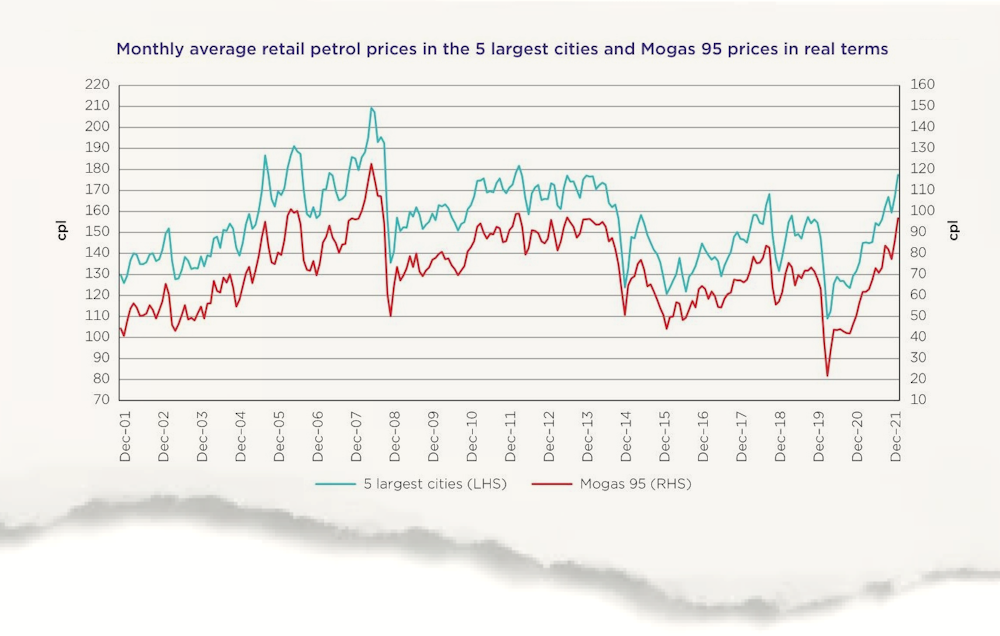
Australian Competition and Consumer Commission By setting the fuel excise lower when oil prices and high, and higher when oil prices are low, the government is acting like a big social insurance company. That’s part of their job (see Medicare, NDIS, unemployment benefits). But there’s a wrinkle to this. According to figures from the Bureau of Statistics’ Household Expenditure Survey, the bottom fifth of households by income spend $27 a week or 3.5% of their income on petrol. Read more: Budget 2022: Frydenberg has spent big – but on the whole, responsibly By contrast, the top fifth of households spend $42 a week or 1.8% of their income on petrol. So, a per litre cut in petrol benefits higher-income households more in dollar terms. It also doesn’t discourage people from driving less. It would be more progressive (and better for the environment) to just give all households a flat rebate. A good plan, well executed The tone at the budget press conference this year was in striking contrast to that at the announcement of the pandemic fiscal strategy in early 2020. Back then there were sharp questions about fiscal irresponsibility, leading then-Finance Minister Matthias Cormann to exclaim: “What would you have us do?” Made with Flourish This time, there were a series of relatively minor questions about whether Victoria was getting enough GST revenue or if medical students who studied in regional Australia would stay there. That is the consequence of a government that jettisoned decades of political branding in March 2022, laid out a compelling plan to get Australia through the pandemic, and delivered on it. Read more: Cheaper petrol, cash handouts in Morrison government's vote-buying budget Authors: Richard Holden, Professor of Economics, UNSW Sydney

Read more https://theconversation.com/josh-frydenbergs-budget-is-an-extraordinary-turnaround-but-leaves-a-40-billion-problem-180123

Interstate Car Transporter Urges Buyers to Book Early

As the conflict in the Middle East continues to put increasing pressure on local fuel supply, Australian transport companies are experiencing increasi...

Digital Minimalism for Business Owners: Fewer Tools, Better Systems

Be honest. How many apps are open right now? One for scheduling, another for invoices, a third for customer notes, plus a spreadsheet someone email...

The Importance Of Proactive NDIS Renewal Preparation For Sustaining Your Provider Business

Your NDIS renewal notice is not a signal to start preparing. By the time it arrives, preparation should already be well underway. For new providers, s...

Why Fire Extinguisher Testing in Sydney Is Becoming a Records Game, Not Only a Maintenance Job

A fire extinguisher used to feel like one of the simpler parts of building safety. It hung on the wall, wore a service tag, and sat there quietly unle...

The Switchboard Upgrade Question Every Melbourne Renovator Should Ask Before the Walls Close Up

Renovations have a funny way of making people think on surfaces first. Splashback, stone, joinery, tapware, paint. Fair enough too. That is the exciti...

Winter Sanitation Gaps in Parramatta Kitchens: A Hidden Pest Risk

Winter brings a host of changes to our homes, from the chill in the air to the cozy warmth indoors. However, this season also introduces sanitation ch...

When to Seek Advice from Employment Lawyers in Melbourne

Australian employment law is detailed and, at times, complex, with rights and obligations that aren't always obvious to employees or employers witho...

7 Benefits of Professional Gutter Cleaning for Australian Homeowners

Gutters aren't exactly glamorous. They sit up there on the edge of your roof, doing their job quietly - until they stop working. Clogged, overflowing ...

Pipe Floats Strengthening Pipeline Performance In Demanding Environments

Pipelines often travel through environments that are anything but predictable, water currents shift, terrain changes, and materials keep moving unde...

Why Ceiling Fans Are Essential For Comfort, Efficiency, And Modern Living

Creating a comfortable indoor environment is not just about temperature; it is about how air moves, how a room feels, and how efficiently energy is ...

Why Duct Cleaning In Melbourne Is A Smart Investment For Healthier Living Spaces

Behind your walls, ceilings, and vents lies a network quietly working every day to keep your home comfortable. Yet over time, this system can become...

Disability Service Providers Supporting Inclusive And Independent Living

Finding the right support system can feel like assembling a puzzle where every piece must fit just right. For individuals and families navigating di...

A Beginner's Guide to Owning a Caravan in Australia

Owning a caravan opens up a style of travel that's hard to match for freedom and flexibility. However, for those just starting out, the process of c...

Preparing Your Air Conditioner for Summer: What Most Homeowners Overlook

As temperatures rise, many homeowners switch on their air conditioning for the first time in months — only to find it’s not performing the way i...

What Actually Adds Value to Properties in Newcastle

Newcastle has seen steady growth over the past few years, with more buyers looking beyond Sydney for lifestyle, space, and long-term value. As dema...

What is Design and Build in Construction?

Imagine you’re about to start a new construction project, maybe it’s a custom home or a commercial building. You’ve got the idea, the land, an...

Commercial roof leak detection: why early action protects your building

Water ingress is one of the most disruptive and costly issues facing commercial properties. For property managers and facilities teams, even a minor...

Custom Photo Frames: Turning Everyday Moments into Lasting Displays

Photos capture moments, but how you display them determines how they’re experienced every day. A meaningful photograph deserves more than a generi...
















