

Modern Australian
The Times

Helen Garner's radical gift is the shock of plain-speaking

  • Written by Edwina Preston, PhD Candidate, The University of Melbourne
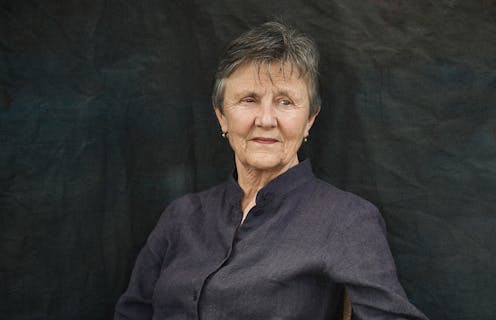
Helen Garner's radical gift is the shock of plain-speaking

Most readers of Helen Garner will be able to pinpoint a first personal encounter with her work: a book, or even a sentence, that cut through like sharp light; a local landmark suddenly immortalised on the page; an unsayable bodily experience transformed into the unabashedly said.

Reading Garner, it’s as though doors and windows have been flung open and there, over the cups and dishes and fruit bowls, is the stuff of life – frankly, tenderly, impeccably revealed. Garner’s clarity is such that it almost aches.

Review: Writers on Writers – Sean O’Beirne on Helen Garner – Sean O'Beirne (Black Inc. in association with the University of Melbourne and the State Library Victoria)

My first encounter came in Christmas 1984, when an aunt gave me a slender novel called The Children’s Bach. Chosen probably on account of its brevity – I’d just turned 14 – this tensile little book was, for me, bewildering in its adult complexity, disorienting in its fragmentary narrative style, indecipherable if I applied the principles of storytelling I was accustomed to. It refused to fill me in, to explain itself, to tell me. It was an initiation of sorts: my first foray into the exciting work that goes with adult literary reading.

Personal confession and concealment

Sean O’Beirne is the same age as me and has followed the “phases” of Garner – my word, not his – much as I have. In his book-length essay on Garner, he doesn’t organise her works into phases, so much as entwine them into a single unfurling ribbon of the self: in different permutations, across time and intents and, of course, books.

Every phase, every work, gets attention. There is the “close to self I” of Nora in Monkey Grip; the “Not-I” of her early and mid-career fiction (The Children’s Bach, Postcards from Surfers, Honour and Other People’s Children, Cosmo Cosmolino); and the “collective I” of her later non-fiction – which he explains as a sort of personal “I” nested within society.

In puzzling these selves in Garner, O’Beirne examines the impulse towards self in his own work. What results is an essay that examines personal confession and concealment in his own writing as scrupulously as it traces these in Garner’s.

O’Beirne’s is one of a series of book-length essays by writers on writers published by Black Inc., in association with the University of Melbourne and the State Library of Victoria. None of the subjects in the series needs introduction. Shirley Hazzard, David Malouf, Patrick White, Beverley Farmer: these are the literary cartographers of 20th-century Australia. Some of the essay writers occupy this same rarefied plane – Christos Tsiolkas, Michelle De Kretser – but other highly accomplished contributors (Josephine Rowe, Richard Cooke), like O’Beirne, will be new to many readers. There is clearly a generational impetus to the selections Black Inc. has made in commissioning this series – a desire to trace influences, connections and continuities across time and writers. Read more: A new literary portrait of Helen Garner leaves you wanting to know more Impersonal, efficient vulnerability O’Beirne, for his part, approaches Garner from what he calls a “place in the junior writing position”. He is the author, so far, of one well-received book: the 2020 short-story collection A Couple of Things Before the End (also Black Inc.). A consistently intelligent humility runs throughout his essay, but O’Beirne is no less probing for his preparedness to defer to Garner’s art. He “carefully, respectfully” adjudicates Cosmo Cosmolino as a “bad book”, for instance, describing it as a sliding-doors moment in Garner’s career in which she might’ve fallen prey to a magical realism that is less cogent, less compelling than her signature crisp realism – yet he remains open to the novel’s innovations. There is a persistent sense that O’Beirne is reaching for something in himself through Garner; something that may well be unreachable, but is worth reaching for all the same. Partly, this is Garner’s receptiveness to self and other, her preparedness to commandeer her vulnerability and plant it, with “brisk impersonal efficiency”, on the page. O’Beirne writes, at one point, that he wishes to “do the good work of less impersonation” in his own writing, to stop disguising himself in fictional personae, to cast off his reticence and put himself frankly there.
Sean O'Beirne.

His tendency to “hide” is partially explained in the spare details he gives of his traditional Australian boyhood in outer-suburban Melbourne where, in order to survive, an impersonation of “manhood” was crucial. You couldn’t be a soft-thinking, sports-averse, self-doubting “boy” who didn’t even know how to have an orgasm. You had to be pretend that you were part of a “bunch of blokes”, swiftly disguising any weakness if it threatened to spill over into the performance. O'Beirne’s habit of disguise is a habit of self-preservation, and Garner thrilled him by showing that being imprisoned in the ashamed not-quite-right self might be a blessing; that “it was contradictorily interesting and delicious and bad and lonely to be so steeped in, waterlogged with the problem of me”.

But, as he is first to admit, the “real man” behind the essayist does not fully materialise here. O’Beirne remains conceptual, not visceral – he wonders why he feels comfortable giving such bodily experiences as a first sexual encounter to a character, but retreats from owning it on the page as himself. He may, like Garner, be prepared to wriggle on the end of his own hook, but he retreats where Garner boldly goes forth.

In elucidating his ideas, O’Beirne employs an idiosyncratic prose style that determinedly avoids the administrative, structural, institutional literary – the world of “Them”, which, he says, Garner also eschews. Often this enables him to say things for which there are no existing words, or no sufficiently illuminating words.

Sometimes, though, in preserving his prose from the already-said, O’Beirne’s choices confound rather than illuminate. His tendency to noun phrases (“my not-as-socially-approved awareness”, “a starting amount of more open confession”, “a trying to be with someone else”) occasionally ruptured my sense of being a co-traveller on his thought journey. Similarly, his choice of the Australian vernacular (“bloke” and “I reckon”) made aesthetic or even ideological sense but nevertheless grated.

When they work, however, his hyphenated compounds, rammed together like a string of mismatched train carriages, led me on new journeys, or even jumped the rails entirely and deposited me in completely fresh territory. Sometimes I couldn’t go there with him, but I was elated when I could.

Read more: Remembering Janet Malcolm: her intellectual courage shaped journalism, biographies and Helen Garner

Primal shock

“I will not hide” is Garner’s gift, O’Beirne says. It remains a radical gift, even in the face of other recent acts of radical literary self-revelation – in the work, for instance, of Maggie Nelson and Sheila Heti, which O’Beirne cites. Yet, for any shock value in Heti’s Motherhood or Nelson’s bone-crackingly good The Argonauts, the primal, bodily shock of Garner (a forgotten tampon, a slow fuck, a shit sucked back up into the body) has always been the shock of plain-speaking, not of sensation or transgression.

O’Beirne doesn’t seek transgression either: just honesty and bravery, the things he admires in his subject. He wants to be like Garner; he cannot be like Garner; the best he can do is be O’Beirne. Ultimately – for me and for him – that’s enough. In this essay, O’Beirne’s honesty may not be of Garner’s register, but it’s honesty all the same.

Authors: Edwina Preston, PhD Candidate, The University of Melbourne

Read more https://theconversation.com/i-will-not-hide-helen-garners-radical-gift-is-the-shock-of-plain-speaking-179090

10 Benefits of Choosing Professional Tutoring Penrith Services

Every student has unique learning strengths, challenges, and academic goals. While classroom teaching provides essential knowledge and structure, so...

Sunshine Coast Baby Classes Prove Big Hit Among First-Time Mums

There's a movement gaining traction on the Sunshine Coast, providing a village of support, socialisation and relief for first-time mothers and babie...

Father's Day Gift Ideas for Men Who Are Hard to Buy For

Some dads are easy to buy for. Others do not want anything, already have everything, or give you the classic "don't worry about me" answer every yea...

Top 5 Mistakes That Wear Out Your Brakes Faster

Brakes don't need frequent replacements like oil changes do.   But a lot of the wear happens quietly, over months, because of habits most drivers...

Plantation Shutters vs Curtains: Which Is Better for Your New Home?

Moving into a new home is an exciting opportunity to personalise your space and make it your own. While many homeowners focus on furniture, flooring...

Celebration of Life vs Traditional Funeral: What's the Difference?

When saying goodbye to someone you love, there is no single way to honour their life. Every family has different traditions, beliefs, and preference...

Building Approval for Roofing Projects: What Homeowners Need to Know

Roofing projects are an important part of maintaining and protecting your home. Whether you're repairing storm damage, replacing an ageing roof, or ...

Chatswood Tutoring And Its Role In Academic Achievement

Academic success often requires more than classroom attendance alone. Students face increasing expectations as they progress through school, particu...

Why Laser Hair Removal Treatments Continue Growing In Popularity

Managing unwanted hair can become time-consuming and frustrating for many people, especially when shaving, waxing, and other temporary methods requi...

Choosing the Right Devices for a Flexible Workplace

For IT leaders managing large fleets, the device layer is where workforce productivity and security policy meet. The shift towards flexible and hybrid...

How Business Advisory Services Help Companies Achieve Sustainable Growth

Every business owner aims to build a profitable and sustainable organisation. While dedication, innovation, and hard work are important, achieving l...

Why Body Contouring Has Become A Popular Cosmetic Treatment

Many people maintain healthy lifestyles through regular exercise and balanced eating habits but still struggle with stubborn areas of fat that are d...

How to Choose the Right POS Hardware for Your Business in Australia

A lot of Australian business owners spend weeks researching POS software but buy hardware almost as an afterthought. That's a mistake. The wrong har...

Why Material Handling Hose Is Critical for Industrial Efficiency

A high-performance material handling hose is an essential component in industries that transport abrasive, dry, or bulk materials on a daily basis...

How to Choose the Right Lawyer in Melbourne for Your Situation

Choosing legal support can feel difficult, especially when the stakes are personal or business-related. The right lawyer in Melbourne should underst...

Hoteliers Look to Clever Value Adds to Increase Revenue

The Australian hospitality industry is still in recovery mode after a notoriously rough patch in recent years. While there has been a post-COVID tra...

Moving to Queensland? Here’s How to Prep Your Car for the Big Move North

There’s no sign of the northern migration slowing down, with thousands of southerners fleeing from chaotic lifestyles and cooler climates for a brig...

Diesel Shortage to Impact Trades and Contractors

Strait of Hormuz blockage affecting all major parts of trades and construction Trades and construction across residential, commercial and industria...
















